| View |
| preceded by | |
 Greece


| succeeded by |
| Greece | Link to Wikipedia |
Greece: History, Coinage and Collectibles
Welcome to the storied history of coinage from one of the world’s most influential civilizations. For over two millennia, Greek numismatics have served as a tangible link between artistry, power, and commerce. This article explores how the cultural heartbeat of Greece was translated into bronze and silver, offering collectors a window into the evolution of Western currency systems.
Historical Background
The story of money in this region begins not with kings or armies, but with trade networks that predate recorded history. Situated on a crossroads between Europe and Asia, Greece's geography fostered maritime commerce early on. The Aegean Sea was the world's first economic artery, linking islands to mainland markets. This connectivity necessitated standardized measures of value long before the establishment of written constitutions.
The rise of the city-states, or poleis, in the Archaic period marked a shift from barter economies to currency-based trade. As Athens rose to prominence under Pericles, her commercial power expanded across the Aegean and Black Seas, fueling demand for reliable coinage that could move as easily on ships as it did through markets. This economic expansion paved the way for what became known in later centuries as "the gold of Athens," establishing a standard of weight and purity (the Attic Silver) that would be copied by neighboring states across the Mediterranean.
The historical narrative continued with Philip II's unification of Greece, which culminated under his son Alexander. The subsequent conquests expanded trade routes from Egypt to India, but they also necessitated a change in how value was represented. When Rome absorbed these territories, Greek coinage did not vanish; instead, it evolved into the imperial currency used by the emperors themselves. For collectors studying ancient economics, this era represents one of the most profound transitions: when local city-state symbols were replaced by Imperial portraits, yet often retaining their high artistic standards.
Currency and Coinage History
The journey toward standardized currency in Greece was a slow process born of necessity. In the early Iron Age (approx. 8th century BC), communities began using metal discs stamped with symbols to represent cattle or grain, known as "proto-currencies." However, true monetary revolution arrived around 500 BC when Lydia introduced coinage into Asia Minor. Athens quickly adopted this innovation for her own silver content.
The first half of the history focuses heavily on silver and bronze production within autonomous city-states like Syracuse, Corinth, and Cyzicus in Ionia (modern Turkey). The standardization began locally but grew through competition; if one state's coinage was considered heavy or pure enough to be accepted elsewhere, it became a preferred medium for trade. By the Hellenistic era following Alexander’s death, kings minted massive quantities of silver tetradrachms—essentially equivalent to four drachmas—in regions stretching from Syria to Greece.
The Roman conquest brought significant changes in currency evolution. The Empire adopted existing Greek standards but centralized production and introduced gold solidi for high-value transactions across the Mediterranean. In later Byzantine times, minting techniques focused on creating durable small bronze coins (the follis) for everyday commerce while issuing gold coinage that would become one of history's most recognizable financial assets.
Mints and Coin Production
Ancient Greek mints were centers of civic identity as much as they were industrial facilities. Unlike modern mass production, each city state had its own minting tradition, leading to an incredibly diverse coinage landscape where the same currency weight could exist in dozens of different designs simultaneously.
- Athens and Eretria: These mints produced the famous "Owl" drachms. They utilized high-quality silver ingots melted down into blanks before stamping, ensuring a level of purity that made them internationally recognized currency (often called 'Electrum' in earlier periods).
- Rhodes and Alexandria: As major naval powers or imperial hubs, these centers produced coins with elaborate relief styles. The reverse designs often featured mythological beasts like the Rhodian lion or symbols of local cults.
The artistic quality varied by era but was generally exceptionally high during Classical Greece (5th-4th centuries BC). This "Classical style" favored simplified backgrounds with bold, flowing lines for portraits and intricate detailing on mythological figures. Later periods shifted toward realism in imperial coinage; the transition from a helmeted Athena to portrait busts of Roman Emperors marked the shift from civic pride to dynastic propaganda.
A key feature distinguishing Greek coins is their reverse die orientation. Unlike many modern currencies which use "machine press" strikes, ancient dies were hand-turned by artisans on metal plates (dies). Consequently, collectors can see slight variations in how symbols sit relative to one another due to the angle of striking—a fingerprint of human craftsmanship.
Notable Coins
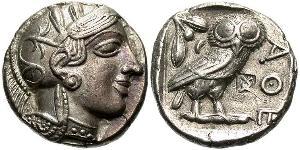
The Athenian Silver Tetradrachm, often depicting Athena wearing a helmet and holding an owl on the reverse, is perhaps the most iconic ancient coin in existence. Minted from 450 BC until roughly 38 AD (and beyond), this was not merely local currency but "world money." Its standard weight made it easy to trade across borders without needing conversion or complex calculation.
The Alexander's Hellenistic Tetradrachms followed in the wake of his campaigns. These coins are unique because they bear no royal portraits, only a bearded head on one side and often symbols representing Greek culture (like Zeus) with Persian attributes like winged lions or griffins as reverses. They symbolize an era where East met West.
In the Roman period, collectors will find Aurelianus' denarii from the province of Macedonia, which are essentially silver issues using local artistic traditions but with the face of a reigning Emperor in Rome. These serve as historical artifacts showing how far trade networks extended—Roman goods and currency entering Greek provinces.
The later Byzantine Solidus (Nomisma), issued by emperors like Justinian, introduced an iconography style that dominated Europe for centuries. While these were gold coins minted in Constantinople rather than Athens proper, they represent the continuity of Roman power and Greek language dominance well into the first millennium.
Cultural Legacy
To a numismatist, coinage is not just a tool of finance; it is a canvas for public art. The obverse (heads) was often reserved for deities or Emperors to convey authority and divine favor—whether honoring Athena as the protector of Athens, Zeus at Delphi where he dispensed oracles on gold staters, or Apollo in Thessaly.
The reverses tell stories of commerce. A merchant's coin might feature a prow of a ship for maritime cities, corn ears to denote grain production states like Corinth, and the Nike goddess (Victory) stamped above a figure as if she herself was paying taxes—she even carried money bags! This imagery reflects that coins in this region were understood by all classes. The transition from civic gods to Imperial heads mirrors political shifts from democracy or oligarchy toward monarchy.
For collectors
Greek coinage remains one of the most rewarding areas for serious collecting because it offers depth beyond simple rarity; each piece tells a story of an era in history. Collectors are drawn to these coins not only for their aesthetic beauty, which rivals fine art periods like Renaissance painting, but also for how they document global trade routes.
For the historian collector or auction buyer looking at these items: The silver drachm represents one of the earliest international standardized assets ever created. Owning an Athenian Owl is owning a piece that was used by merchants from Egypt to Persia before 30 AD, centuries after it left the mint. Whether studying imperial propaganda with Imperial Roman issues or appreciating religious iconography in later Christian Byzantine gold coins, these collections offer a unique timeline of human history through metal.
The legacy extends into modern collecting today as many countries maintain mints and traditions that pay homage to this past—such as the commemorative coins issued for Athens hosting major sporting events or the Olympic Games. For those seeking historical depth in their portfolio, no collection is complete without a representation of these enduring artifacts from Greece.