| View |
| preceded by | ||||
|
||||
|
|||||||
 German Confederation (1815 - 1866)
|
|||||||


| German Confederation (1815 - 1866) | Link to Wikipedia |
German Confederation: History, Coinage and Collectibles
Historical Background
The story of the German lands in the nineteenth century is one of fragmentation seeking unity through economic power rather than political subjugation. This narrative begins following the great upheaval caused by Napoleon Bonaparte, which concluded with his defeat at Waterloo and led to a reordering of Europe's borders. In 1815, under the auspices of Congress Vienna, the German Confederation was established as an association of thirty-nine sovereign states. It encompassed territories ranging from Hamburg in the north to Bavaria in the south. While it lacked a strong central government or federal capital similar to modern unions, this confederation represented a delicate political balancing act where Austria and Prussia vied for dominance over German-speaking lands.
Culture flourished within these borders amidst political tension during this era, with poetry, art, music, and science advancing rapidly. The intellectual spirit of the region was known as Romanticism, which emphasized national identity through shared language and tradition rather than strict imperial rule. This cultural cohesion became a driving force that eventually pushed for economic integration to facilitate trade across these many small borders. As industrialization began in Prussia during this period, merchants required stable currency systems to operate beyond their own duchies or grand-duchies. The Confederation thus served as the incubator where German states learned how to manage money together before ever attempting full political unification.
Currency and Coinage History
In 1815, the monetary landscape remained fragmented; nearly every state maintained its own currency system. However, for a collector examining pieces from this period, there is an immediate shift toward uniformity in quality rather than standardization of design or value immediately after Vienna. While gold and silver bullion standards were generally aligned to prevent arbitrage opportunities between states like the Austrian Gulden (Thaler) and Prussian Thaler, local variation persisted for a generation.
The most significant monetary reform occurred through the establishment of the Zollverein in 1834, led by Prussia. This Customs Union removed internal tariffs but initially required members to use their own currencies despite sharing borders. It was not until later that specific coinage reforms began to harmonize weights and fineness across participating states. For numismatists, this transitional phase is fascinating; you will find coins of different denominations circulating side by side within a single city in major economic hubs like Leipzig or Berlin.
The role of the state seal was paramount here. Coins were not merely payment for goods but symbols of sovereignty and loyalty to a particular monarch or ruling house. The evolution from copper half-pfennings used for local purchases to silver groschen utilized in regional trade, up to gold thalers for international exchange, illustrates an economy maturing out of feudal constraints into modern commerce. Collectors often seek this era because it represents the final steps taken before the formation of a unified German Empire in 1871.
Mints and Coin Production
The coinage production during the Confederation years was highly decentralized yet standardized by quality control within certain blocs. The major mints operated under specific sovereign authority but utilized advanced metallurgical techniques developed across Central Europe. In Berlin, located in Prussia's heartland, a central mint produced thalers that circulated widely due to economic dominance and stability.
Munich, serving as the capital of Bavaria, was another major center producing coins with distinct artistic touches compared to northern states like Saxony or Württemberg. In Munich, die-cutters often took greater liberties in portraiture than required by conservative regimes elsewhere, sometimes depicting rulers in elaborate dress that highlighted their dynastic connection rather than just official uniform.
The technology of the time relied on manual engraving followed by press striking using copper and steel dies. However, to prevent debasement (reducing metal content), most German states adhered strictly to weight standards derived from Vienna bullion conventions in 1830. This meant that while designs differed between a coin struck for Württemberg and one produced in Munich or Hamburg, the silver value remained consistent enough for traders.
Berlin's mint was particularly noted for its precision engineering during this period as Prussia sought to export economic power through currency reliability. Artistic styles on these coins shifted from classicism toward romantic realism over thirty years of production, reflecting the changing tastes of patrons who appreciated high artistry in small denominations.
Notable Coins
The Bavarian Ducat is perhaps one of the most visually striking pieces issued during this timeframe. Issued by King Maximilian I and his successor Louis II, these coins bear a distinctive design where portraits appear on both obverse and reverse sides occasionally, or show detailed heraldic shields rather than just standard busts. The silver content was excellent for a coin used domestically in Bavaria.
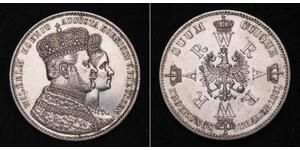
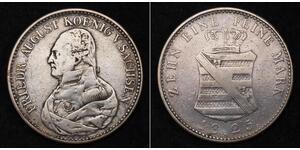
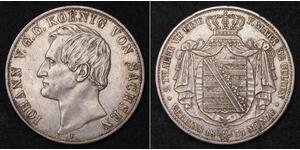
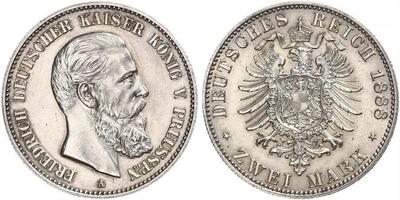
In contrast to the elaborate designs of southern states, Prussian thalers are celebrated by collectors for their durability and conservative design that emphasized duty over grandeur. These pieces often feature simple but strong profiles on both sides depicting current rulers like King Frederick William IV or later Wilhelm I before 1865.
Anthony II's coins from the Duchies of Nassau-Weilburg offer a glimpse into smaller state production within the Confederation, where minting traditions were heavily influenced by local folklore rather than imperial mandates. The coinage for these small territories often utilized copper or bronze alloys which have survived better in circulation today due to wear resistance compared to silver.
Cultural Legacy
To study the numismatics of this period is to look into a mirror reflecting fragmented political aspirations. Every state seal stamped onto metal signifies an independent identity within a fragile union that was trying, through commerce, to become something more cohesive before Prussian dominance led to its dissolution in 1866.
The symbols used on these coins—the double-headed eagle of the Habsburgs for Austrian influence versus the heraldic lions or eagles of lesser princes—tell a story of power struggle. However, it was not always hostility; many designs depict shared themes such as Liberty figures wearing Phrygian caps to represent economic freedom and internal trade barriers falling.
The legacy remains relevant today because these coins mark the end of feudal coinage practices where money represented only local authority rather than international value standards adopted by larger powers like Great Britain or France. The German Confederation era is often cited as a bridge between regional monarchies and modern nation-states, with currency serving as both memory of past independence and tool for economic integration.
For collectors
The coinage from the former territories of this confederation remains highly valued in today's market not merely for rarity but because they document a unique period of history where politics remained fractured while money moved freely. For those entering collections, focusing on silver pieces helps ensure long-term value retention as historical significance grows over time.
Pieces from the Zollverein era are particularly sought after by buyers who understand the transition to modernity better than others might realize. A coin minted in Bavaria around 1830 carries more meaning for a specialist because it represents one of the last times before full unification when states could still issue distinct legal tender without interference from federal mandates.
In conclusion, these objects serve as historical records preserved by metal and fire rather than paper documents. They remind us that commerce can unite nations even where governments struggle to agree on political borders or leadership structures for the public good.