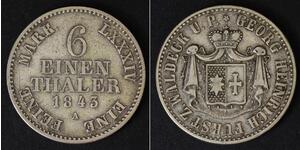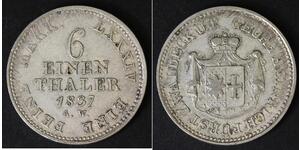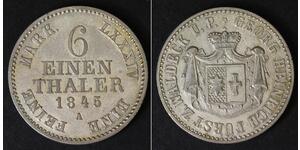
| preceded by | |
|
|||||||||||||
 Waldeck (state) (1180 - 1918)
|
|||||||||||||


| succeeded by |

| Waldeck (state) (1180 - 1918) | Link to Wikipedia |
Waldeck: History, Coinage and Collectibles
Welcome to our exhibition on a microstate that once carved out its own path in the complex history of central Europe: Waldeck. This region is fascinating not just because of its political intrigues but for how those events shaped one of Germany's most distinct numismatic narratives.
Historical Background
The story of Waldeck begins deep within the Holy Roman Empire, a time when territory was often defined more by loyalty to an overlord than strict geographical lines. Originally rising from the Counts of Schwalenberg in North Hesse around 1180 through their marriage into the family of Reichenbach and Hollende, these nobles established Waldeck Castle overlooking the Eder River.
The economic landscape here was defined by feudal complexity. At first a fiefdom under Mainz Electorate before shifting to Imperial immediacy in 1379, the political survival of its rulers often dictated their monetary policy. A critical moment came when finances faltered; in moments like this, small states had little choice but to enter personal unions with larger powers or surrender administrative control.
This tension peaked under Frederick and George regarding Pyrmont. For centuries they shared a residence at Cuylenburg-Werth until the late 1600s, yet Waldeck remained the main seat of power until the mid-17th century when it shifted to Arolsen—a town that remains famous today not just for its castle but as one of Germany's few surviving historic towns.
The family line frequently fractured into junior lines like Wildungen and Eisenberg. While this often meant internal feuds, in numismatics the result was a rich variety of coinage types striking each territory separately until their eventual reunification under Christian Louis in 1692. This history is vital to understanding why finding coins attributed specifically to the "Wildung" or "Eisenberg" lines is such an achievement for collectors: they were effectively distinct entities.
Currency and Coinage History
The evolution of money in Waldeck mirrors its political struggle for independence. In a Holy Roman Empire context, even minor counts often struck their own silver thalers to prove sovereign status. When the county inherited Pyrmont in 1626, it gained access to wealthier mineral regions and trade routes via Lower Saxony.
Coinage evolved from purely local needs for copper coinage used by merchants to high-value silver issues proving diplomatic independence. During the Napoleonic Wars (1807–1815), Waldeck joined the Confederation of the Rhine but retained its own sovereignty, which theoretically preserved its right to mint currency.
The turning point came in 1862 and intensified by 1868. Facing bankruptcy during the Austro-Prussian War era where it fought for Prussia rather than Austria, Waldeck signed a military convention that eventually led Prussia taking control of its deficit and internal administration.
The Numismatic Decline
This fiscal subjection drastically altered coin production. The 1867 treaty meant the principality remained nominally independent, but the loss of financial sovereignty usually implied a halt to new state-minted currency or an agreement to use Prussian patterns with local heraldry.
By this time, the region was effectively integrating into Prussia's monetary system. While they may have struck commemorative pieces for events like their accession treaties in 1867 and military conventions, independent minting of thalers became a historical memory rather than current commerce practice by 1900.
Mints and Coin Production
To understand the quality of these issues, we must look at how mints functioned. In smaller German states like Waldeck-Pyrmont, there were rarely on-site facilities with full capacity to handle heavy silver output.
- The Tradition: Most coins from this region during the 18th and early 19th centuries struck at contracted mints in neighboring territories such as Thuringia or Coburg, where master minters were available to produce dies for these minor sovereigns.
- The Technology: The artistry on these coins is surprisingly high despite the small state size. We see fine details typical of Westphalian engravers who had access to advanced technology even when resources were stretched thin by local wars and debts.
A key distinction for collectors was how mints operated under Prussian influence post-1867. When Berlin took control, they often struck Waldeck's coins in their own facilities, but with specific permission or authorization to use the Prince's arms. This made distinguishing pre-control issues from later "authorized" ones critical.
Notable Coins
Finding a true piece of Waldecker numismatics offers a connection to this unique political past. Here is how collectors should view these historical artifacts:
- The Early Modern Silver Thaler (Pre-1700): Before the reunification under Christian Louis, coins bore arms for specific branches like Waldeck-Eisenberg or Waldeck-Wildungen. These are significant because they prove distinct rule over time rather than a single long reign.
- The Pyrmont Union Issues (1849): As the two territories merged legally, new coinage reflected this union in the legends and central designs on the reverse sides. The minting of these coins is significant because it coincides with their brief moment as a modern Free State before WWI.
- Copper Half-Groschen: In commerce, small copper issues were vital for local trade. These bear heraldic symbols like bears and lions common to the Eder river region, distinguishing them from Prussian half-mark or kreuzer coins circulating in the same pocket.
- The Transition Pieces (1870-1920): These are particularly rare as they show a decline. As administration passed to Berlin officials, these often display "Prussia" on one side and Waldeck shields on the other in transitional designs before WWI.
Cultural Legacy
The coins from this small principality serve more than commerce; they act as a physical record of political survival. The heraldry is distinctively rich, displaying the "Bear" or shield arms which were common symbols for Waldeck's lands in Lower Saxony and Hesse.
- Loyalty:The eagle motif often seen on later issues reflects loyalty to the Empire before WWI, but by WWII it reflected their forced integration into larger German states like Hannover or Prussia (1929 partition).
Relying heavily on trade with Hamburg and Kassel meant that coins struck here circulated far beyond Waldeck. The design choices—often simpler than Berlin's massive empire coinage but no less elegant—reflect the "middle class" aesthetic of a small state trying to impress neighbors while maintaining dignity.
For collectors
The enduring value for numismatists today lies in scarcity and historical context. Waldeck is not just another German province; its coinage was issued by sovereigns under Imperial protection but who faced constant pressure from larger states like Prussia to join their economic zones.
In short, collecting Waldeck coins means owning fragments of history where small nobility navigated massive political shifts from Holy Roman Counts to Weimar Free States. Their silver pieces capture the twilight era of minor German states trying to survive in an industrialized world before being dissolved and divided among larger Prussian provinces.