| View |
| preceded by | |
|
|||||||||
 Anhalt-Bernburg (1603 - 1863)
|
|||||||||


| succeeded by | ||||
|

| Anhalt-Bernburg (1603 - 1863) | Link to Wikipedia |
Anhalt-Bernburg: History, Coinage and Collectibles
Historical Background
The legacy of Anhalt-Bernburg is woven into the rich tapestry of Central European history as a testament to the resilience of local governance in an era dominated by greater powers. Situated within what would become modern Saxony-Anhalt, this principality represents one of the many small duchies that defined German statehood before unification and its subsequent evolution during the 19th century.
The narrative begins with the House of Ascania, a dynasty whose roots ran deep in the medieval foundations of the region. Unlike larger empires where history is often written by kings who commanded vast armies, Anhalt-Bernburg was shaped by local dukes navigating complex webs of alliances within the Holy Roman Empire and later Prussia.
Cultural life thrived amidst these political constraints. The castle in Bernburg served not just as a fortress but as a seat of arts and culture for centuries. This region sat on vital trade routes, connecting agricultural producers to merchants who sought silver across borders. Such economic necessity often dictated the policies of local rulers. When external pressures mounted from neighboring Prussia, which was rising under Frederick William III, Bernburg had to balance maintaining its distinct identity with adhering to emerging customs unions.
The transition toward greater integration in the late 19th century changed life for common people and merchants alike while leaving a specific mark on their currency. The cultural landscape retained unique traditions even as political borders dissolved into larger entities by early twentieth-century standards. Historians often note that small states like this preserved regional languages, customs, and coin designs longer than expected because there was no single capital to impose homogeneity instantly.
Currency and Coinage History
The evolution of money in the Bernburg region mirrors the broader trajectory of German monetary systems but with unique local flavor. For centuries, trade relied on coinage derived from bullion mined across Europe and brought to Central markets by caravans.
In earlier periods, small states could not print paper currency effectively due to a lack of centralized banking trust, leading them instead to mint silver coins that served as stable storehouses of value for their populations. This practice allowed merchants to exchange hard wealth without risk from inflationary policies common in later years when gold reserves were hoarded.
The most significant shifts occurred during the economic integration into Prussia and Germany proper around 1908, where standardization required replacing autonomous coinage with Reich currency marks. Yet before this consolidation, ducal thalers struck locally remained prized assets for regional commerce because they featured high quality metal purity often superior to mass-produced central currencies.
The role of coinage in government was twofold: it facilitated tax collection and funded public infrastructure projects like roads or bridges needed by merchants. Coins acted as portable history books, allowing travelers from across Europe to verify their location through the ducal crest stamped on silver disks they used for daily market transactions.
Mints and Coin Production
The minting traditions in this area reflect a period when craftsmanship was more important than mass production efficiency. While larger cities housed grand mints, smaller centers like Bernburg relied on skilled die cutters who understood the nuances of heraldic engraving.
Techonology evolved slowly but steadily from hand hammer striking to modern presses by 1800s standards which allowed for uniformity in strike quality. This shift impacted collectors significantly as older coins showed distinct artistic imperfections that later pieces did not. The artist's signature or specific workshop mark found on certain denominations offered provenance clues today.
Noteable Coins
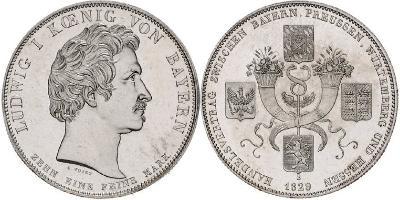
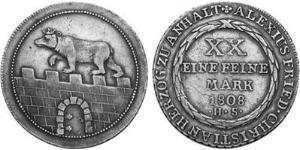
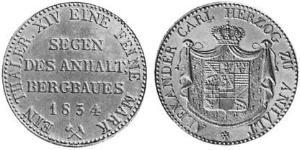
- Silver Thaler Series: These silver issues often feature detailed portraits of ruling dukes alongside heraldic shields representing local coats. They are prized for their sharp relief and high-quality silver composition which made them durable enough to withstand daily wear yet retain visual beauty.
- Late Period Gold Pieces: Though rare, certain gold coins struck in the region before unification served dual purposes as both state currency and sovereign tokens used by visiting dignitaries. Their scarcity today is due to their historical utility rather than artistic innovation alone.
Early issues are distinguished by more ornate designs featuring laurel wreaths that symbolize royal authority, whereas later coins became simpler with plain borders as the design focus shifted toward clarity of face and heraldry. This evolution mirrors industrial advancements in stamping processes across Europe during this era.
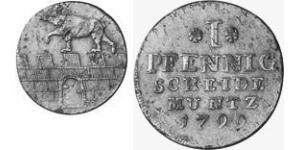
Digital catalogues often overlook smaller denominations like Marks struck prior to total unification, yet these small silver pieces tell the story of local taxation and everyday commerce. Their survival rates are low compared to bullion coins because they were melted down for industrial uses or repurposed during times of war.
The production of special proofs indicates that not all issues went into general circulation but some existed solely as diplomatic gifts. These bear different striking characteristics and often higher levels of luster, offering collectors a window into how ducal courts utilized numismatics to foster international relations during times when political boundaries were fluid.
Cultural Legacy
The coinage of Anhalt-Bernburg serves as enduring proof that local culture mattered even under imperial rule. Symbols stamped on silver reflect local beliefs, religious influences from Protestant traditions prevalent in the region, and symbols associated with agriculture which formed the backbone of its economy.
Silver coins found today connect us to ancestors who walked these lands carrying value for goods like grain or timber that once moved through castle gates at Bernburg. This tangible link reminds modern observers how much human interaction occurred across regions where trade flowed uninterrupted despite political shifts in borders drawn on parchment maps thousands of years later.
The aesthetic choices made by mint designers—whether choosing to depict a lion rampant, star patterns representing local towns or portraits with flowing robes—all reflect the broader artistic movements that swept through Europe at specific times. This allows history enthusiasts to date an object purely through stylistic comparison without needing written documentation of its origin.
For Collectors
This principality remains important because it offers rare opportunities for those who enjoy exploring regional numismatics rather than collecting only famous gold from major empires. Every piece tells a story of economic life in Central Europe and helps reconstruct trade routes across centuries.
In Summary: Why It Matters
The enduring appeal lies not merely in rarity but in narrative depth, offering an accessible entry point for understanding how small polities shaped the modern map. Whether examining a worn thaler from early days of coinage or preserved mint marks before 1908 standards changed forever, these items stand as testaments to local governance and artistic skill that history has largely forgotten yet preserves today.