| preceded by | ||||||||||
|
||||||||||


|
|||||||
 Second Polish Republic (1918 - 1939)
|
|||||||


| Second Polish Republic (1918 - 1939) | Link to Wikipedia |
Second Polish Republic: History, Coinage and Collectibles
The rebirth of a nation is often measured in ink on parchment and metal stamped with an emblem. The Second Polish Republic, which emerged from the ashes of World War I to reclaim sovereignty after over a century of partitions, offers collectors a profound narrative etched into silver and bronze.
Historical Background
In November 1918, Poland regained independence following three centuries of foreign partition by Austria-Hungary, Prussia-Germany, and Russia. This restoration was not merely administrative; it represented the resurrection of a historic state identity that had survived cultural erasure while maintaining its distinct heritage. The new government faced immediate challenges in building institutions from scratch to restore international trade relations, stabilize an economy devastated by war, and unify diverse populations under one national banner.
The interwar period was defined by intense geopolitical pressure. Poland served as a strategic buffer state between two expanding imperial powers, the Soviet Union and Nazi Germany, which meant its sovereignty was constantly threatened in real political terms. This precarious existence influenced domestic policy, forcing rapid industrialization to secure economic independence before foreign rivals could dictate trade conditions.
Cultural life flourished during this time as part of a nationalist awakening that permeated all institutions. Artistic revivalism became popular across the nation; paintings restored national pride while architecture blended modernist trends with traditional folk elements, celebrating a distinct Polish style in contrast to Western European influences. These ideals were naturally applied to monetary policy and iconography on coins.
Currency and Coinage History
The transition of currency during this era is complex for the collector because it spans from occupation money printed by three foreign administrations into a unified national coinage, eventually transitioning toward modernized standards. Upon regaining independence in 1918, Poland initially sought to use existing banknotes and coins left behind or recovered after German withdrawal.
The currency system was reformed several times as the new government stabilized its economy against inflationary pressure from wartime paper issuance. By early 1923, a radical reform introduced a completely new złoty based on an earlier monetary concept to replace depreciated denominations associated with war chaos and occupation regimes.
This new standard established in March 1924 became the foundation for serious numismatic collecting until World War II interrupted trade. Coins were designed to reflect financial strength, which was vital as Poland needed foreign investment. However, this era ended abruptly when global economic conditions deteriorated in 1930 and the rise of fascism threatened security again.
Mints and Coin Production
Coin production shifted from a fragmented arrangement to centralized state control after independence was fully consolidated. The primary minting facilities were established within Warsaw, where the State Mint operated as an arm of government finance ministry oversight.
Silver coins contained varying levels of precious metal content designed to match international market prices while ensuring enough volume for circulation needs. Bronze and bronze-alloy coins served smaller denominations required by a growing cash economy in expanding industrial cities like Krakow, Lodz, and Poznan.
- Artistic Direction: The designs were curated to be modern but respectful of tradition.
- Minting Quality: While early post-war issues showed wear due to heavy circulation in rebuilding economies, the later pre-war series featured higher relief and better die craftsmanship.
Notable Coins
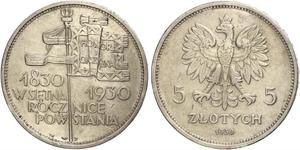
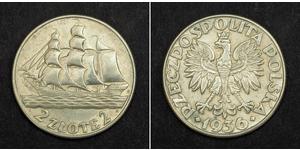
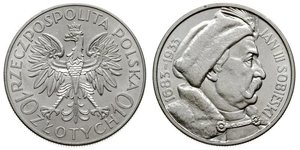
The most iconic piece of Polish interwar coinage is found on the silver denominations carrying national symbols. These issues typically feature a depiction of Poland's heraldic White Eagle facing right, designed to be recognizable and bold even in foreign markets.
- Silver Złotys (Early 1920s): Issued with various dates showing the transition from war-time currency into modern standards. Collectors appreciate these for their historical narrative of economic stabilization rather than strictly rarity.
- Bronze Grosh Issues: These small coins were widely circulated in commerce and often featured allegorical designs representing agriculture or industry, reflecting Poland's agrarian economy transitioning toward manufacturing power.
The coinage from the latter part of the period also includes special commemorative pieces marking significant anniversaries within state history. For collectors interested in high-grade examples with full luster, these issues offer a window into how Polish citizens viewed their heritage during moments of nationalistic fervor before WWII.
Cultural Legacy
The Second Republic coins were essentially propaganda vehicles for positive imagery amidst difficult political conditions. In an era where the nation was frequently threatened by war on its borders, minting high-quality currency projected confidence and stability that might not have been felt elsewhere.
Pole collectors view these pieces differently from Western counterparts because they understand how deeply those national symbols were connected to survival against partitions or foreign rule. The Eagle motif used consistently was a rejection of imperial imagery imposed during the occupation periods, signifying authentic Polish sovereignty rather than subjugation by Germany or Russia.
The artistic quality on these coins is often described as refined and sober compared to some contemporary issues from nations with longer monetary traditions. They served as everyday objects for citizens who would use them in markets without thinking about their historical weight, but today they are appreciated as small artifacts of a resilient nation rebuilding itself.
For collectors
The Second Polish Republic remains an important area for hobbyist collecting because the pieces encapsulate how a young democracy asserted its identity on paper and metal. The scarcity is driven more by time than rarity, as millions were produced for everyday use before many of these coins survived to modern times.
Rare examples typically show wear consistent with heavy circulation in pre-war Poland where coinage was melted or lost during conflict preparations later. Collectors seeking investment grade pieces should look at the transition issues between the occupation currency and national standards, which bridge numismatic history for those who value understanding how countries rebuilt their economies after great wars.