| preceded by | ||||||||||
|
||||||||||


|
||||||||
 First French Empire (1804-1814)
|
||||||||
|
||||||||


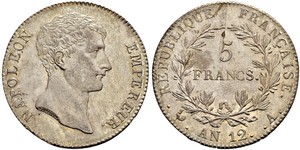
| First French Empire (1804-1814) | Link to Wikipedia |
First French Empire: History, Coinage and Collectibles
Historical Background
The rise of the First French Empire stands as a pivotal moment in European history, bridging the chaos of the Revolutionary period with the stability required for modern commerce. In the aftermath of 1789, France was reeling from political instability and economic collapse driven by war debt and hyperinflation. The new regime initially sought to maintain Republican ideals but quickly faced opposition that necessitated a strong central government under Napoleon Bonaparte. By 1804, this consolidation transformed the republic into an empire with distinct characteristics of statehood not just in governance but also in its economy.
This political shift profoundly influenced the monetary systems and trade practices across Europe. Prior to the Empire's formation, France utilized a currency system that had been heavily impacted by assignats and livre tournois standards which were unreliable for long-distance commerce. The Napoleonic state prioritized stability over revolutionary symbols of liberty in its economy, favoring a strict adherence to weight-based metallic standardization. This period marked the end of erratic economic fluctuation and established France as an industrial and banking leader on mainland Europe.
Currency and Coinage History
The evolution of money during this era was characterized by one specific, critical legal act: the Germinal Law of 1803. Before this decree, currency values were often tied to paper notes that lost value rapidly or relied on inconsistent metal content in coins minted during earlier decades. The First French Empire introduced a standardized bimetallic system using gold and silver for higher denominations and copper alloys for small change. This reform was not merely domestic; the new franc germinal quickly became the international reference standard, influencing coinage reforms across neighboring European nations like Italy, Spain, and Germany.
The role of coinage in government commerce during this era shifted from a symbol of republicanism to one of imperial power and state sovereignty. Every denomination was designed with specific metal purity rules that facilitated trust between merchants traveling through the Napoleonic territories. The coins were minted with precise weight standards, ensuring they could be used seamlessly across borders where French economic influence prevailed. This systemization allowed for unprecedented movement of goods in France's commercial sphere, facilitating trade routes from Marseille to Saint Petersburg.
Mints and Coin Production
Production centers played a vital role in the artistic quality associated with this era. The Paris Mint was the primary source of all gold coins but also served as an arbiter for silver coinage standards set by imperial decree during 1803-1815. Smaller provincial mints such as Strasbourg, Lyon, and Nancy contributed copper issues to supply everyday commerce needs throughout the kingdom's vast interior.
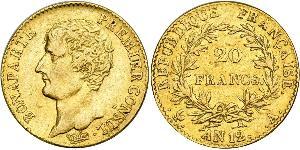
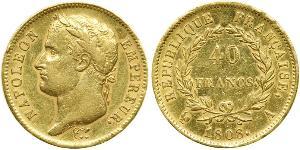
The artistic characteristics of these coins reflect a transition in French aesthetic sensibility. Early Republic coinage featured allegorical figures like Liberty with Phrygian caps; this evolved during 1804-1815 into depictions featuring imperial crowns and laurel wreaths, often bearing the head of Napoleon I or his wife Josephine depending on specific years. The engravers were masters of their craft who worked under strict supervision to ensure that every coin bore a dignified image suitable for an empire expanding its borders.
Notable Coins
Focusing on items widely collected by numismatists reveals several key types defining this period. The most significant among them is the Gold Franc piece, also known as the Napoleon or Imperial Eagle series. This denomination features a standing eagle facing left atop columns with the inscription "Franc" prominently displayed along the rim.
- The Franck Germinel of 1803: A gold coin that stabilized international trade by setting purity standards widely adopted in Europe during early nineteenth century financial reform movements.
- The Silver Denier or Quarter Franc: Circulated widely within domestic commerce, these coins featured portraits transitioning from Republican imagery to the profile of Napoleon as Emperor, highlighting his consolidation of power visually on metal currency.
Among copper issues, collectors often look at the 1807 Centimes which were struck in Paris before being distributed nationwide. The transition in portrait engravings—from Houdon's busts to more dynamic profiles by artists like Cagnie—marks a distinct era where state authority was visually communicated through artistic refinement rather than political slogans.
Cultural Legacy
The legacy of the First French Empire coinage is deeply embedded in modern numismatic culture. The transition from revolutionary republicanism to imperial grandeur tells a story about how societies visualize their power structures. Coinage during this period reflected an obsession with order, discipline, and artistic perfection which permeated all aspects of life within France's borders.
Religious symbols were carefully balanced against secular ideals; the Concordat between Napoleon I and the Vatican allowed for cross imagery to reappear alongside imperial eagles on some denominations during 1809-1815. These artistic elements reflect a complex cultural synthesis that blended Catholic tradition with Enlightenment reason.
For Collectors
First French Empire coins remain important today because they represent the birth of modern monetary standards globally recognized by historians and economists alike. Their survival in fine condition offers rare glimpses into how an empire governed its economic subjects while maintaining artistic quality at a high standard unmatched until later industrial revolutions.
Their scarcity is largely determined not just by mint numbers, but their historical context where they facilitated stability after years of chaos caused by previous conflicts and hyperinflationary periods in France's past. Collectors seek these coins for the story they tell about Napoleon's centralized statecraft which prioritized financial uniformity over political agitation.