| View |
| preceded by | ||||
|
||||

|
|||||||
 People's Socialist Republic of Albania (1944 - 1992)
|
|||||||

| succeeded by | ||||
|
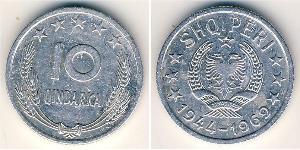
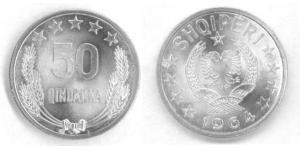
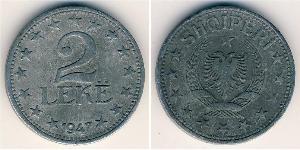
| People's Socialist Republic of Albania (1944 - 1992) | Link to Wikipedia |
People%27s_Republic_of_Albania: History, Coinage and Collectibles
Historical Background
To understand the coinage of Albania during its time as a People’s Republic, one must first appreciate the rugged geography that defines this Balkan nation. For millennia, the landscape itself dictated isolation; surrounded by towering mountains—part of the Dinaric Alps—and separated from neighbors by high passes and difficult terrain, Albania developed an economy heavily reliant on agriculture, with precious metals playing only a minor role in everyday life until modern times.
The state formed during World War I following centuries of Ottoman suzerainty. By the mid-20th century, under the leadership of Enver Hoxha, this nation adopted a path that was as radical as it was unique: extreme isolationism. In 1967, Albania declared itself "the first atheist state in history," closing its borders to foreign influence and restricting travel even within neighboring countries.
This geopolitical pivot fundamentally altered the monetary landscape of Europe at large. While Western Europe struggled with inflation or currency crises during this period, Albania retreated into a closed economic bubble. For collectors, this context is vital because it explains why certain high-denomination issues from the early 1970s are so highly prized today: they were not intended for broad commerce but rather as tools of state propaganda to be held within a small elite or given to foreign dignitaries.
Currency and Coinage History
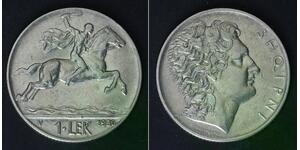
The story of Albanian currency does not begin in 1946, though that marks the official formation of the People's Republic. The roots lie with King Zog I (Ahmet Zogu) who reigned briefly before being ousted by the Communists after his death and shortly thereafter. Under Zog’s rule from 1925 to 1938, Albania issued its own gold and silver currency: "Gjylit" and Francs.
This is a critical distinction for collectors of Albanian history because these issues look remarkably similar to their contemporaries in Italy or France but are distinguished by the double-headed eagle on reverse. They serve as an important bridge between modern European numismatics and Balkan heritage.
- The transition from gold Francs to silver Gjylit mirrors standard economic policy of that era, but with distinct Albanian iconography.
When the Communists seized power in 1946 following a Soviet-backed uprising, they sought immediate control over monetary systems. In September 1946, Albania introduced its first "socialist" currency unit: The Lek (plural Din), replacing the Gold Franc at face value.
- The early years saw a mix of old and new issues; however, by the late 1950s, a full set of copper-bronze fractional coins was established to facilitate local trade among farmers in rural markets that could not access larger denominations immediately.
Mints and Coin Production
The production centers for these currencies were primarily centralized at the Tirana Mint. However, unlike major European mints of Berlin or London which utilized sophisticated die-striking techniques to create intricate reeded textures on edges that hid imperfections, Albanian coinage from this period reflects a different reality.
Technological Context:
- Die Striking Technology: As with many smaller developing economies at the time, die-striking was used to produce most denominations of copper-bronze coins during the mid-century. By 1980, Albania had switched over entirely to modernized press technology.
- Metal Composition:Due to global shortages and economic self-reliance policies common in Eastern Bloc nations around this time, coin composition shifted frequently. While earlier issues were pure silver or copper-bronze, later decades introduced heavy zinc-alloy strikes that were meant for circulation but rarely saw extensive use.
- The "Mint Mark": Unlike many European countries where you see a mint mark on every denomination to distinguish production locations (e.g., Paris vs. Rome), the Tirana Mint did not always utilize visible identifiers during the PSL era, making grading and authentication more reliant on weight and composition rather than location.
Notable Coins
This collection of currency has several standout issues that serve as "jewels" for collectors focused on history. Here are a few examples where design intersects with national narrative:
- **The 50 Lek Coin (1946-1973)**: Issued under the reign of Enver Hoxha, this coin features his portrait alongside two large hands clasped—a common socialist symbol for "worker unity."
This denomination was a bridge between denominations but had high minting quality as it carried significant value. Its obverse depicts an architectural monument that is often debated among experts—it represents either the National History Museum in Tirana or a generic representation of state power.
- **The 10 Lek Coin**: Perhaps the most recognizable piece from the socialist era, this coin typically featured the image of "Lenin" (Vladimir Lenin) alongside agricultural machinery. However, what makes it valuable is not its circulation frequency but rather early errors produced at a time when resources were scarce.
The reverse design frequently shows wheat stalks—a staple crop—but often paired with images representing industrial progress like hammers or the double-headed eagle (which was reintroduced in specific contexts to link historical pride with modern ideology).
- **The First Set of Coins for "State Bank"**: These are distinct from later political regimes and focus strictly on economic themes. Early 20th-century issues often featured King Zog’s head, which collectors value as a transitional artifact showing the shift from monarchy to republic.
The key takeaway regarding these coins is that they were not designed for profit or foreign trade (which Albania banned), but rather served an ideological purpose. Consequently, finding them in circulated condition can be challenging; most entered into collections of state workers immediately upon release due to limited availability outside the government circle.
Cultural Legacy
The legacy of these coins lies in how they reflect a culture that was deeply introspective and determined. The imagery on coinage moved away from religious iconography, which was suppressed following Hoxha’s declaration to eliminate religion within two years by 1967.
- **Symbols and Ideals**: Before the atheist decree of 1968, you would see Christian motifs; afterwards, imagery focused on industry, agriculture, and national icons like Besa or Skanderbeg. This shift in design is a powerful numismatic record of a society attempting to redefine itself from scratch.
This era provides fascinating insights into the relationship between art and ideology. For example, the use of the double-headed eagle—a symbol with roots reaching back to Byzantium and Illyrian kingdoms—was revived during this time not just for its aesthetic beauty but as a rejection of foreign influence while maintaining national sovereignty.
For Collectors
If you are approaching Albanian coinage from the perspective of collecting history, remember that these pieces offer an unvarnished look at Cold War politics in miniature. Albania’s isolationism means their mintage numbers were often low by design rather than just due to limited resources.
- **Rarity and Condition**: Most issues have high survival rates only for the early Zogian period or specific error pieces produced before 1960. After that, they are rare in mint condition.
Whether focusing on the transition from monarchy to communism or seeking out unique varieties of denominations like the "Lek" and "Dine," Albania remains an essential field for serious Balkan numismatists who wish to own a complete representation of Europe's history between 1946 and 1990.