| View |
| preceded by | ||||
|
||||

|
|||||||
 July Monarchy (1830-1848)
|
|||||||

| succeeded by | ||||
|
| July Monarchy (1830-1848) | Link to Wikipedia |
The French July Monarchy: History, Coinage and Collectibles
Historical Background
To understand the silver pieces struck in Paris during this era, one must first appreciate the political landscape that birthed them. The period known as the July Monarchy marks a significant turning point between the traditional monarchy of King Charles X and the Second Empire of Napoleon III. Following the revolutions of 1830 which overthrew the Bourbons, Louis-Philippe I ascended to the throne in an unexpected move that defined this epoch. He was not crowned by divine right but accepted as king by a constitutional charter representing a liberal shift within European governance. This specific brand of monarchy is often called "The Citoyen King" because his reign coincided with massive industrialization efforts and social changes across the French provinces.
The era saw France transform from an agrarian power into one capable of leading in industry and finance, setting a precedent for trade relations that extended well beyond national borders. This shift impacted how money was perceived by merchants who required reliable instruments to facilitate expanding commerce with England, Germany, Italy, and Russia. The stability brought by the July Monarchy allowed artists and metallurgists to develop coinage designs reflecting modern industry rather than solely aristocratic tradition. For history enthusiasts, this period explains why French currency struck between 1830 and 1848 often features a more relaxed, approachable style of kingship compared to his predecessor.
Currency and Coinage History
The monetary evolution during the reign of Louis-Philippe represents an era where coinage remained stable yet modernized. France had largely adopted a decimal-based system decades earlier, but this regime solidified its production capacity under industrial conditions that were rapidly improving mint technologies across Europe. Prior to 1830, coins often bore heavy religious iconography or royal effigies meant to convey divine power. By the time of Louis-Philippe, however, coinage began reflecting a more secular image suited for the growing commercial middle class.
This shift in government policy influenced not only how money was spent but also who minted it and why specific denominations were favored over others. The standard silver 5 Franc pieces served as both domestic currency for daily commerce and international exchange coins that circulated widely across continental Europe during this trade-focused age. It is fascinating to observe that despite the revolution's fervor, France maintained continuity in its gold reserves and did not attempt a radical decimal overhaul until much later under Napoleon III.
Mints and Coin Production
The central hub for striking these historic treasures remained Paris Mint (La Monnaie). This facility was renowned throughout Europe for the high quality of metalwork produced there during this 15-year window. While other mints occasionally operated in Strasbourg or Lyon, most silver production centered around the capital to ensure strict government oversight and weight standards that merchants demanded.
Minting traditions under the July Monarchy were heavily influenced by French art academies which ensured that every profile of the king was executed with classical precision yet retained a sense of realism. The transition from copper coins used for small change to nickel or zinc versions occurred slowly after this period, but during Louis-Philippe's reign, bronze and silver compositions ruled. Coin production also reflected an era where dies were often reused extensively in Parisian workshops unless new orders specifically requested proof pieces for presentation to diplomats.
Notable Coins
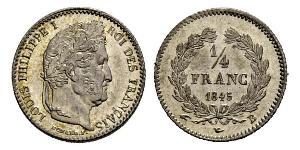
The most sought-after piece from this regime is undoubtedly the silver 5 Franc coin struck during the early and mid-1830s through 1847. Its design, featuring a bust of Louis Philippe facing right with flowing hair styled to mimic classical Greek art rather than stiff royal formality, became iconic for collectors worldwide.
Historical context dictates that this particular coin was minted during times of rapid urbanization in Paris and industrial growth at the borders, leading to increased demand. Its importance lies not just as legal tender but as a symbol of modernizing monarchy where commerce overrode traditional court hierarchy. The reverse often depicts a ship or shield depending on the year struck, indicating trade ambitions.
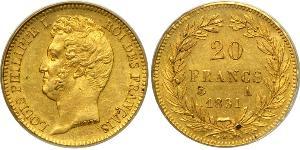
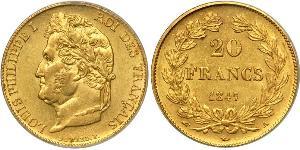
Collectors also find value in later 20 Franc gold pieces produced toward the end of this period before transition to imperial designs began in France. These high-denomination coins were less common than their smaller counterparts and served as savings for merchants traveling abroad.
Cultural Legacy
The coinage from July Monarchy era is now viewed through a lens that appreciates both political symbolism and industrial craftsmanship. It reflects the tension between old royal symbols and new republican ideas emerging after 1848 when Louis-Philippe was forced to abdicate. Even though this regime ended quickly, its coins circulated into other European economies for decades because they were reliable.
Cultural elements such as the Gallic Rooster symbol appear on later issues of these coins and reflect a shift toward national identity independent from dynastic rule alone. The artistic style used by sculptors in Paris during this time influenced currency design across Europe, making France one of the few nations that successfully blended classical Greek motifs with modern industrial manufacturing.
For collectors
The French July Monarchy remains important to collectors because it represents a unique bridge between old monarchy and new industry. Coins from these years are prized for their artistic detail rather than purely for rarity, as many denominations were issued over several decades without major changes in design until the very end.
Determining age often relies on examining how wear patterns interact with mint marks found mostly under the bust of Louis-Philippe. Proof pieces exist but are rare compared to circulation strikes which show distinct tonation due to their use in trade routes across Europe and America where they were frequently exported by merchants from Bordeaux or Marseille.
In conclusion, these silver items tell a story not only of kingship but also of commerce, artistry, and the transformation of France during its most industrializing years. For auction buyers seeking pieces that connect to European heritage without modern political baggage, this era offers some of the finest artistic goldsmithing from 19th-century Europe.