| preceded by | ||||
|
||||

|
|||||||
 First Spanish Republic (1873 - 1874)
|
|||||||

| succeeded by | ||||
|

| First Spanish Republic (1873 - 1874) | Link to Wikipedia |
The First Spanish Republic: History, Coinage and Collectibles
Welcome to our gallery of history in metal. Today we explore a fleeting but profoundly significant era for Spain known as the Primer República Española, or the First Spanish Republic.
Historical Background
To understand what is struck upon these coins, one must first look at the tumultuous political stage upon which they were born. The late nineteenth century was a time of profound change across Europe, where monarchies faced new challenges from democracy and nationalism. In Spain, this upheaval culminated in 1868 following the Gloriosa Revolution, which expelled Isabella II from her throne.
A provisional government took control with an eye toward establishing democratic institutions and constitutional governance by a national vote. This political experiment began in earnest during April of eighteen seventy-three but proved incredibly fragile to maintain amidst civil unrest. Between competing factions—some favoring the restoration of monarchy, others seeking radical reform—the nation struggled economically.
The Republic lasted barely fifteen months before General Serrano orchestrated the coup and paved the way for Amadeo I’s arrival from Savoy in 1870s to restore stability, eventually leading back under Alfonso XII. The instability was not merely political; it deeply influenced national economics and how the government managed public money.
Currency and Coinage History
In any nation where a regime changes abruptly during wartime or revolution, currency serves as an artifact of that transition. For Spain in this short window between Isabella II’s departure and Amadeo I taking power, the evolution of coinage was driven by necessity rather than design elegance.
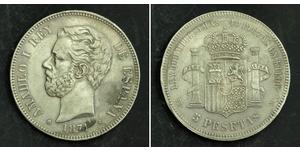
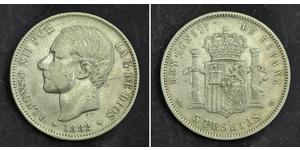
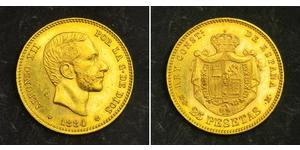
The First Republic did not immediately establish entirely new denominations for its own minting process because it faced severe treasury issues. Consequently, existing designs from previous monarchies were utilized, sometimes altered with different dates or legends to reflect changing sovereignty. The silver dollar continued to circulate as the primary international standard used in commerce, but smaller domestic units required immediate attention.
This period marks a time of transition where mints had to produce coinage that was politically acceptable yet technically sound for trade markets dependent on Spanish exports like wine and oil. Because coins are tangible history, these transitional issues hold significant value not just as bullion or artistry, but as proof of the Republic's fleeting existence.
Mints and Coin Production
The heart of coin production was centered around Madrid and Barcelona during this period. These mints operated under unique conditions where political directives could change overnight. At these locations, metalworkers were tasked with striking coins that had to navigate the delicate balance between republican ideals and royal tradition.
*Madrid MintThis facility continued production of standard Spanish pesos using older dies for a short period before shifting fully toward Amadeo I designs once political stability returned. The transition from Isabella II's portrait to new emblems often occurred through the same physical machinery, showing how quickly history was redefined on a metal plate. *Barcelona
In Barcelona, there were efforts by local provisional committees to mint their own silver coins that would circulate in Catalonia. These pieces sometimes bear distinct markings from regional authorities before central oversight consolidated again under the restored monarchy following Alfonso XII's proclamation as king of Spain after Amadeo I abdicated.
Notable Coins
Serious collectors recognize several key categories within this period that define what was available to citizens during these tumultuous months. The most valuable are those that prove a minting authority actually operated under the short-lived democratic government rather than continuing old royal contracts.
*Provisional Silver Dollars- Historical Context:
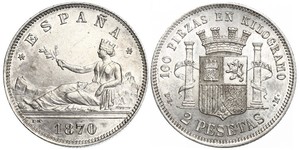
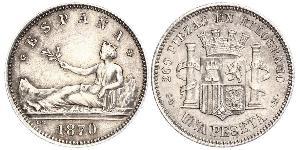
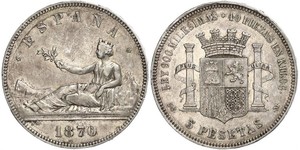
Design Features: The obverse usually carries an effigy of liberty or republican mottoes rather than royal crowns while maintaining technical standards required for international trade acceptability.
Importance to Collectors: These coins are prized because they represent the final attempt by a democratic government before Spanish history reverted to monarchical restoration in 1875.
During this period, authorities relied heavily on copper centimos or nickel reales for everyday commerce. Collectors can distinguish these by subtle variations in lettering indicating which government controlled the mint at a specific date.
Cultural Legacy
The coins from 1873 to 1875 reflect how quickly cultural symbols shifted across Spain. One might see republican eagles or oaks replacing crowned figures, but often only briefly because public sentiment leaned toward stability provided by returning monarchies like Amadeo I and later Alfonso XII.
The legacy of this coinage lies in the contrast between political ambition and economic reality. While republicans sought to imprint their ideology on metal currency, financial instability meant most coins struck bore familiar imagery with only subtle textual changes that modern eyes might miss unless guided by historical context. This creates a fascinating puzzle where history is written not just through dates but through symbols of authority.
For collectors
The First Spanish Republic remains important today because its coinage offers insight into the fragility of early republican governments in Europe during this era. These pieces are rare and valuable not merely for their condition, but as historical documents proving that a short-lived democracy existed.
*Why these matter:- Rarity: Coins issued under the Provisional Government are extremely scarce because few were needed or authorized.
Educational Value: They demonstrate how currency production reflects regime changes.
Motif Analysis: Comparing these pieces to Amadeo I and Isabella II coins helps collectors track political sentiment through numismatic design shifts.
In essence, the silver dollars or copper centimos bearing the date of 1873-74 are more than just money; they represent a brief period when Spain looked toward European republicanism before settling into an age that would eventually lead to its modern monarchy. For those who appreciate history written in metal, this era is one of particular mystery and charm.