| View |
| Duchy of Parma (1545 - 1859) | Link to Wikipedia |
Duchy of Parma and Piacenza: History, Coinage and Collectibles
Historical Background
Welcome to a brief journey through the rich heritage of northern Italy's Duchy of Parma and Piacenza. For nearly three centuries, this elegant state stood as one of the jewel boxes on the map of Europe, shaped by an illustrious dynasty that defined its culture and economy for generations.
The heartland was originally forged in 1545 when Pope Paul III elevated his son's territories into a hereditary duchy. It began under the Farnese family, who understood early on that prosperity required not just land, but trade routes and cultural capital. Situated at the crossroads of Italian commerce between Venice to the northeast and Milan to the northwest, Parma was strategically vital.
The region's economy thrived on agriculture—particularly silk production—and wine, which fueled a robust merchant class eager for secure currency. In 1587, an expansion into the Stato Pallavicino further consolidated these resources under the Farnese banner. However, history turned with seismic force in 1731 upon the death of Antonio Farnese without male heirs. This succession crisis ended one dynasty and ushered in a period where foreign powers—specifically Spain's Habsburgs and later their Bourbon relatives—took control.
The state endured Napoleonic annexation, seeing its sovereignty restored briefly before being integrated into the Kingdom of Italy under King Victor Emmanuel II in 1859. The transition was rapid; from a fiefdom ruled by popes to an independent Italian state within two decades. This political volatility is crucial for understanding why coinage production varied so drastically between reigns and how economic policies shifted with every change of government.
Currency and Coinage History
Money in Parma was not merely a tool for trade; it was the face of state authority. For much of its independent existence, the Duchy adopted currency standards that mirrored those of Spain, given the Farnese family's loyalty to the Crown.
The dominant denomination throughout the 16th and early 17th centuries was the Scudo di Parma. This coin circulated freely not just within the duchy but across Europe as a recognized unit of value between Italy and France. When Francesco II became Duke, he famously faced severe economic strain after wars involving France and Spain drained his treasury. To restore financial discipline, he reduced court expenses drastically.
This period marked significant numismatic evolution: the state mint shifted from producing high-volume coins to refining quality control. By 1720s under French intervention (Napoleon's rule), the Scudo di Parma became a standard of exchange for Napoleon's own currency system, reflecting its status as an "European" coin rather than just a local one.
The transition to Bourbon-Parma in 1834 was perhaps the most transformative era. The Bourbons moved away from Spanish-influenced iconography and embraced more traditional French designs while retaining Italian artistic finesse. Their reigns brought about decimalization of sorts, introducing smaller denominations like the centesimi for local commerce. However, the famous "Parma Scudo" retained its place as a collector's coin even into the Napoleonic era.
Mints and Coin Production
The minting operations in Parma were centered on the Ducal Palace itself, but production was decentralized during times of conflict. In peace, coins struck at the main Royal Mint bore the distinct mark of Farnese artistry.
The artistic style evolved with each dynasty's preference. The early Farnese era (1545–1731) favored classical designs rooted in Greek and Roman traditions, often emphasizing portraits that highlighted noble lineage. Coins during this time were known for their high metal content—solid gold ducats rather than alloyed pieces—a testament to Parma's wealth.
In 1609, under Alessandro Farnese (son of Ranuccio I), a decree was issued to ensure the "Ducat" remained pure. The mintmaster employed in this period had to balance production needs with maintaining high standards that impressed foreign buyers from Florence and Venice. Later reforms introduced specific legends identifying coinage by year rather than just reigns, allowing for more precise dating.
The Habsburg takeover (1738–1796) temporarily standardized coinage under Spanish models, introducing the "Real" denomination alongside local variations. This period saw a decline in weight and fineness due to wars of succession consuming metal reserves—a stark reality recorded on many hoarded coins found today.
Notable Coins
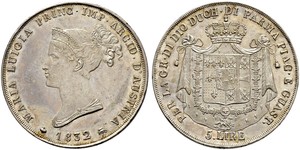
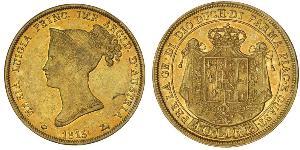
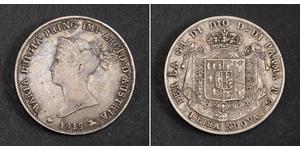
Coin collectors often seek out specific types that tell a story about the era. Here are three standout examples from our collection:
- The Farnese Gold Scudo (late 16th Century):
This gold coin bears the portrait of Alessandro or Ranuccio I, often accompanied by allegorical figures representing peace and prosperity. Historically significant because it marked Parma's transition to an international trade hub, these coins were prized for their fine gold content (often 23 carats). The design features intricate heraldic details that set this apart from common Spanish-style scudi of the day.
- The Scudo di Francesco II (late 17th Century):
Fascinating for its "war-time" context. This silver coin, minted during his reforms to curb expenses, displays a very restrained design focusing strictly on the Duke's face and crown rather than religious scenes. It represents an era where money became essential for national survival.
- The Bourbon-Ducal Copper Centesimi (mid-19th Century):
A rare but popular collectible in the copper sector, these coins were issued as Parma prepared to merge into Piedmont-Sardinia. They are highly sought after by those collecting Italian "Unitary" transition series.
Cultural Legacy
The coinage of Parma is a reflection of its culture and social life. The portraits stamped on these pieces showcase the fashion, hairstyles, and attire of the European elite between 1500 and 1860. A collector looking at a Farnese ducat sees more than just metal; they see the face of Italy's aristocracy before the unification.
The symbols used—the cross on coins struck for Catholic devotion, alongside the fleur-de-lis from French influence—illustrate Parma's diplomatic position between Rome and Paris. The high artistic standards reached under Alessandro Farnese were a deliberate policy to elevate local craftsman to international fame; even the lowest copper coin bore a level of artistry that would take Italian states another fifty years to surpass.
This state was also notable for its patronage of arts, which extended from architecture (The Theater) down to mint engraving. The "Parma School" of portrait medallions and coins flourished under the Farnese family, creating a legacy that influenced coin design across Italy. To hold one is not just possessing currency; it holds a piece of Italian Renaissance cultural sophistication.
For Collectors
Duchy of Parma coins are highly regarded for their quality and historical narrative. Because the state was often subject to annexation or war, high-grade examples in pristine condition became extremely scarce over time. For example, a Farnese ducat from 1589 is historically significant because it commemorates an era when Italy's political fragmentation ended.
The transition of power between families offers distinct collecting themes—Spanish influence vs local autonomy. This numismatic history parallels the broader story of Italian unification and makes these coins not just financial artifacts, but historical documents in metal form.