| View |
| preceded by | ||||
|
||||

|
|||||||
 Vichy France (1940-1944)
|
|||||||

| succeeded by | ||||
|

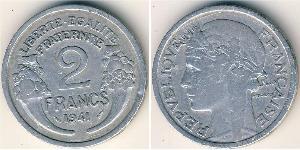
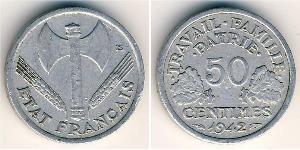
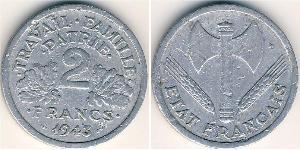
| Vichy France (1940-1944) | Link to Wikipedia |
Vichy France: History, Coinage and Collectibles
Welcome to a journey through one of the most complex eras in modern numismatic history. Today we examine Vichy France, the state established during World War II, often referred to as the ‘État Français.’ For collectors studying world currencies or French coinage specifically, this period offers fascinating insights into how political upheaval dictates monetary evolution.
Historical Background
To understand the coins produced during these turbulent years, one must first appreciate the landscape they emerged from. In June 1940, following a rapid military advance by German forces through northern France and Belgium, Paris fell quickly to enemy occupation lines running along the Loire River in its southern sectors. While free French forces continued to fight elsewhere under General de Gaulle, Marshal Philippe Pétain established his administrative capital at Vichy in the south of Lyon.
This new regime was founded on a concept called the National Revolution. The ideology emphasized authoritarian rule and traditional values such as family structure, national unity, and obedience to authority over political debate or democratic liberty. Under this administration, France moved away from its republican roots towards an autocratic style reminiscent of ancient monarchies.
The economic situation was dire immediately following June 1940. The nation faced severe material shortages due to the blockade by Allied forces across Europe and supply lines cut off in Germany-controlled territories. This era required a state where every franc issued carried propaganda, reflecting a desire for autarky or national self-sufficiency that never fully materialized.
Currency and Coinage History
The monetary system did not disappear overnight when the Third Republic fell in 1940. The government continued to utilize existing circulation of francs, though strict control was placed on their issuance. Initially, the Banque de France maintained its operations under supervision from Berlin's military administration.
Metal scarcity became a defining feature during this period due to international embargoes and German demands for gold reserves held in occupied French vaults. Consequently, many coin designs shifted away from traditional precious metals like silver or bronze towards base alloys that were harder to track but easier to acquire under the strict rationing laws of 1940.
The transition period saw a significant shift in design philosophy where art no longer celebrated liberty but rather obedience and labor. Coins minted between late 1942 into early 1943 began appearing with specific legends emphasizing ‘Travail, Famille, Patrie’, though standard denominations like the centime pieces continued to circulate daily among ration-starved populations.
Mints and Coin Production
The Paris Mint remained the primary production center throughout this tumultuous period until German forces took direct administrative control of coinage operations later in 1940. However, by that point, many facilities were stripped to secure their machinery for the Reich or repurposed entirely.
Tours mint became relevant under certain circumstances as Paris was restricted due to security concerns and supply chain issues regarding materials needed from Germany-controlled mines. The artistic output of this era often lacked the refined detail seen in earlier French pieces, largely because high-quality silver plating for coins meant for export or bullion purposes were removed.
Coinage production during Vichy was heavily influenced by German oversight to ensure that precious metal reserves remained available for military use. Artisans and engravers worked under pressure where unauthorized imagery could lead to confiscation of machinery, resulting in a distinct utilitarian aesthetic replacing the ornamental styles popular from 1935.
Notable Coins
For collectors seeking specific examples from this era, two primary issues stand out. First are small denominations such as five centimes pieces featuring profile images of Marshal Pétain or allegorical figures representing French labor replacing the traditional Marianne head seen on pre-war currency.
The most historically significant coins were those minted between 1940 and early 1943 which bore new legends emphasizing collaboration rather than resistance. These pieces often show a shift in iconography to align with occupation goals, including symbols that encouraged national unity under the shadow of war. Collectors appreciate these not merely as metal but as documentation of daily life.
Another notable aspect is the scarcity caused by melting down efforts during later phases of the conflict where soldiers or civilians melted older coins for fuel or bullion purposes to survive starvation conditions in 1942-43, reducing supply significantly today. These pieces became essential artifacts for historians understanding local economies under siege.
Cultural Legacy
The coinage of this period serves as a powerful testament to the transition from Republican France toward authoritarian collaborationism during World War II. By embedding symbols like Pétain's face directly into daily currency usage, leaders sought to normalize their authority among the general population through repeated exposure in pockets and wallets.
Cultural narratives shifted towards themes of discipline over freedom visible even on small change used for bread ration stamps or fuel exchanges with local merchants. These items tell a story about how culture was reshaped by political necessity without ever reaching total victory against Allied forces who later reclaimed French soil.
For Collectors
Vichy France coinage remains significant today because it completes the historical narrative of modern European currency evolution. It offers rare opportunities to study design shifts under duress during wartime material shortages and propaganda campaigns affecting global economies throughout 1940-1945.
The scarcity factor associated with these issues makes them particularly interesting for those who wish to build a comprehensive portfolio regarding French state history extending into WWII without the need for political commentary on controversial figures. Studying how small denominations were produced under occupation provides essential context for understanding why certain coin types are valuable beyond their face value.
Finding specimens in near-mint condition from 1942 or earlier helps preserve memories of an era when daily life depended heavily upon local currency that no longer circulates freely today. Ultimately, these pieces serve as tangible historical documents connecting us to a time where money was essential yet incredibly scarce during global conflict.