| View |
| Bremen (state) | Link to Wikipedia |
Bremen: History, Coinage and Collectibles
Welcome to the exhibit of Free Hanseatic City of Bremen (FHB). As a curator here at the Historical Numismatic Society, we are often asked why collectors seek out coins from a state so small by population size yet historically monumental. To understand this unique numismatic landscape, one must first look beyond its borders. Although surrounded entirely by Lower Saxony and lacking natural resources like coal or ore in abundance, Bremen's history is defined by the river, specifically the Weser.
Historical Background
The story of our state begins not with a battle for territory, but with an assertion of trade autonomy. Since 1646, following earlier privileges from as far back as 1186, Bremen existed as a sovereign Free Imperial City within the Holy Roman Empire. This status was critical; it allowed Bremen to mint its own currency independent of surrounding monarchies like Hanover or Saxony.
The trajectory shifted dramatically with the Napoleonic era. In an attempt to enforce economic embargoing against Britain, the First French Empire annexed the city-state in 1811 during a period when coins were often replaced by assignats and copper tokens under direct military occupation. The subsequent restoration of independence at the Congress of Vienna in 1815 was pivotal for our minters.
The state's economy relied on its seaport exclave, Bremerhaven ("Bremen's harbour"). This geography dictated that coins had to be internationally acceptable yet distinctively local until unification. By buying land from Hanover at the mouth of the Weser in 1827, Bremen solidified a port capable of handling massive emigration and colonial trade.
Currency and Coinage History
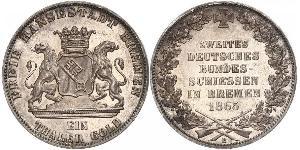
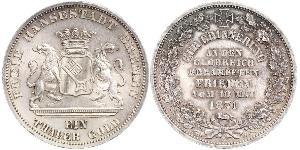
The most significant period for collectors to focus on is pre-unification. Until 1873, when financial pressure forced the adoption of Prussian standards, the state circulated the Bremen thaler (Th). This silver coin was a masterpiece of regional commerce.
Bremen joined the North German Confederation in 1867 and subsequently became part of the German Empire in 1871. Following victory over France that same year, it entered an era where smaller state sovereignty was gradually eroded by federal currency laws.
The Great War (WWI) further complicated the monetary system with inflationary issues common across Germany, but Bremen's unique position persisted until World War II. The city suffered heavy Allied bombing in 1945 and came under US military administration shortly after occupation began in April of that year. During this transitional period, between the collapse of Nazi currency controls and the restoration as a state in 1947, circulation consisted primarily of American Occupation Marks (D-Mark) before eventually transitioning to the federal Mark issue used by all German Länder.
Mints and Coin Production
In many ways, Bremen's minting operations mirror those of its Hanseatic twin, Hamburg. Because it lacked a large-scale industrial base for coin production (unlike Saxony or Bavaria), the city relied heavily on external mints during later periods.
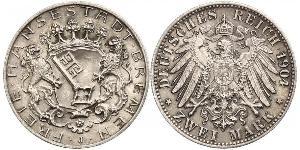
The primary artistic output belongs to the late 19th and early 20th centuries. These were times when German state seignorage was at its peak creativity before federal consolidation in 1873 and again after WWI forced a centralization of coinage under Prussian standards. The Bremen Mint produced issues that often featured maritime iconography—ship anchors, tridents referencing Neptune as the patron god of ports, and detailed depictions of sailing vessels.
Bremen Thalers (Silver):
- Era: Late 17th to early 20th Century.
- Rarity: High relief strikes with sharp details of the Hanseatic shield or ship anchors are sought after by enthusiasts looking for "pre-unification" distinctiveness before it vanished into standard Mark coins.
The post-war transition presents a different challenge. Unlike Bavaria, which continued to mint its own 5-Mark piece well past unification in East/West divides, Bremen's local production was more limited or restricted by the Federal Law requiring uniform issues across the new German Republic starting from 1948/1949.
Notable Coins
The Bremen Thaler stands as perhaps the most culturally significant issue. While it circulated concurrently with Imperial Prussian coins, the Bremen version featured local heraldry and often bore a date indicating its distinct regional issuance before 1873.
- The Occupation Mark (US Zone):
This is less about "coinage" in the traditional sense of seignorage, but rather numismatic historical markers. After British forces entered Bremen in 1945 and handed it to American troops for supply duties toward Berlin, the occupation marks became ubiquitous.
- Rarity: Common circulated issues vs high-grade uncirculated examples where original paper texture is retained.
Cultural Legacy
The evolution of Bremen's currency mirrors its transition from an independent trading republic to a German state. The designs reflect the city's identity as a maritime power and later a liberal, industrial hub dominated by the Social Democrats (SPD) in politics.
- Symbols: Anchors, tridents, and ships are key motifs found on pre-1873 issues. The Bremen Thaler design often incorporated these symbols to distinguish it from the "Prussian" style coins that dominated after 1905.
For collectors
Bremen represents a fascinating niche in German state numismatics for three specific reasons:
- The Transition Era (Pre-1873):
- You can see the exact moment sovereignty was lost and local currency issues ceased, a rarity compared to larger states like Bavaria.
Bremen remains important because it preserves the memory of the Hanseatic cities. Collectors who specialize in "Small States" (Kleinstaaten) often overlook Bremen for that very reason—it was small and integrated quickly—but this makes high-grade specimens from the Imperial era particularly valuable to those seeking depth rather than just surface catalog numbers.