| View |
| preceded by | |
|
|||||||||
 Free City of Frankfurt
|
|||||||||


| succeeded by |
| Free City of Frankfurt | Link to Wikipedia |
The Free City of Frankfurt: History and Numismatic Legacy
Historical Background
In the intricate tapestry of European history, few cities hold as distinct a place as the city that stood on the banks of the Main. For nearly five centuries, it existed in its most celebrated form not merely as an urban center for trade and art, but as a sovereign entity known to posterity through its specific political status: the Free Imperial City (or Reichsstadt). This unique position meant the metropolis was subordinate only to the Holy Roman Emperor rather than any local prince or duke. It served the Empire with unwavering devotion, hosting imperial elections since 885 and acting as a seat of power for centuries.
The city's story is one of survival against political currents that would swallow many other states in its neighborhood. While much of Germany underwent mediatisation in 1803 to accommodate changing dynastic powers, the Free City retained its sovereignty through an act of Imperial will until it fell under French influence following Napoleon’s conquests. It found itself ruled by a Catholic cleric named Dalberg before eventually becoming part of a Grand Duchy and later merging back into its pre-war identity after 1815 via Congress of Vienna.
This resilience continued even as the nature of German politics shifted from imperial immediacy to modern statehood under Prussian rule. Following its neutrality during the Austro-Prussian War in 1866, it was annexed by decree and became a part of Hesse-Nassau Province within the Kingdom of Prussia just before unification in 1870/71. For numismatists, this history represents not merely a city's biography, but a microcosm of how German monetary sovereignty evolved from fragmented Imperial control to unified national standards.
Currency and Coinage History
The evolution of money in Frankfurt is deeply tied to the region’s economic identity rather than sovereign gold reserves. During its long era as an Imperial City, it was a central node for trade finance where banking houses like those founded by the Rothschild family established their dominance over bonds across Europe. While this financial hegemony overshadowed physical minting operations early on, the city remained crucial to monetary systems because it hosted the Federal Assembly and acted as one of the primary hubs for coin circulation.
When Napoleon reorganized the region in 1806, he did not abolish the currency system entirely but rather attempted to standardize trade through French influence. The subsequent establishment of the Grand Duchy under Dalberg saw attempts to emancipate Catholics and stabilize economic relations with Britain—a contract signed as early as 1832 that allowed free shipping and trade along the Rhine-Main corridor.
After Napoleon’s defeat, Frankfurt regained its pre-Napoleonic status briefly before eventually joining the German Customs Union in 1866. The transition from a sovereign Imperial City to a member state was not immediate; coins changed hands at borders while merchants used various regional currencies alongside the emerging standardized Reichsthaler. For collectors of this era, understanding these transitional periods is vital, as coinage often reflects the political anxiety or relief associated with joining larger economic unions.
Mints and Coin Production
The history of minting in Frankfurt mirrors its changing status within Germany’s monetary sphere. In earlier centuries, before Prussian annexation, it acted more as a center for trade rather than production for itself. However, under Dalbergian rule (post-1803), there were attempts to reform currency standards to facilitate international commerce.
By the 19th century, Frankfurt had become part of a broader German network where coinage was often centralized by larger states or shared among members of unions like Hesse-Nassau. The Prussian victory in 1866 meant that Frankfurt ceased its independent minting and became integrated into the Kingdom’s production infrastructure.
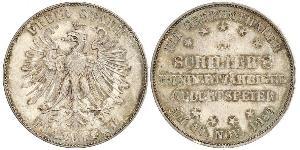
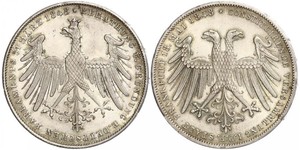
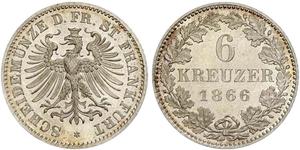
Collectors looking for "Frankfurt" coins will typically find pieces that bear the city's heraldry but were struck under the authority of regional states or later, Germany proper. The transition is visible in how earlier designs gave way to Prussian motifs—Eagles replacing more localized emblems as Frankfurt lost its status and became a provincial capital within Hesse-Nassau.
The city flag itself—a design featuring red and white stripes with an Eagle—is indicative of the symbolic weight carried by these metal objects. The transition from medieval minting to modern standardized coinage during this period was slow, yet profound. Unlike many German states that retained their unique sovereign currencies throughout much of history, Frankfurt’s numismatic output is a study in integration.
Notable Coins
If one were examining a collection dedicated to the region's heritage, several types emerge as particularly significant due to the historical weight they carry rather than intrinsic silver value alone:
- The Sovereign Pieces of the Holy Roman Empire: Before 1806 and briefly after 1815, Frankfurt issued or circulated coins symbolizing its status. These are often found in series connected to Hesse-Darmstadt or as distinct mint issues from specific years under unique ducal rule.
- The Grand Ducal Daler of Dalberg: Issued following the 1803 changes, these pieces marked a period where local authorities attempted to maintain economic independence against Prussian pressure. These coins often bear designs that celebrate the city’s Catholic emancipation and unique political status.
- The Prussian Thalers Minted in Frankfurt: Following annexation after 1866, many high-quality silver coinage struck at local facilities or neighboring centers entered circulation within the former Free City. These are highly prized for their quality and because they bear Prussia's symbols but circulated specifically among Frankfurt’s commercial elite.
For auction buyers today, these coins represent a bridge between medieval Imperial tradition and 19th-century nationalism. Each coin tells a story of political survival—from surviving the fall of HRE to the Napoleonic Wars—and highlights how finance was more powerful than minting in Frankfurt's history.
Cultural Legacy
The legacy of the Free City is etched into its currency through symbols that persist even after the end of statehood. The city’s culture, which fostered liberal movements and supported major scientific institutions like the Society for German History founded by Stein in 1819, was deeply influenced by the presence of prominent Jewish figures such as Ludwig Börne.
This intellectual ferment is often reflected on coins that bore civic mottos or symbols representing a city-state proud of its autonomy. The coinage reflects a period where trade and liberal ideas flourished before being suppressed or reconfigured under more authoritarian Prussian rule. Collectors are drawn to this region not just because it was wealthy, but because the metal artifacts served as proof that Frankfurt survived major continental collapses—only to eventually become part of a larger whole.
Unlike many other German states where coinage ended in 1870 with full unification, the numismatic trail leading up to this point for Frankfurt offers a unique window into how individual city-states maintained their economic identity against centralization. These coins are educational artifacts that remind us of Germany's complex political history.
For Collectors
The Free City of Frankfurt remains important in today’s collecting market because its coinage is steeped in historical significance rather than high silver content alone. Unlike gold issues from Vienna or Munich, Frankfurt’s local currency often represents the transitionary phases of German unification and trade.
Collectors interested in banking history will find that these coins provide physical evidence of an era where finance trumped government—a rare concept even by modern standards. Whether it is a late Prussian coin struck during its brief period as a provincial capital, or earlier issues tied to the Grand Duchy, they serve as tangible links between the city’s merchant past and modern German financial identity.
A well-circulated specimen offers more than just history; it tells the story of a resilient metropolis that navigated empires without becoming consumed by them. For those who appreciate numismatics with depth over simple value, Frankfurt represents one of Europe's most fascinating chapters in monetary evolution.