| Смотреть |
| предшественники | |
|
|||||||||
 Вольный город Франкфурт
|
|||||||||


| последователи |
| Вольный город Франкфурт | Ссылка на Википедию |
Монеты и история государства Вольный город Франкфурт
Welcome to a journey through time and metal, gentlemen. Today we stand before you at the virtual desk of our numismatic museum not merely to display artifacts, but to interpret them as historical documents in their own right.
Исторический обзор: От имперских вольностей до свободной торговли
To understand a coin minted in Frankfurt-am-Main during the 19th century is first to grasp the unique status of its place. For fifty years, from 1816 until the mid-1860s, this entity stood as an "Free City" — a small sovereign state within the German Confederation.
The narrative begins after the Napoleonic Wars and culminates in one of Germany's most significant political crises. The city was chosen by the Great Powers at the Congress of Vienna not only for its strategic position but because it had historically been a Hanseatic trading hub, accustomed to self-rule. When we look beyond politics into economics — which is the true lifeblood of numismatics — we see that this state functioned as an open port and financial center.
The early history was shaped by what one might call "Imperial Memory." Following the dissolution of the Holy Roman Empire, Frankfurt inherited a legacy. It did not just want to be part of Germany; it wanted to remain independent within Europe's great powers sphere. The political constitution established in 1816 defined its autonomy — an independence that eventually found itself tested against the rising Prussian shadow.
The narrative arc ends abruptly but dramatically. In July 1866, amidst the Austro-Prussian conflict, Frankfurt sided with Austria (and Bavaria), while surrounding states joined in a "North German" coalition of sorts before the final battle at Koeniggratz decided their fate for them. Within weeks of the Prussian victory under General Saldern and von Falkenstein's march into the city, the independent status ended.
История валюты и монетного дела: Эпоха реформ
The numismatic landscape of this Free City evolved rapidly. In 1816, Frankfurt sought to standardize its currency against other German states like Bavaria and Württemberg — the "War of Currency" (Krieg der货币). This was a time when silver standards varied wildly across Germany.
In those years before unification under Kaiser Wilhelm II, there were no national currencies. Each state minted Thalers with its own face value relative to weight ratios that would be accepted internationally but not always domestically without tax laws intervening. The Frankfurt Mint produced pieces for internal circulation and commercial trade — often called "Frankfurters" by neighbors.
The mid-1840s brought economic crises affecting all of Europe, impacting coinage quality. It was only through reforms in the 1850s that silver content became more regulated across Germany, aligning with international gold standards later in the decade. Collectors look closely at this era to see how Frankfurt transitioned from its old "free city" identity toward Prussian integration.
Монетные дворы и производство монет: Традиции чеканки
The minting tradition of free cities was small but technically advanced. The Frankfort Mint did not have the sprawling complex of Berlin or Vienna, so its coins bore a special weight and character.
Fine engravings became crucial to distinguishing local currency from counterfeit pieces or foreign imports that circulated widely across river routes like those on the Rhine-Main system used during trade. The mint's work was defined by two things: purity of silver in Thaler denominations, and artistic motifs chosen for their civic virtue.
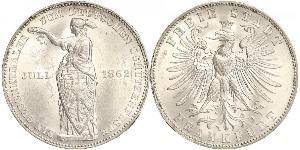
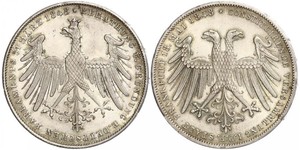
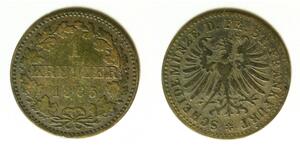
The coinage reflected a unique aesthetic — it did not boast Prussian eagles or imperial double-headed symbols but instead leaned on republican themes: scales representing the Senate (Senat), laurel wreaths signifying victory over political chaos during 1848, and allegorical figures of Commerce that honored Frankfurt's status as an open port.
Известные монеты: Символы эпохи и коллекционного интереса
For a collector to identify the most sought-after pieces from this Free City, they need three things in mind: date range (1830–1865), material quality (high silver content is standard before 1847 reforms), and mint mark variety. We will focus on two categories that typify these short-lived independent issues.
- The "Classic" Thaler of the Free City:
- The Transitional Issues (1850s–1862):
- The 1865-Preparation pieces:
This type, often bearing a date in the late 1830s or early 1840s, was minted under supervision that sought to honor local civic pride. The design might have featured motifs drawn from Roman law — relevant for this former Holy Roman Empire capital. These coins were heavy and richly struck on high-grade silver. They circulated alongside Bavarian pieces but held a higher prestige because of Frankfurt's political weight.
After the reforms allowing Jews to participate in government and business — which expanded trade networks — new mint issues appeared that reflected this "modernization" of society. These coins often featured updated bust designs, showing a move away from traditional imperial icons toward more civic-facing profiles.
In the final years before annexation in summer 1866 — when Prussia took control via military occupation rather than peaceful union (as happened with Hesse-Darmstadt or Baden) — Frankfurt coins became more scarce. Many of these show signs that their mintage was interrupted by political turmoil.
The "classic" Thaler remains the centerpiece for collectors: heavy, silver-rich pieces struck under a short-lived republican regime within Germany's broader economic order. These are rare and highly regarded because they document Frankfurt's autonomy before it became part of Prussia.
Культурное наследие монет
A coin is more than paper or metal; it tells the story of a society's art, politics, and values. For Frankfurt in its final years (1850s–60), this meant an emphasis on civic pride rather than monarchical worship — unlike other German states at that time.
We see motifs drawn from Greek antiquity representing democracy or Roman history referencing the city's status as former capital of a great empire. This artistic choice tells us about how the Free City saw itself: not merely a town, but an heir to Rome and Venice in terms of political independence within Germany.
Для коллекционеров
Gentlemen collectors and historians — what remains important for you is that these coins do exist outside of major national mints. They are rare because the state existed only 50 years, making high-grade examples scarce. But why seek them out? Because they connect us to a moment when Frankfurt was independent in law and economics.
The transition from "Free City" to Prussian town happened quickly in summer 1866 after military occupation. For the numismatist who values history over mere metal content, these pieces tell an entire story: how Germany moved toward unification not through treaties alone but through coinage changes that mirrored political integration.
If you seek to understand German monetary history from a different angle — one where small republics stood between big empires and kingdoms (Prussia & Austria) — then the coins of Frankfurt are essential reading, if I may use the term metaphorically. Collecting them is collecting 19th-century diplomacy written in silver.