
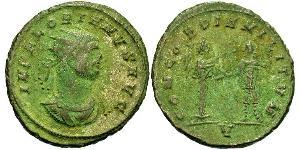
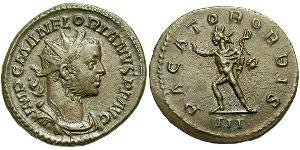
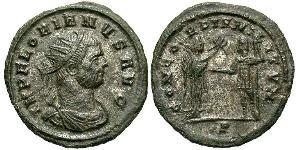
| Florianus | |||||
|---|---|---|---|---|---|
| 46th Emperor of the Roman Empire | |||||
| Reign | 276 | ||||
| Predecessor | Tacitus | ||||
| Successor | Probus | ||||
|
|||||
| Died | 276 Tarsus, Cilicia[1] |
||||
Florianus (Latin: Marcus Annius Florianus Augustus;[2] died 276), also known as Florian, was Roman Emperor for a few months in 276.
Contents
Biography[edit]

Florian was reportedly a maternal half-brother to the Emperor Marcus Claudius Tacitus.[4] Appointed Praetorian Prefect in Tacitus's army in his campaign against the Goths,[2] according to the available sources, he was chosen by the army in the West to succeed Tacitus in 276, without the Roman Senate consensus.[5] However he minted coins bearing the "SC" legend, thus showing some bonds to the Senate.[6]
Probus Rebellion[edit]
Florian was fighting the Heruli when the army in the East elected Probus.[7] Florian had the support of Italia, Gaul, Hispania, Britain, Africa, and Mauretania.[5] The two rival emperors met in battle in Cilicia; Florianus had the larger army, but Probus was a more experienced general and avoided a direct clash.[8] Florian's western army was not accustomed to the hot, dry eastern climate,[9] and Probus likely secured a small victory. Florian was assassinated by his own troops near Tarsus once their confidence was lost.[6] He died in September 276, having been emperor for only eighty-eight days.[1]
A family of the Brandenburg nobility called von Blumenthal claimed descent from Florianus in a fanciful legend which says that after his death his sons fled over the Alps and introduced viticulture to the north Germans.
Sources[edit]
Primary sources[edit]
- Aurelius Victor, "Epitome de Caesaribus"[10]
- Historia Augusta, Vita Taciti[11]
- Eutropius, Breviarium ab urbe condita, ix. 16[12]
- Joannes Zonaras, Compendium of History[13]
- Zosimus, "Historia Nova"[14]
Secondary sources[edit]
- Mc Mahon, Robin, "Florian (276.D.)"[6] De Imperatoribus Romanis, (2000)
- Jones, A.H.M., Martindale, J.R. The Prosopography of the Later Roman Empire, Vol. I: AD260-395, Cambridge University Press, 1971
- Southern, Pat. The Roman Empire from Severus to Constantine, Routledge, 2001
- Canduci, Alexander (2010), Triumph & Tragedy: The Rise and Fall of Rome's Immortal Emperors, Pier 9, ISBN 978-1-74196-598-8
- Gibbon. Edward Decline & Fall of the Roman Empire (1888)
References[edit]
- ^ a b Canduci, pg. 101
- ^ a b Jones, pg. 367
- ^ This coin celebrates the AETERNITAS AVG, the eternal life of the emperor. However, Florianus ruled only eighty-eight days.
- ^ Historia Augusta, Vita Taciti, 17:4
- ^ a b Southern, pg. 127
- ^ a b c "Roman Emperors - DIR Florian". roman-emperors.org.
- ^ Historia Augusta, Vita Probi, 10:1
- ^ Gibbon, Ch. 12
- ^ Southern, pg. 128
- ^ "Roman Emperors - DIR Epitome of Sextus Aurelius Victor". roman-emperors.org.
- ^ "Historia Augusta • Life of the Emperor Tacitus". uchicago.edu.
- ^ "Eutropius: Abridgement of Roman History, Book 9". forumromanum.org.
- ^ "Zonaras: Alexander Severus to Diocletian: 222-284". ancientsites.com.
- ^ "Zosimus, New History. London: Green and Chaplin (1814). Book 1.". tertullian.org.
External links[edit]
 Media related to Florianus at Wikimedia Commons
| Regnal titles | ||
|---|---|---|
| Preceded by Marcus Claudius Tacitus |
Roman Emperor 276 |
Succeeded by Probus |


