| Vasudeva I | Link to Wikipedia |
Vasudeva I c. 191–232 CE: History and Coinage
Vasudeva I stands as a pivotal figure in the twilight of the Kushan Empire, reigning from approximately 191 to 232 CE. As the final Great Kushan ruler, he presided over a time when the dynasty's influence was retracting from its Central Asian heartlands toward India proper. His significance lies not only in his military and political standing but also in a profound religious shift that redefined imperial iconography within Northern India.
A Royal Transition
The name Vāsudeva identifies him with the Hindu deity Krishna, marking the first instance of a Kushan king adopting this specific nomenclature. This choice signaled his center of power in Mathura and indicated personal conversion to Hinduism during his lifetime.
Contemporary Chinese chronicles record Vasudeva as Bodiao, noting that he maintained diplomatic relations with China until 229 CE before the withdrawal of significant Han or Wei influence. His reign coincided with rising Sasanian pressure in Bactria, eventually leading to territorial loss around 240 CE and establishing Indo-Sassanian rule.
Currency and Religious Shift
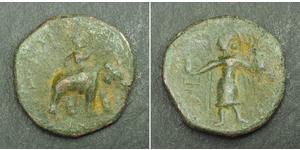
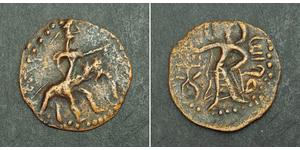
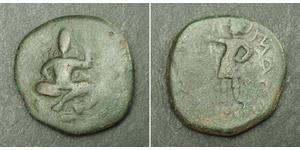
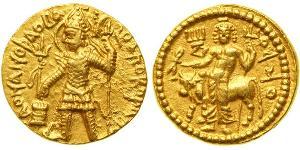
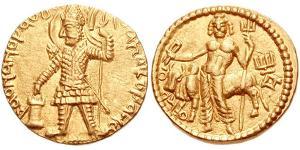
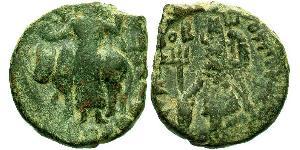
The coins minted under Vasudeva reflect his evolving spiritual identity and political strategy. He largely abandoned the traditional pantheon of deities found on issues by predecessors Kanishka and Huvishka, replacing them with Hindu motifs while continuing to circulate gold dinars from Balkh.
- The obverse typically depicts a standing king performing sacrifices over an altar, holding a trident rather than the spear seen earlier. Some designs include a nimbus or halo around his head, marking him as nimbate during this period of Hindu integration.
- Oesho, identified as the Hindu deity Shiva, appears frequently on reverses, signaling official state patronage over Shaivism during this transition period alongside Buddhist artistry that was prominent earlier in Kushan history. Copper coins also featured Jain dedications found at Mathura.
A distinct shift occurred late in his rule with the introduction of the nandipada symbol on copper denominations, serving as a marker for collectors identifying specific phases of his reign or distinguishing it from early issues.
The Numismatic Legacy
For numismatists, Vasudeva represents a fascinating intersection of cultural assimilation during the end of an era. His coinage serves as tangible evidence of the empire's shift from Pan-Indian to explicitly Hindu-centric imagery while navigating geopolitical decline against Sasanian expansion in Bactria.
Collectors value these pieces because they document the final synthesis of Greco-Bactrian, Indian, and Central Asian artistic traditions before fragmentation. The coins are generally cast in gold and copper, often showing a distinct stylistic maturity that distinguishes them from later fragmented provincial issues or posthumous tributes found in other regions.