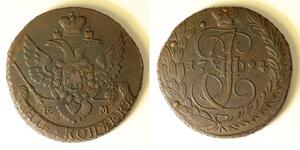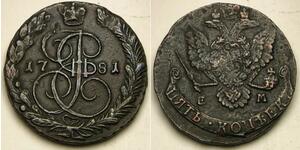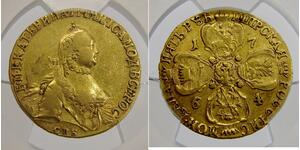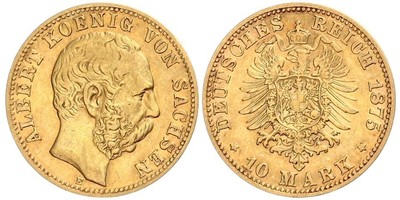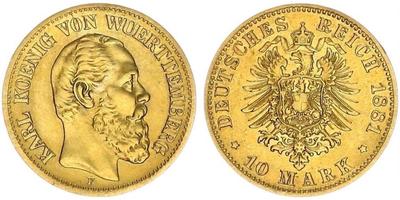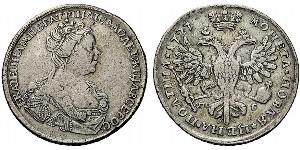
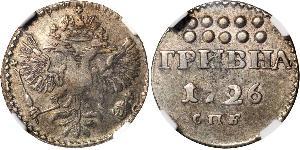
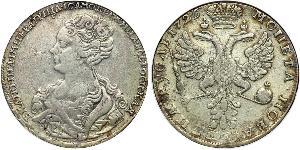
| Catherine I (1684-1727) | Link to Wikipedia |
Catherine I of Russia (1684–1727): History and Coinage
In the annals of Russian history, few figures transition as dramatically from obscurity to absolute power as Catherine I. Born Marta Helena Skowrońska in 1684, her early origins remain a subject of scholarly debate between Estonian and Latvian birthplaces. Raised largely by family connections after plague took both parents at age four, she became the wife of Peter the Great through his intervention during their first meeting in Menshikov's household.
Catherine is best known for stabilizing the Russian state following the death of her husband, who left no named successor. During a campaign against the Ottomans in 1711, she famously intervened to secure Peter’s life by proposing the use of women's jewelry as ransom from the Grand Vizier.
Histories record that upon his demise, it was not bloodline but political loyalty—specifically that offered by her faction within the guards—that secured her throne. This marked a turning point in Russian governance, favoring merit over aristocratic heritage for several decades following Peter's reforms. Her reign from 1725 until May of 1727 ended shortly due to illness.
The Numismatic Legacy
Coinage serves as the physical embodiment of imperial authority. During Catherine’s brief tenure, coins issued by Russia were critical in validating her sovereignty after Peter I's passing. While many circulating pieces retained imagery from his reign for continuity, numismatists often track how iconography slowly evolved to acknowledge a female regnant.
The image of the empress on state currency was not merely decorative; it declared that power rested legitimately with those she represented—the "New Men". Collectors are particularly drawn to coins associated with this period for several distinct reasons:
- Rarity and Transition: Coins minted immediately after Peter's death in 1725 were produced during a chaotic transition of power, making surviving examples scarce.
- Sovereignty Symbolism: These pieces represent one of the earliest instances of female regency on Russian coinage, distinguishing them from purely ceremonial consorts who lacked political authority until Catherine's accession.
Catherine’s story invites collectors to examine not just the metal and design quality, but a fleeting moment where Russia chose stability over tradition. For enthusiasts exploring early imperial history, these artifacts offer essential context regarding 18th-century statecraft. Her presence in numismatics connects the collector directly to an era when competence superseded birthright as the defining trait of leadership.