| Louis the Pious (778-840) | Link to Wikipedia |
Louis the Pious (778 – 840): Life, Legacy, and Numismatics
A Bridge Between Eras: The Historical Context
Welcome to a brief examination of one of Europe’s most significant medieval figures, Louis the Pious. As the sole son of Charlemagne who survived his father's passing in 814, Louis represented the continuity and fragility of the Carolingian Empire. He ascended not merely as king but as Emperor, inheriting a realm defined by military conquest yet challenged by internal succession crises.
Louis is historically significant for attempting to hold together an empire that was geographically vast and culturally distinct—from the borders of Italy in the south to Aquitaine in the west. His reign marked a pivotal transition from pure martial expansion under Charlemagne toward a period defined more by administrative management and spiritual piety, earning him his epithet "the Debonaire." While civil war eventually tore at the fabric of his rule during the 830s following attempts to divide power among his sons, Louis remains a crucial figure in understanding how early medieval empires were governed. He was not merely an administrator; he embodied the ideal Christian monarch—a ruler who sought justice and unity amidst growing political instability.
The Emperor on Silver: Understanding the Coinage
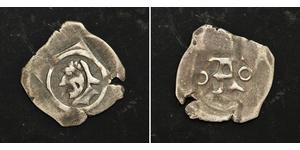
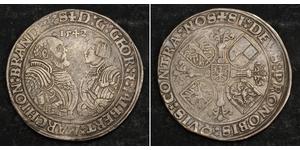
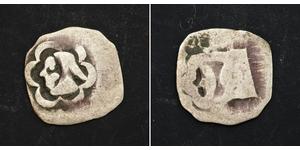
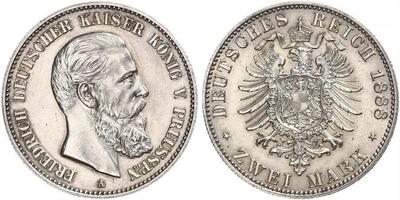
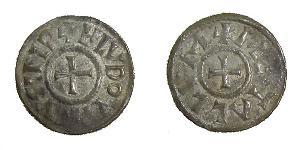
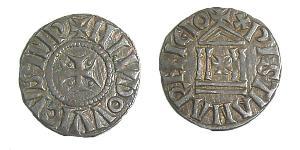
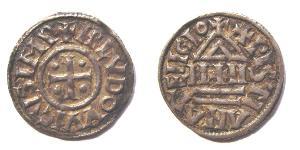
For numismatists, coins of Louis the Pious offer a fascinating glimpse into Carolingian propaganda. The Frankish court in Aachen continued his father's artistic style, often featuring portraits that closely imitated Charlemagne’s own likeness to legitimize authority across borders.
- The Portrait: Unlike earlier Roman coins which featured emperors in laurel crowns and armor of victory, Louis appears on currency with a softer demeanor. The iconography emphasized his role as "the Debonaire" (peaceable), showcasing him often crowned or wearing imperial regalia to signify stability.
- The Mints: During the 810s through 839, silver deniers were struck in major mints including Tours and Aachen. These coins circulated widely as payment for soldiers and taxes, proving Louis's authority was still felt from his heartland to its farthest marches.
- Lifetime vs. Posthumous: Most surviving examples were minted during his lifetime, though the chaotic succession of his sons eventually led to varied regional issues that complicate collecting these early medieval pieces.
The Collector's Perspective: Value and Rarity
Why do collectors seek out Louis the Pious? Primarily because he serves as a vital link between Carolingian history and numismatics. A coin from this period is often an "accessory" to studying Charlemagne, yet it stands on its own merit.
The historical importance of these coins lies in their ability to communicate power without words; a portrait on silver could assert loyalty over rebellious nobles or newly conquered territories like Barcelona. While the sheer volume of surviving examples makes high-grade specimens somewhat accessible for intermediate collectors compared to ancient issues, specific types—such as those showing more elaborate iconography than standard deniers—are highly prized.
Collecting these pieces allows you to own a tangible piece of history from when Europe was transitioning toward feudalism. They are not just metal discs; they represent the face of an empire trying to unify itself through faith and law, making them essential for any serious medieval numismatic portfolio focused on Western European expansion.