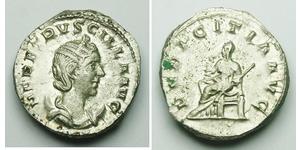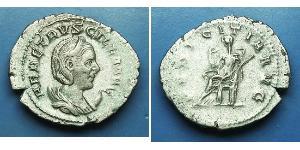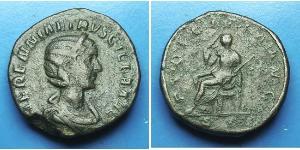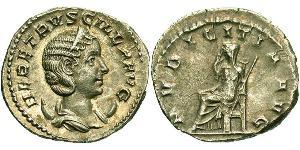
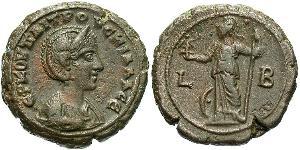
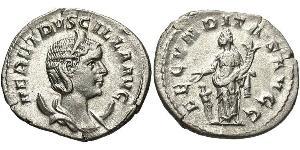
| Herennia Etruscilla (249-251) | Link to Wikipedia |
Herennia Etruscilla c. 240–253: History and Coinage
Herennia Etruscilla stands as a remarkable figure within the turbulent landscape of third-century Roman history, representing one of the few empresses with significant numismatic representation during this unstable period.
Introduction to Her Reign and Legacy
As the wife of Emperor Decius and mother to Emperors Hostilian and Herennius Etruscus, she navigated an era defined by rapid political shifts following the Battle of Abritus. While many contemporary women are obscure in historical records due to scarcity, her significance is preserved through coins struck during a succession crisis involving Trebonianus Gallus, establishing her as a crucial bridge between the reigns of Decius and his successors.
Herennia was born into the senatorial family of Herennia gens from Etruria. When Emperor Trebonianus Gallus assumed power in 251 AD following deaths at Abritus, he sought legitimacy among the populace by retaining her official title of Augusta, even though his marriage connection to Decius's family was not primary at that time. This political calculation required public symbols of continuity that money could provide effectively across vast territories.
Relationship to Coinage
The coinage reflects this complex diplomatic stance perfectly through differing legends found on currency from Rome versus Alexandria. While Roman mints simplified her name on bronze issues using only Herennia Etruscilla, specialized silver tetradrachms from Alexandria retained the Greek element Cupressenia.
Why Collectors Value These Coins
Collectors value coins featuring Empress Herennia for several specific reasons beyond their aesthetic appeal. These pieces offer a rare glimpse into how women of senatorial rank were utilized as political tools during crisis, allowing the state to maintain stability when emperors died quickly in battle or plague.
- Historical Importance: The coins depict her surviving an epidemic while retaining imperial status after hosting her sons' deaths.
- Linguistic Insight: Variation between Latin inscriptions on Roman bronze issues and Greek abbreviations for Cupressenia found on Alexandrian silver tetradrachms demonstrates the bilingual nature of currency administration within Egypt versus Rome.
- Rarity and Context: Examining them encourages a deeper appreciation for how women influenced imperial power structures during transition from one dynasty to another, offering vital historical documents rather than mere financial instruments.
These artifacts remain essential reading material not just as currency but as symbols of survival and continuity in an age of instability. Collectors exploring the ancient Roman period find Herennia Etruscilla's portrait a compelling subject for understanding how empresses functioned within dynastic politics without direct blood ties to every ruler they served.