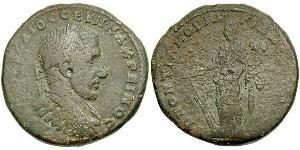
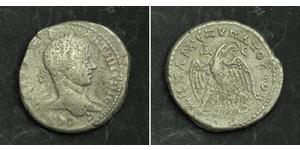
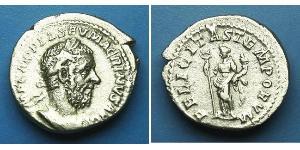
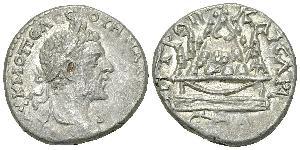
| Macrinus | |||||
|---|---|---|---|---|---|
| 24th Emperor of the Roman Empire | |||||
| Reign | 8 April 217 – 8 June 218 | ||||
| Predecessor | Caracalla | ||||
| Successor | Elagabalus | ||||
| Spouse | Nonia Celsa (?) | ||||
| Issue | Diadumenian | ||||
|
|||||
| Father | equestrian family | ||||
| Born | c. 165 Iol Caesarea |
||||
| Died | June 218 (aged 53) Cappadocia |
||||
Macrinus (Latin: Marcus Opellius Severus Macrinus Augustus;[1] ca. 165 – June 218), was Roman Emperor from 217 to 218. Macrinus' origin was Mauretanian,[2] probably of mixed extraction with Punic or Punicized elements.[3] As a member of the equestrian class he became the first emperor who did not hail from the senatorial class.
Macrinus was overthrown and executed in 218.
Contents
Background and career[edit]
Born in Caesarea (modern Cherchell, Algeria) in the Roman province of Mauretania to an equestrian family, Macrinus received an education which allowed him to ascend to the Roman political class. Over the years he earned a reputation as a skilled lawyer, and under the emperor Septimius Severus he became an important bureaucrat. Severus' successor Caracalla appointed him prefect of the Praetorian Guard.
While Macrinus probably enjoyed the trust of Caracalla, this may have changed when, according to tradition, it was prophesied that he would depose and succeed the Emperor, and rumors spread regarding his alleged desire to take the throne for himself. Given Caracalla's tendency toward murdering political opponents, Macrinus probably feared for his own safety should the Emperor become aware of this prophecy. According to Dio, Caracalla had already taken the step of reassigning members of Macrinus' staff.
In the spring of 217, Caracalla was in the eastern provinces preparing a campaign against the Parthian Empire. Macrinus was among his staff, as were other members of the Praetorian Guard. In April, the Emperor went to visit a temple of Luna near the spot of the battle of Carrhae, accompanied only by his personal bodyguard, which included Macrinus. Events are not clear, but it is certain that Caracalla was murdered at some point on the trip (perhaps on April 8).
Caracalla's body was brought back from the temple by his bodyguards, along with the corpse of a fellow bodyguard. The story as told by Macrinus was that the dead guard had killed Caracalla. By April 11, Macrinus had proclaimed himself emperor, and also nominated his son Diadumenianus Caesar and successor; he conferred upon him the name "Antoninus", thus connecting him with the relatively stable reigns of the Antonine emperors in the 2nd century.
Reign (April 217 – June 218)[edit]
Despite his equestrian background, Macrinus was confirmed in his new role by the Senate. According to S.N. Miller, this may have been due to both his background as an accomplished jurist and his deferential treatment of the senatorial class. He found it necessary, however, to replace several provincial governors with men of his own choosing. Caracalla's mother Julia Domna was initially left in peace, but when she started to conspire with the military he ordered her to leave Antioch. Being at that time in an advanced stage of breast cancer (Cassius Dio) she chose instead to starve herself to death.
In urgent matters of foreign policy, Macrinus displayed a tendency towards conciliation and a reluctance to engage in military conflict. He averted trouble in the province of Dacia by returning hostages that had been held by Caracalla, and he ended troubles in Armenia by granting that country's throne to Tiridates, whose father had also been imprisoned under Caracalla. Less easily managed was the problem of Mesopotamia, which had been invaded by the Parthians in the wake of Caracalla's demise. Meeting the Parthians in battle during the summer of 217, Macrinus achieved a costly draw near the town of Nisibis and as a result was forced to enter negotiations through which Rome was obliged to pay the enormous indemnity of 200 million sesterces to the Parthian ruler Artabanus IV in return for peace.
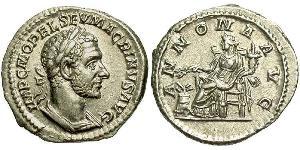
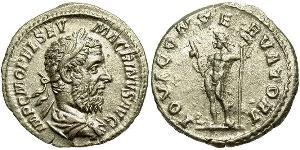
Macrinus displayed some financial farsightedness[citation needed] when he revalued the Roman currency. He increased the silver purity of the denarius from 51.5% to 58% — the actual silver weight increasing from 1.66 grams to 1.82 grams.[4]
Macrinus' reluctance to engage in warfare, and his failure to gain victory over the Parthians caused considerable resentment among the soldiers. This was compounded by him curtailing the privileges they had enjoyed under Caracalla and the introduction of a pay system by which recruits received less than veterans. After only a short while, the legions were searching for a rival emperor.
At a high point of his popularity monuments were built to honour Macrinus, including the grand tetrastyle Capitoline Temple, in Volubilis was erected in 217 AD.[5]
His popularity also suffered in Rome. Not only had the new emperor failed to visit the city after taking power but a late-summer thunderstorm caused widespread fires and flooding. Macrinus' appointee as urban prefect proved unable to repair the damage to the satisfaction of the populace and had to be replaced.
Downfall[edit]

This discontent was fostered by the surviving members of the Severan dynasty, headed by Julia Maesa (Caracalla's aunt) and her daughters Julia Soaemias and Julia Mamaea. Having been evicted from the imperial palace and ordered to return home by Macrinus, the Severan women plotted from their home near Emesa in Syria to place another Severan on the imperial throne.
They used their hereditary influence over the cult of sun-deity Elagabalus (the Latinised form of El-Gabal) to proclaim Soaemias' son Elagabalus (named for his family's patron deity) as the true successor to Caracalla. The rumor was spread, with the assistance of the Severan women, that Elagabalus was Caracalla's illegitimate son and thus the child of a union between first cousins.
Execution (218)[edit]
On May 18, Elagabalus was proclaimed emperor by the Legio III Gallica at its camp at Raphana. A force under his tutor Gannys marched on Antioch and engaged a force under Macrinus on June 8, 218. Macrinus, deserted by most of his soldiers, was soundly defeated in the battle and fled towards Italy disguised as a courier.[citation needed] He was captured near Chalcedon and later executed in Cappadocia. His son Diadumenian, sent for safety to the Parthian court, was captured at Zeugma and also murdered.[citation needed]
Macrinus' short reign, while important for its historical "firsts", was cut short due to the inability of this otherwise accomplished man to control or satisfy the soldiery.[citation needed] In his death at the hands of his own troops, Macrinus reinforces the notion of the soldiers as the true brokers of power in the third-century empire and highlighted the importance of maintaining the support of this vital faction.[citation needed] His reign was followed by another seventeen years of rule under the Severan emperors Elagabalus and Severus Alexander.
Notes[edit]
- ^ In Classical Latin, Macrinus' name would be inscribed as MARCVS OPELLIVS SEVERVS MACRINVS AVGVSTVS.
- ^ "Macrinus, by race a Moor, from Caesarea... one of his ears had been bored in accordance with the custom followed by most of the Moors", Cassius Dio, Dio's Rome (bk 79), Kessinger Publishing, 2004, v.6, p.21
- ^ Andrew G. Scott, Change and Discontinuity Within the Severan Dynasty: The Case of Macrinus, ProQuest, 2008, ISBN 9780549890416, p. 53
- ^ Tulane University "Roman Currency of the Principate"
- ^ C. Michael Hogan (2007) Volubilis, The Megalithic Portal, edited by A. Burnham
References[edit]
- Dio Cassius, bk. 79
- Herodian, 4.14–5.4
- Historia Augusta
- Miller, S.N., "The Army and the Imperial House," The Cambridge Ancient History, Volume XII: The Imperial Crisis and Recovery (A.D. 193–324), S.A. Cook et al. eds, Cambridge University Press, 1965, pp 50–2.
External links and references[edit]
 |
Wikimedia Commons has media related to Macrinus. |
- Life of Macrinus (Historia Augusta at LacusCurtius: Latin text and English translation)
- "Macrinus and Diadumenianius" at De Imperatoribus Romanis (by Michael Meckler of Ohio State University)
- Macrinus by Dio Cassius
- Livius.org: Marcus Opellius Macrinus
- Macrinus, The Columbia Encyclopedia, Sixth Edition. 2001–05
- Ross Cowan, 'The Battle of Nisibis, AD 217', Ancient Warfare 3.5 (2009), 29-35. An examination of Macrinus' generalship.
|
Macrinus
Born: 11 April 165 Died: June 218 |
||
| Regnal titles | ||
|---|---|---|
| Preceded by Caracalla |
Roman Emperor 217–218 Served alongside: Diadumenianus |
Succeeded by Elagabalus |
| Political offices | ||
| Preceded by Gaius Bruttius Praesens , Titus Messius Extricatus |
Consul of the Roman Empire 218 with Marcus Oclatinius Adventus |
Succeeded by Elagabalus, Marcus Oclatinius Adventus |
|
- 165 births
- 218 deaths
- 218 crimes
- Severan dynasty
- Opellii
- Executed Roman emperors
- 2nd-century Romans
- 3rd-century Roman emperors
- Imperial Roman consuls
- 3rd-century Berber people
- Romans from Africa
- Praetorian prefects
- People of the Roman–Persian Wars
- People from Cherchell
- 3rd-century executions
- Executed Algerian people
- People executed by the Roman Empire