
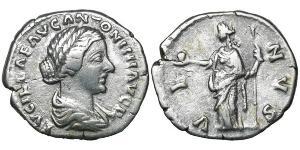

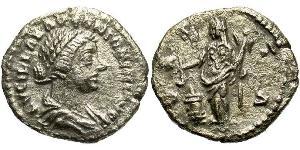
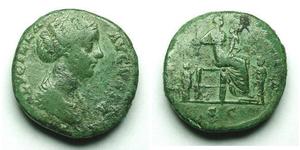
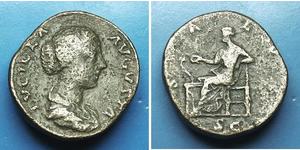
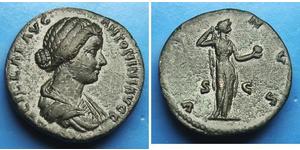
| Lucilla (148-182) | Link to Wikipedia |
Lucilla (7 March 148 or 150 – 182) History and Coinage
The Daughter of the Philosophers: A Brief Biography
In the shadow of Rome's Golden Age, few figures embody the transition from stability to chaos like Lucilla. Born into one of history's most powerful families as the daughter of Emperor Marcus Aurelius and Empress Faustina the Younger, she was a woman who straddled two distinct eras. Early life in luxury gave way to political influence when her father arranged her first marriage to his co-ruler, Lucius Verus, elevating her status from mere princess to Augusta.
Lucilla's historical significance lies not only in her aristocratic lineage but also in the tragic end of her story. Her later years were defined by a bitter rivalry with her brother Commodus and an ultimate failure that cost her life. As the niece of Emperor Antoninus Pius, she represents the pinnacle of Roman nobility before the imperial succession became increasingly unstable under Commodus' command.
The Numismatic Representation of Power
For modern collectors examining ancient currency, identifying coinage associated with Lucilla offers a unique window into how Rome depicted women of power. Unlike many male counterparts who ruled for decades and accumulated vast minting series, coins bearing her portrait were issued primarily during the reigns of Marcus Aurelius and his co-emperor husband, Verus.
These silver denarii often display Lucilla alongside Faustina or with Verus himself. While portraits of women were less common than men's in ancient Rome compared to later centuries, Lucilla’s likeness appeared regularly when her marriage placed her on the throne as an Augusta. The coinage serves a crucial educational purpose for historians and collectors: it marks the final days of traditional imperial family harmony before Commodus ascended solely to power.
The cessation of these portraits after 180 AD is historically poignant, coinciding with Marcus Aurelius' death and Lucilla's subsequent banishment. Collectors seeking coins from this period should note that no official portrait struck during the reign of her brother was ever released in circulation without his permission—a detail crucial for dating specific hoards or understanding political suppression within a coin series.
A Rare Numismatic Story
Lucilla's place in a numismatist's collection is not merely defined by market value, but by narrative rarity. Finding an ancient denarius from the late Antonine period connects you to a time when political alliances were cemented in metal and ink simultaneously.
The scarcity of these pieces makes them highly sought after for specialized collections focusing on women leaders or the fall of Marcus Aurelius' regime. By examining Lucilla's coins, enthusiasts gain access to an intimate story of high-born Roman life that is rarely told through text alone. The artistry found on these silver discs captures a moment where Rome held both peace and tragedy in equal measure.
We invite you to look beyond the faces on your cabinet table for this poignant figure whose brief, turbulent life was immortalized briefly in gold and bronze, before her story ended abruptly under the shadow of political ambition.


