
| Leopold I, Holy Roman Emperor (1640-1705) | Link to Wikipedia |
Leopold I (1640–1705): History and Coinage
A Legacy of Defense and Faith
Leopold Ignaz Joseph Balthasar Franz Felician stands as a defining sovereign of the mid-Seventeenth Century. Born in Vienna, he inherited the throne not by conquest but through lineage after his brother's death, eventually succeeding to lead an empire caught between rival powers on multiple fronts. His reign was one of endurance rather than expansion; it spanned nearly half a century and endured against relentless aggression from France in the west and the Ottoman Empire in the east.
Beyond political titles, Leopold is remembered for his profound religious nature and personal piety. He eschewed military ambition found among many contemporaries but ruled as a "warrior-king" who understood that spiritual fortitude was essential to governance during times of crisis. For historians, he represents the apex of Habsburg conservatism and loyalty—the pietas Austriaca—a concept central to understanding his era.
An educated man with a background in law, medicine, and theology rather than traditional warfare command early on, Leopold's personal life was marked by deep faith cultivated through Jesuit tutors. He famously preferred Italian over German for official correspondence at court and founded an academy of letters there. His physical appearance was often noted; he possessed the distinct Habsburg jaw but appeared somber due to a sickly constitution.
The Emperor in Metal: Context for Collectors
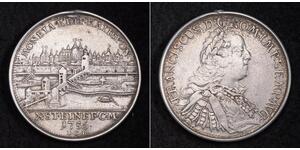
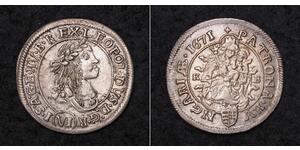
Numerous political entities issued coinage during this turbulent period. However, the most significant issues stem from the Imperial mints of Vienna and Hungary. During Leopold's life, coins served a critical function beyond currency; they were tax receipts and war funding tools. His government frequently utilized silver to pay armies for the Great Turkish War or subsidies against Louis XIV.
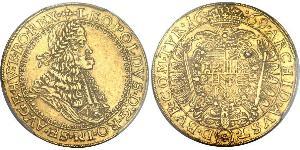
The transition in his portrait is noteworthy to numismatists. Early issues depict a handsome young heir apparent as he rose through the ranks of the clergy before assuming imperial duties. Later portraits reflect age and physical attributes typical of his dynasty—the prominent jaw—which serves as an important identifier distinguishing him from contemporaries like Louis XIV or Leopold's son Joseph I.
The use of Italian court language often influenced regional issues, while Latin scripts remained standard for silver thalers struck in Austria to stabilize economies facing inflation. These are typically adorned with crosses rather than purely secular coats of arms, mirroring his devout public persona and the "conservative" nature expected by Catholic powers.
The Historical Treasure Trove
Collectors value Leopold I's coinage for its narrative depth within a collection of major European power struggles. The rarity lies in high-grade examples that show minimal wear, particularly those minted after the Treaty of Karlowitz which marked his military victories over Turkey. They are prized by specialists because they represent specific moments where religious conviction met fiscal reality.
Focusing on these silver pieces allows a collector to engage with history without relying solely on books; handling a coin from this period is like holding a receipt for the very wars that defined Europe's borders at the turn of an era. Understanding the scarcity and distinct iconography helps one distinguish authentic Imperial issues, offering deep educational insight into how seventeenth-century monarchs used art to project power through silver.