

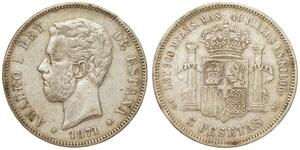
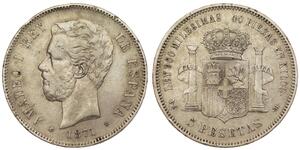
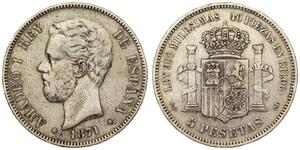
| Amadeo I of Spain (1845 - 1890) | Link to Wikipedia |
Amadeo I (1845–1890): History and Coinage
Introduction
Prince Amadeus of Savoy represents a singular chapter in the Spanish monarchy, serving as King from 1870 to 1873. Born in Turin on May 30, 1845, he was the second son of Victor Emmanuel II and served primarily known by his title, Duke of Aosta. His ascension came following the Glorious Revolution that deposed Isabella II, elected specifically because his Italian royal lineage brought a modern liberal monarchy to a fractured nation.
This reign proved pivotal as it bridged an era ending Bourbon dominance with the rise of radical republicanism and Carlist rebellions in northern regions. Despite being born into European royalty before fighting for the cause of Italy against Austria, he became King solely after Cortes Generales elected him. His tenure was brief but historically unique because no other House of Savoy member ruled as a sovereign monarch outside that branch later.
Relationship to Coinage
The political entities issuing coins during his reign were the Kingdom of Spain and briefly, local Italian mintings for Aosta. The Spanish coinage issued from 1870 depicts him on currency alongside standard denominations like the four reales and silver twenty centimos. These pieces bear portraits designed to solidify legitimacy following General Prim’s assassination in early 1871 while Amadeo traveled north.
The coins were minted during a volatile period of transition, intended to show national unity against Carlists who favored traditionalist Bourbons over an Italian king. They also represented the new liberal constitution emphasizing separation of church and state principles found within the coin designs or accompanying legal texts. However, his resignation in 1873 halted this production line abruptly when the First Spanish Republic was declared.
Why Collectors Value These Coins
Coin collectors prize these specimens for their rarity and historical context regarding constitutional monarchy failure rates during rapid regime changes. Scarcity is often due to political collapse immediately following his abdication, resulting in low mintage quantities that survived well into modern circulation.
- Rarity: Low production numbers from 1870-1873 make these coins rare compared to standard Spanish issues under Isabella II or later Alfonso XII and XIII. The abrupt end of his reign means many pieces were melted down quickly after the republic began.
- Historical Significance: These objects serve as tangible evidence during Spain's liberal crisis, specifically illustrating the instability that led from monarchy to civil unrest under republican leadership.
Savoyard connection also adds a unique layer of interest for collectors studying royal lines and how minor dynastic branches can briefly become central figures in foreign numismatics. The artwork reflects mid-19th century mint engraving quality before the rise of modern industrial mass production, preserving visual details that define this specific historical moment.


