| View |
| preceded by | ||||
|
||||
| Kushan Empire (60-375) |
| succeeded by | ||||
|
| Kushan Empire (60-375) | Link to Wikipedia |
The Kushan Empire: History, Coinage and Collectibles
Historical Background
To understand a piece of ancient coinage from this region, one must first grasp the unique civilization that created it. The land known historically as Bactria or Gandhara was once the stage for an incredible cultural experiment, often called "Pax Kushana" due to its long period of relative peace and flourishing trade. This empire did not emerge in a vacuum; rather, it represented a powerful convergence of civilizations.
The story begins centuries before Roman expansion into Europe or Han China's dominance over the East. A nomadic confederation known as the Yuezhi fled northwestern regions to settle in Bactria by 128 BC. However, their history is not merely one of migration but of transformation. They did not displace culture; they absorbed it and re-expressed it.
The early rulers began this process with a unique syncretism. Adopting Greek traditions while navigating the religious complexities of India, the kingdom evolved from a local power into an international broker. The dynasty's capital was fluid but its trade influence spanned the entire breadth of Eurasia. From Afghanistan to Uttar Pradesh in northern India, their territory sat squarely between Rome and China.
This geography turned their currency into a diplomatic tool as much as a medium for commerce. As emissaries traveled from Alexandria to Chang'an, they carried these coins across vast deserts and mountains. This trade network was the lifeblood of the economy, financing temples in Mathura or funding monumental architecture in Balkh.
Currency and Coinage History
The evolution of Kushan currency reflects a fascinating transition from Hellenistic models to Indian independence. Initially, coins struck for these territories bore legends reminiscent of Macedonian kings like Alexander the Great's successors. The portraits depicted beardless youths or draped figures in flowing robes.
Rapidly changing political needs drove reforms within decades rather than centuries. Early issues were minted by "tyrants" declaring independence from central authority, establishing local rule before forming a unified empire under Kujula Kadphises and his successors Vima Kadphises and Kanishka I. As the state solidified, coinage became a means of projecting imperial majesty.
A pivotal shift occurred during the reigns of later emperors: the script on the reverse changed from Greek legends to ancient Brahmi script in Sanskrit or Old Khotanese languages known as "Kushana." This textual switch marks one of the most significant developments in Asian monetary history, transitioning coinage from a purely commercial token into a medium for religious propaganda. The coins began featuring deities like Shiva alongside traditional Greek gods.
This numismatic evolution paralleled their diplomatic relations with distant powers. Kanishka I is particularly famous for issuing heavy gold dinars that connected the Kushan economy to the global standards of Rome and India simultaneously, proving they were a wealthy intermediary in world trade.
Mints and Coin Production
The production centers of this empire functioned much like modern satellite factories. There was no single "Kushan Mint" but rather a network established at key economic hubs such as Peshawar, Kabul, Balkh (Bactria), and Mathura in India.
Minting technologies utilized the advanced punch-engraving skills brought over by Indo-Greek craftsmen. While Indian artisans were masters of iconography—perfectly depicting gods seated on lotus thrones—the Greek influence remained visible in the portrait styles, often retaining Hellenistic facial features even as clothing changed to local drapery.
The artistic quality was remarkably high for ancient standards; many silver coins display intricate designs showing horses or standing deities with a level of detail that rivals contemporary Roman production. This indicates highly specialized guilds and significant investment in artistry, driven by the need to impress international trade partners who might otherwise view these foreign currencies as mere tokens.
Notable Coins
Focusing on three distinct issues reveals the arc of this empire's development:
- The early reigns saw coins bearing names like Koshano, which were stylistically Greek but used to assert local authority in a newly conquered area.
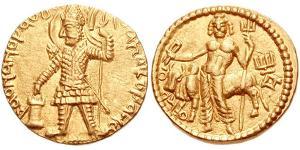
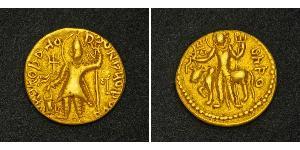
- Vima Kadphises introduced an important shift by replacing Greek deities with Hindu ones on the reverse side, reflecting the growing importance of Brahminical and Shaivite patronage among his subjects. These coins are essential for collectors studying the spread of Indian culture into Central Asia.
The most celebrated examples often hail from Kanishka I's reign. His gold dinars feature a unique combination: a portrait that retains some Greek features but is adorned in local style, while the reverse side displays Buddhist symbols or Zoroastrian fire altars alongside Roman-style inscriptions. The sheer weight of these coins—their purity and substantial mass—testifies to their value as trade bullion across the Silk Road.
- Kujula Kadphises is also important for establishing lineage claims, his silver tetradrachms often depicting him standing in a pose reminiscent of Apollo yet labeled distinctly as Indian. These are prized because they represent the unification phase where multiple Yuezhi tribes consolidated their power and began minting under one banner.
This variety allows collectors to trace the empire's expansion geographically; coins struck on the eastern edge differ in script and iconography from those in Bactria or Sogdiana, offering a map of influence rather than just political boundaries.
Cultural Legacy
The legacy of these artifacts lies in their ability to encapsulate an era when East met West. Before the Silk Road was fully explored by modern explorers like Marco Polo centuries later, Kushan coins walked that path every day carrying news between continents.
Collecting them is essentially collecting visual proof of religious diversity and artistic fusion. The iconography on a silver tetradrachm can show Shiva with trishul (trident) in one hand while the legend remains Greek; this duality was not an error, but intended to signal that their power encompassed all traditions equally.
This period laid the groundwork for Mahayana Buddhism's spread into China. The coins serve as tangible links between Indian philosophy and Chinese history, showing how a nomadic people from Central Asia became custodians of spiritual ideas that would shape Eastern thought for millennia.
For Collectors
This material remains highly significant today because it is the oldest surviving currency in India with high artistic merit. Unlike many contemporary artifacts which are fragile or poorly preserved, these coins were often buried as bullion to hoard wealth during tumultuous times and excavated centuries later.
The rarity of early issues under Kujula Kadphises makes them "key dates" for any complete collection focused on Indian numismatics. Later silver types with high relief work are also in demand, prized by connoisseurs who appreciate the intricate engraving style that blends Persian detail with Roman composition.
Awarded status as key artifacts of the ancient world alongside Greek tetradrachms or Chinese wu zhu coins, they represent a unique chapter where global history intersects. For an enthusiast seeking depth beyond mere rarity lists—those looking for stories about nomadic dynasties becoming kings and patrons of art—the Kushan collection offers unparalleled access to that legacy.
In summary, the study and appreciation of these coins reveal not just how currency worked in antiquity but how a civilization navigated its way between two worlds. They invite us to see history through the lens of trade, diplomacy, and artistic synthesis rather than mere conquest or war narratives alone.