| View |
| preceded by | |
|
|||||||
| French protectorate in Morocco (1912 - 1956) | |||||||
| succeeded by | ||||
|

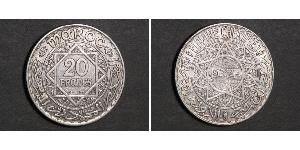
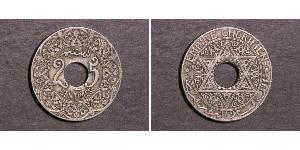
| French protectorate in Morocco (1912 - 1956) | Link to Wikipedia |
Kingdom of France-Morocco: History, Coinage and Collectibles
Welcome to a journey through the annals of French Protectorate Morocco, an era that stands as a bridge between ancient Mediterranean traditions and modern colonial geopolitics. As we step into this gallery today, you will not merely be observing historical events; rather, you are examining how economic power was physically encoded in metal and paper during one of North Africa's most transformative periods.
Historical Background
The story begins over a century ago when the delicate balance of global empires shifted their gaze toward Morocco. The 'Alawi dynasty had long resisted foreign dominance, maintaining independence amidst shifting sands while other nations succumbed to British or French rule. However, by 1904 and following diplomatic maneuvering between Britain and France (and Spain), European economic interests grew too powerful for the Sultanate's traditional autonomy.
The narrative takes a sharper turn with the "Protectorates" established in 1912 through the Treaty of Fez. This treaty was not merely a document; it was an economic restructuring of the land. The French administration, led by Hubert Lyautey, aimed to prevent rapid cultural assimilation but nonetheless modernized infrastructure—railways, ports like Casablanca and Tangier—which became critical arteries for global commerce.
This era also coincided with Morocco's rise as a supplier of strategic minerals like phosphates. Before the Protectorate dissolved in 1956 under the Franco-Moroccan Joint Declaration, this was an economy heavily integrated into France’s industrial machine. It is within this context—the tension between preserving tradition and facilitating exploitation—that collectors find profound interest.
Currency and Coinage History
The evolution of money in Morocco during the Protectorate mirrors the complex relationship between colonizer and local ruler. Initially, various indigenous currencies circulated alongside imported coinage from France and Spain. However, as French influence solidified, a standardized currency became necessary to manage trade.
Morocco's monetary system evolved through a phase of dual management. Before independence was restored in 1956, the economy relied heavily on imports of gold bullion and silver coinage minted at Parisian mints for use within Morocco itself. Unlike colonies where completely new currencies were printed de novo (like French West Africa), Protectorate Morocco saw an effort to maintain local economic identity while adopting Western standards.
The currency was pegged, often using the gold standard that France utilized during this era. However, post-World War II inflation and shifting geopolitical realities led towards paper money dominance by 1956, rendering silver coinage of the Protectorate period rare among collectors today as it shifted into a transitional phase where coins served largely ceremonial or hoarding purposes rather than daily commerce.
Mints and Coin Production
The production centers for these historical pieces were centralized in Europe. During this era, most coinage circulating within the Protectorate was struck at facilities like Tourneville (in France) rather than locally minted on soil under French supervision. This reflects a common colonial practice where precious metal reserves—often drawn from colonies themselves or imported bullion shipments to Morocco banks such as the Bank of Algeria and its equivalent in Morocco—were sent back for minting.
The artistic characteristics were strictly regulated by imperial decree, avoiding local imagery that could be deemed provocative. Instead, designs adhered to classical French iconography: profiles of monarchs or allegorical figures representing Liberty and Justice (Marianne). However, the die preparation was handled with high precision intended for a diverse audience in North Africa.
Notable Coins
- The Silver 5 Franc Piece:
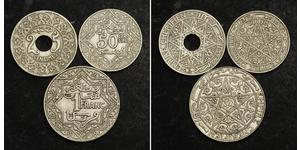
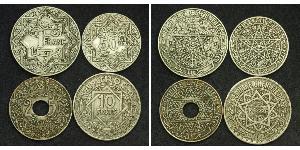
This silver piece is perhaps the most recognizable artifact of this era. The historical context dates these issues primarily to pre-1940s, though later variants appeared after WWII. Design features include elegant laurel wreaths and classical portraits authorized by French state decrees. For collectors, their importance lies in mintage figures; often issued only a few million times globally before the war disrupted global metal markets.
- The Gold 20 Francs Issue:
A rarer collector's item found mostly in hoards or high-condition specimens. These were used for international trade and diplomatic payments within North Africa, reflecting the wealth of phosphate mining contracts that began to blossom towards this period.
- The Copper 20 Centimes:
This base-metal coin is significant because it was issued in such large quantities for local wages and small market transactions. While less valuable, its historical significance represents the labor of the colonial workforce—often overlooked but crucial to daily life.
Cultural Legacy
The legacy found in these coins is one of duality. They represent an attempt by France to project a classical Roman aesthetic onto North African soil, while simultaneously serving as functional tools for economic extraction. The symbols on these pieces reflect the values of the state: order, permanence, and power.
Influence extended beyond mere aesthetics; even after independence was gained in 1956 and Morocco moved toward its own currency (the Dirham), there remained a numismatic memory of French influence that persisted well into the post-independence era. Collectors today appreciate these coins not just for their rarity, but as tangible records of an empire's complex relationship with indigenous governance.
The economic stability provided by France during this period meant that Moroccan trade flowed smoothly through French networks, using coinage guaranteed by a superpower economy rather than local resources alone. This reliance on European standards is visible in every piece: the sharp edges, high relief designs of minted silver pieces intended for circulation.
For collectors
Tangible remnants remain accessible to those with an eye for history and condition. These coins are valuable not just as bullion items but as numismatic artifacts representing a specific historical moment: the twilight of European colonialism in North Africa, where trade routes from the Atlantic were managed by Parisian administrators.
The value to collectors lies in their story—each silver coin represents an era of global commerce spanning Morocco and France. For auction buyers or enthusiasts seeking education on economic history, these pieces serve as gateways into understanding how monetary policy was used to stabilize a region while imposing foreign political will over local sovereignty. They remain essential reading for the serious collector interested in mid-20th century colonial economics.