| View |
| preceded by | |
|
|||||||||
| Free City of Lübeck | |||||||||


| succeeded by |
| Free City of Lübeck | Link to Wikipedia |
The Free and Hanseatic City of Lübeck: History, Coinage and Collectibles
Historical Background
In the annals of medieval European history, few stories rival the saga of a city-state as vibrant as Lübeck. Founded in 1226 by Emperor Frederick II to serve as an Imperial Free City, this Hanseatic powerhouse rose alongside its neighbor Hamburg but distinguished itself through maritime dominance and legal independence known as Lübeck law. For seven centuries, until it ceased statehood in the modern era of Nazi Germany, Lübeck functioned autonomously within a complex political landscape that spanned from Scandinavia to Central Europe.
The city’s identity was forged not merely by walls but through commerce. It became widely known as the Queen of the Hanseatic League after rising to prominence during the 14th century. This status relied on strategic territorial acquisitions, such as the purchase of Mölln in 1359 and the Lordship of Bergedorf later that same decade. These lands secured Lübeck's control over critical trade routes for salt from Scandinavia, a commodity highly prized across Europe. The city maintained armed guards to protect these corridors against robbery and rival dukes. However, political independence was fragile; wars with Denmark in 1435 and the internal strife of Germany’s Count’s Feud tested its sovereignty repeatedly.
Lübeck weathered major geopolitical storms well into the modern era. It remained neutral during the Thirty Years' War but suffered economically as trade shifted to the Atlantic following maritime discoveries elsewhere in Europe. Under Napoleon, Lübeck surrendered neutrality in 1806 and was formally annexed by France between 1811 and 1813. This French occupation introduced Continental System economic structures that stifled local production for a brief period before independence returned.
Currency and Coinage History
The evolution of money in Lübeck mirrors its political sovereignty, shifting from autonomous silver standards to integrated imperial currency systems. When the city became part of the First French Empire as a department named Bouches-de-l'Elbe, it utilized French coinage during that brief occupation era.
After reassuming independence following Napoleon’s defeat in 1813 and being reconfirmed by Congress Vienna, Lübeck sought to stabilize its economy. As an independent state within the German Confederation established after the Napoleonic Wars, it eventually joined the North German Confederation in 1867. By this time, many autonomous coinages had merged into a more uniform standard.
The most significant transition occurred following Lübeck’s entry into the newly founded German Empire in 1871 and later during the Weimar Republic era. While technically an autonomous state until 1933, economic integration meant that local silver issues were increasingly rare as paper money gained prominence with international banking standards.
The final decades brought political coordination by Nazi Germany after 1933. As part of a broader centralization effort called Gleichschaltung in April 1934, Lübeck effectively lost its sovereignty to the Reich government. This era marked the end of any distinct state monetary issues for Lübeck as it transitioned into standard German Imperial and Republic currency.
Mints and Coin Production
The production history of coinage in this region was influenced heavily by geography and proximity to Hamburg, which shared a condominium over territories that bordered Lübeck. In 1867, the city sold its share in Bergedorf—formerly held jointly with Lübeck—to Hamburg.
Minting traditions here were distinct but eventually harmonized under federal law. Earlier medieval mints operated independently based on local weights and silver quality standards typical of northern German Hanseatic cities, often utilizing specific designs reflecting the ruling authority’s heraldry or trade guilds.
Later production relied heavily on technological advancements shared across Prussian territories before becoming centralized in national mints like Hamburg, Munich, or Berlin. The artistic characteristics shifted from intricate medieval profiles and complex patterns to cleaner neoclassical lines common throughout Germany by the 19th century as designs sought international recognition.
Notable Coins
To understand what collectors value most about this territory, one must look at coins that represent specific moments of political or economic autonomy. The first notable category lies in the medieval and early modern silver pieces associated with the Hanseatic League. These often bore local seals of city authority.
- The Medieval Silver Standards: Before 1806, Lübeck issued coins that were essential to regional trade networks spanning the Baltic Sea. While many were struck in bulk for commerce rather than treasury reserve purposes, surviving examples depict coats-of-arms and heraldic lions common across the Hanseatic League.
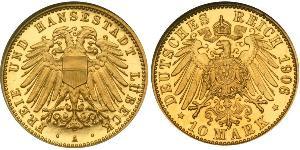
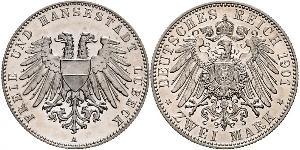
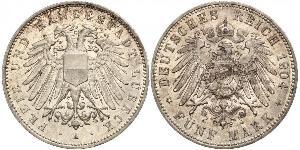
- The North German Confederation Marks: After joining this confederation following 1867, silver coins with the Mark denominations became widespread. These serve as transition pieces showing Lübeck’s economic integration into a unified German economy just before full imperial unification in 1871.
- The Pre-War Reichsmarks: In the late 1920s and early 1930s, standard gold and silver issues carried regional mint marks. Collectors often seek pieces struck during this period as they represent a final chapter of statehood before Nazi centralization erased local distinctions.
Cultural Legacy
The coinage from these lands tells the story more about economic ambition than mere monetary policy. During its independent era, coins reflected Lübeck’s self-image: an intellectual hub where figures like Thomas Mann were born and later wrote his Nobel-winning literature on cultural life in the north.
Coin designs also honored historical events such as treaties with Hamburg or victories against Denmark that expanded territorial holdings before trade routes changed. The imagery shifted from local rulers who signed feudal agreements to national symbols once political independence waned under imperial pressure, illustrating how visual art tracks state identity transformation.
For Collectors
Lübeck remains a significant entity for numismatists interested in the history of German states that enjoyed sovereign status prior to 1937. Unlike larger regional entities like Prussia or Bavaria, Lübeck’s coinage is scarcer and more specialized.
- The End of Independence: Coins from before 1860 represent the period when this was a true independent power state within Europe rather than just another German province. Finding pieces with distinct local mint marks prior to national unification offers tangible proof of historical autonomy.
- Rarity and Context: Because much of the territory merged into Schleswig-Holstein after 1937, specific regional issues from this era are rare on modern markets where only unified German currency survives. The narrative of a city-state dissolving due to political pressures provides unique educational opportunities.
- Investment Potential: As interest in medieval and early modern silver grows among enthusiasts looking for authentic artifacts reflecting global trade networks, Lübeck’s historical connection ensures these pieces maintain relevance beyond their monetary value. They serve as portable records of a time when small cities held power over vast maritime regions.