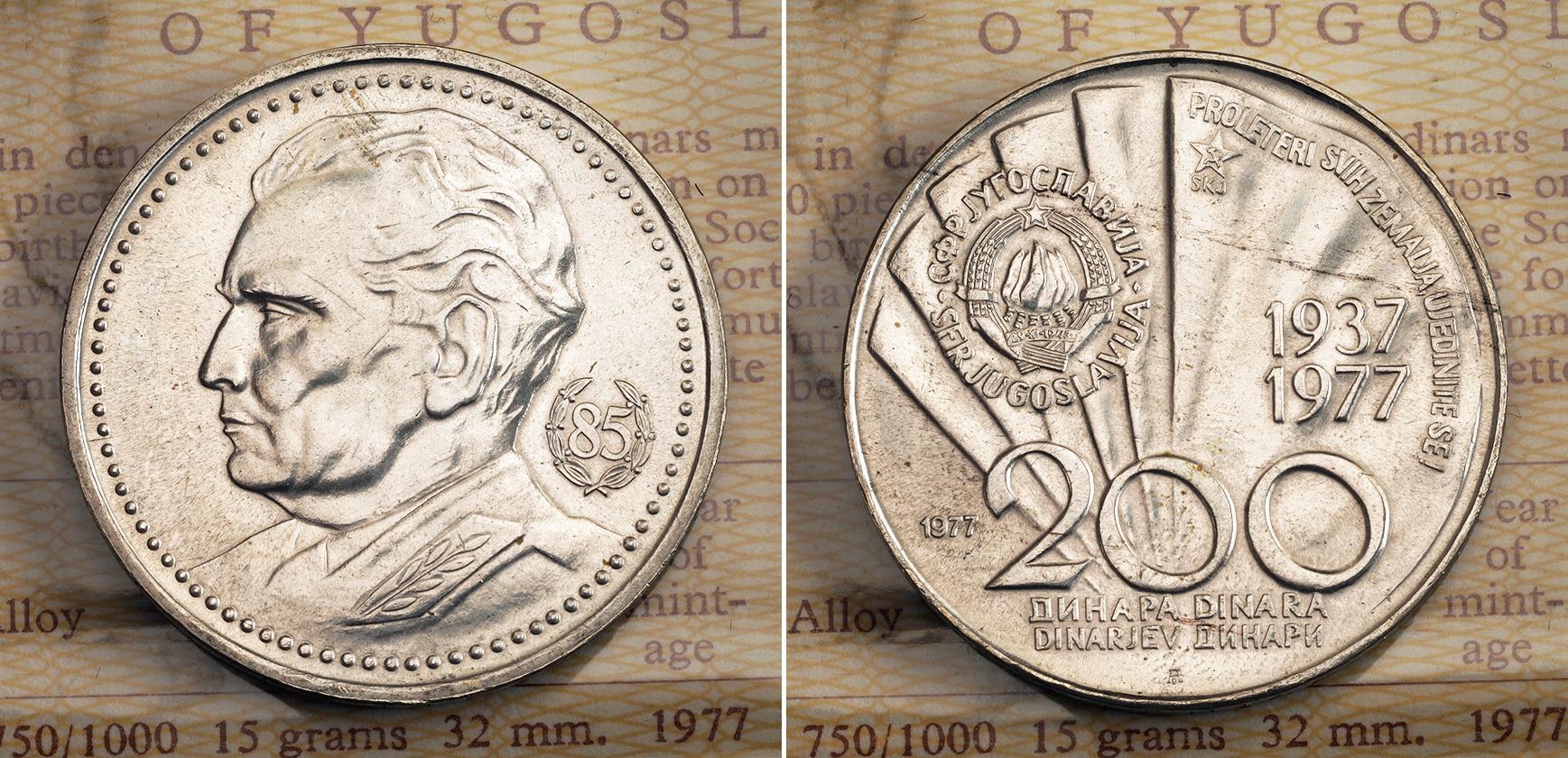
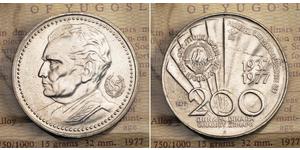
200 Dinar Socialist Federal Republic of Yugoslavia (1943 -1992) S ...
-gD3qEmSPJBIAAAF9IUG4blCN.jpg "200 Dinar Socialist Federal Republic of Yugoslavia (1943 -1992) Silver")
1977, Yugoslavia (Socialist Republic). Silver 200 Dinara Coin
Mint Year: 1977 Reference: KM-64. Denomination: 200 Dinara - 75th Birthday of Josip Broz Tito. Material: Silver (.750) Diameter: 32mm Weight: 15gm
The Socialist Republic of Serbia (Serbo-Croatian: Социјалистичка Република Србија / Socijalistička Republika Srbija) was one of the six constitute republics of the Socialist Federal Republic of Yugoslavia. It was the largest republic in terms of population and territory. Its capital, Belgrade, was also the federal capital of Yugoslavia.
Josip Broz (Јосип Броз, 7 May 1892 – 4 May 1980), commonly known as Tito (Тито), was a Yugoslav communist revolutionary and statesman, serving in various roles from 1943 until his death in 1980. During World War II, he was the leader of the Partisans, often regarded as the most effective resistance movement in occupied Europe. He also served as the president of the Socialist Federal Republic of Yugoslavia from 14 January 1953 until his death on 4 May 1980.
Broz was born to a Croat father and Slovene mother in the village of Kumrovec, Austria-Hungary (now in Croatia). Drafted into military service, he distinguished himself, becoming the youngest sergeant major in the Austro-Hungarian Army of that time. After being seriously wounded and captured by the Russians during World War I, he was sent to a work camp in the Ural Mountains. He participated in some events of the Russian Revolution in 1917 and the subsequent Civil War. Upon his return to the Balkans in 1918, Broz entered the newly established Kingdom of Yugoslavia, where he joined the Communist Party of Yugoslavia (KPJ). He later was elected as general secretary, later president, of the League of Communists of Yugoslavia (1939–1980). During World War II, after the Nazi invasion of the area, he led the Yugoslav guerrilla movement, the Partisans (1941–1945).5 By the end of the war, the Partisans – with the backing of the invading Soviet Union – took power over Yugoslavia.
After the war, he was the chief architect of the Socialist Federal Republic of Yugoslavia (SFRY), serving as both prime minister (1944–1963), president (later President for life) (1953–1980), and marshal of Yugoslavia, the highest rank of the Yugoslav People’s Army (JNA). Despite being one of the founders of Cominform, he became the first Cominform member to defy Soviet hegemony in 1948. He was the only leader in Joseph Stalin’s time to leave Cominform and begin with his country’s own socialist program, which contained elements of market socialism. Economists active in the former Yugoslavia, including Czech-born Jaroslav Vanek and Yugoslav-born Branko Horvat, promoted a model of market socialism that was dubbed the Illyrian model. Firms were socially owned by their employees and structured on workers' self-management; they competed in open and free markets. Tito managed to keep ethnic tensions under control by delegating as much power as possible to each republic. The 1974 Yugoslav Constitution defined SFR Yugoslavia as a “federal republic of equal nations and nationalities, freely united on the principle of brotherhood and unity in achieving specific and common interest.” Each republic was also given the right to self-determination and secession if done through legal channels. Lastly, Tito gave Kosovo and Vojvodina, the two constituent provinces of Serbia, substantially increased autonomy, including de facto veto power in the Serbian parliament. Tito built a very powerful cult of personality around himself, which was maintained by the League of Communists of Yugoslavia after his death. Twelve years after his death, as communism collapsed in Eastern Europe, Yugoslavia dissolved and descended into a series of interethnic wars.
Although some historians criticize his presidency as authoritarian, others see Tito as a benevolent dictator. He was a popular public figure both in Yugoslavia and abroad. Viewed as a unifying symbol, his internal policies maintained the peaceful coexistence of the nations of the Yugoslav federation. He gained further international attention as the chief leader of the Non-Aligned Movement, alongside Jawaharlal Nehru of India, Gamal Abdel Nasser of Egypt, and Kwame Nkrumah of Ghana. With a highly favourable reputation abroad in both Cold War blocs, he received some 98 foreign decorations, including the Legion of Honour and the Order of the Bath.
-300-150-gD3qEmSPJBIAAAF9IUG4blCN.jpg "200 Dinar Socialist Federal Republic of Yugoslavia (1943 -1992) Silver")
(1737 X 840 pixels, file size: ~323K)
Posted by: anonymous 2021-11-24
1977, Yugoslavia (Socialist Republic). Silver 200 Dinara Coin w. COA & Pouch! Mint Year: 1977 Reference: KM-64. Condition: Uncirculated with mint certificate and pouch! Denomination: 200 Dinara - 75th Birthday of Josip Broz Tito. Material: Silver (.750) Diameter: 32mm Weight: 1 ...
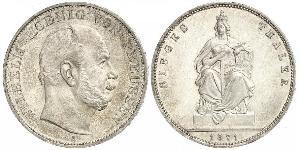
-300-150-DpzBwcI0um8AAAEm2kkdQQpe.jpg "10 Franc French Fifth Republic (1958 - ) Brass")
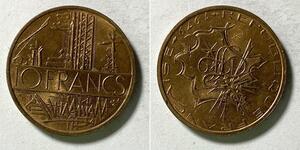
10 Franc French Fifth Republic (1958 - ) Brass
group has 8 coins / 6 prices
⇑
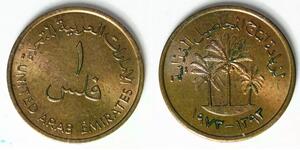
-300-150-URLBwcI0sC0AAAEqydhDRaZ5.jpg "1 Fils United Arab Emirates (1971 - ) Bronze")
1 Fils United Arab Emirates (1971 - ) Bronze
group has 3 coins / 3 prices
⇑