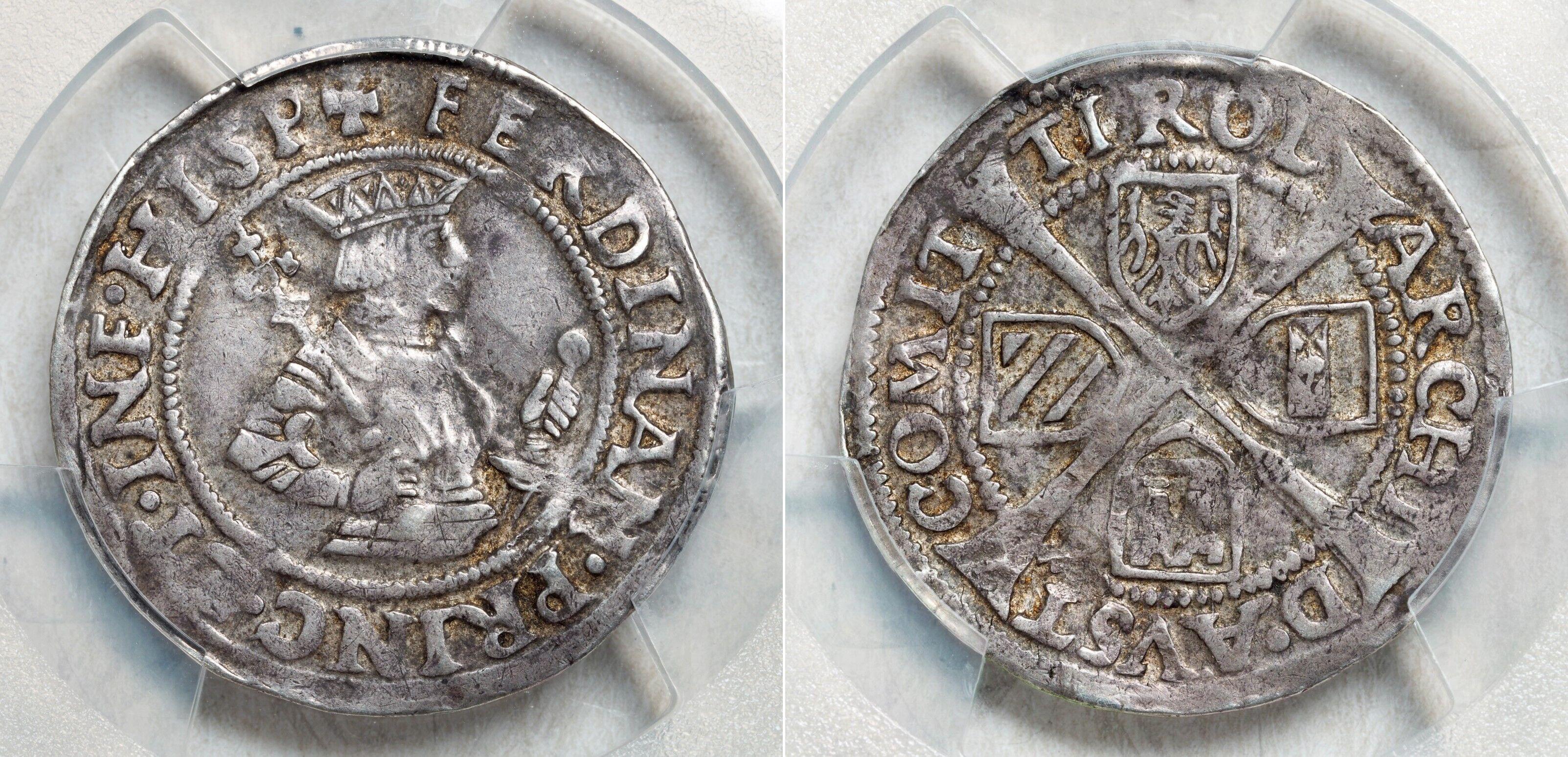
6 Kreuzer Austria Silver Ferdinand I, Holy Roman Emperor(1503-1564)
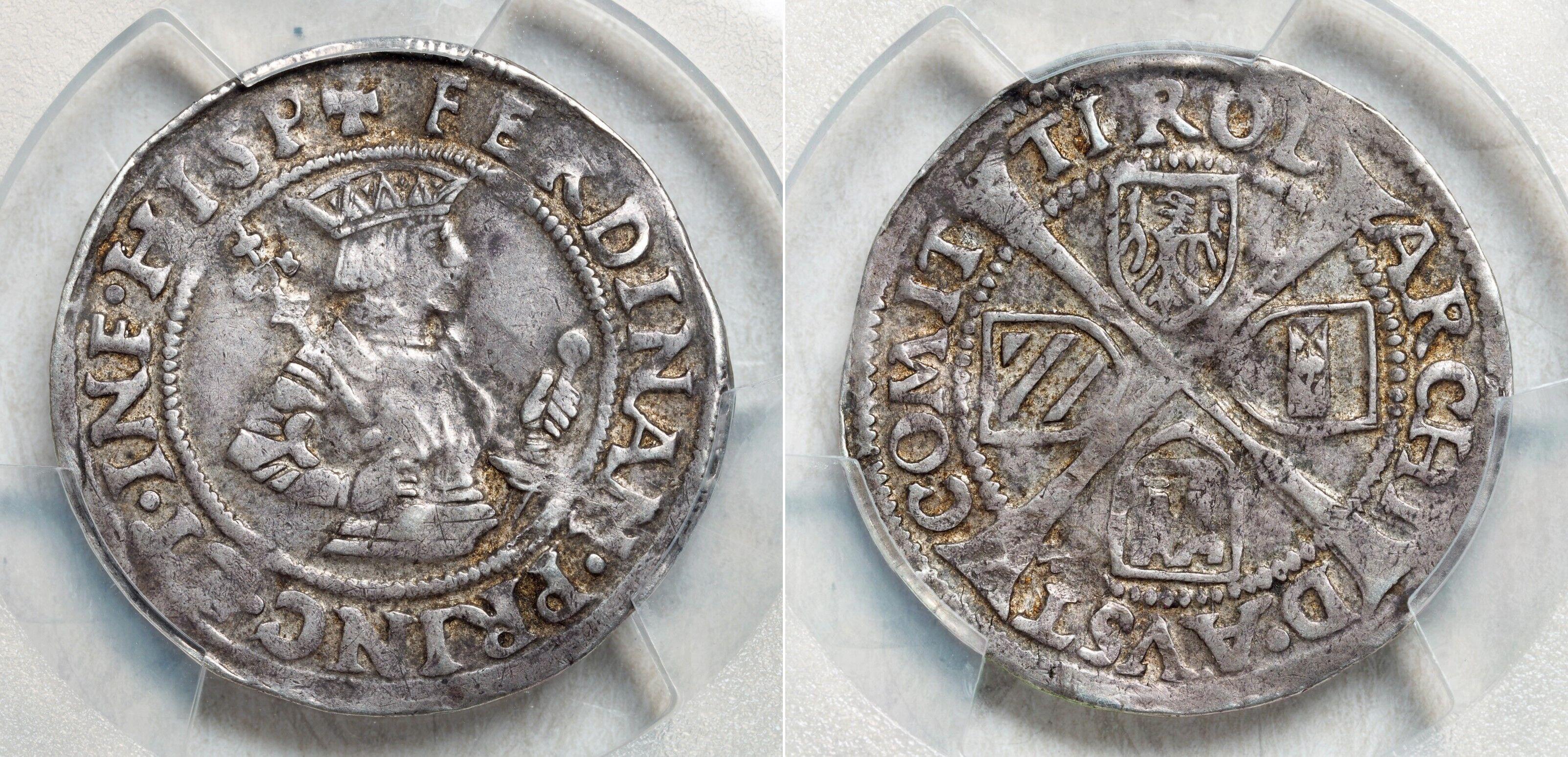
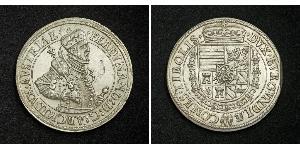
1564, Emperor Ferdinand I. Silver 6 Kreuzer (Sechser) Coin
Mint Place: Hall (Tyrol)
Mint Period: 1521-1564
Reference: Moser/Tursky 89.
Denomination: 6 Kreuzer ("Sechser")
Weight: ca. 2.9gm
Diameter: 23mm
Material: Silver
Obverse: Crowned and armoured half length figure of Ferdinand I right, holding scepter and double-handed sword.
Legend: + FERDINAN . PRINCE . ET . INF . HISP
Reverse: Large cross splitting legend. Four shields (Tyrol (eagle), Austria (stripe), Spain (Castle), Burgundy (diagonal stripes).
Comment: The spanish arms shows the re-established connection to Spain, where the Habsburg Emperor was raised!
Legend: ARHI D . AVST COMES TIROL
Ferdinand I, Holy Roman Emperor (10 March 1503-25 July 1564) was a Central European monarch from the House of Habsburg. His titles from birth were Archduke of Austria, from his father, and Infante of Castile, León, Aragon and Navarre from his mother.
He ruled the Austrian hereditary lands of the Habsburgs most of his public life, at the behest of his elder brother, Charles V, Holy Roman Emperor and King of Spain. Ferdinand was Archduke of Austria from 1521-1564. After the death of his brother-in-law Louis II, Ferdinand ruled as King of Bohemia and Hungary – Croatia (1526-1564). When Charles retired in 1556, Ferdinand became his successor as Holy Roman Emperor, while Spain, the Spanish Empire, Naples, Sicily, Milan, the Netherlands, and Franche-Comté went to Philip, son of Charles.
Ferdinand’s motto was Fiat justitia et pereat mundus (“Let justice be done, though the world perish”).
Ferdinand was born on 10 March 1503 in Alcala de Henares, 40 km from Madrid, the son of the Infanta Joanna of Castile (1479-1555), the future Queen of Castile known as Joanna the Mad, and Habsburg Archduke Philip the Handsome (1478-1506), Duke of Burgundy and future King of Castile, who was heir to Emperor Maximilian I. Ferdinand shared his birthday with his maternal grandfather Ferdinand II the Catholic, King of Aragon.
Charles entrusted Ferdinand with the government of the Austrian hereditary lands, roughly modern-day Austria and Slovenia. Ferdinand also served as his brother’s deputy in the Holy Roman Empire during his brother’s many absences and in 1531 was elected King of the Romans, making him Charles’s designated heir in the Empire. Charles abdicated in 1556 and Ferdinand succeeded him, assuming the title of Emperor elect in 1558.
After Sultan Suleiman the Magnificent defeated Ferdinand’s brother-in-law Louis II, King of Bohemia and of Hungary – Croatia, at the battle of Mohacs on 29 August 1526, Ferdinand was elected King of Bohemia in his place. Nicolaus Olahus, secretary of Louis, attached himself to the party of King Ferdinand, but retained his position with the queen-dowager Mary of Habsburg. The throne of Hungary became the subject of a dynastic dispute between Ferdinand and John Zapolya, voivode of Transylvania. Each was supported by different factions of the nobility in the Hungarian kingdom; Ferdinand also had the support of Charles V. After defeat by Ferdinand at the Battle of Tokaj in 1527, Zapolya gained the support of Suleiman. Ferdinand was able to win control only of western Hungary because Zapolya clung to the east and the Ottomans to the conquered south. Zapolya’s widow, Isabella Jagiello, ceded Royal Hungary and Transylvania to Ferdinand in the Treaty of Weissenburg of 1551. In 1554 Ogier Ghiselin de Busbecq was sent to Istanbul by Ferdinand to discuss a border treaty over disputed land with Suleiman.
The most dangerous moment of Ferdinand’s career came in 1529 when he took refuge in Bohemia from a massive but ultimately unsuccessful assault on his capital by Suleiman and the Ottoman armies at the Siege of Vienna. A further Ottoman attack on Vienna was repelled in 1533. In that year Ferdinand signed a peace treaty with the Ottoman Empire, splitting the Kingdom of Hungary into a Habsburg sector in the west and John Zapolya’s domain in the east, the latter effectively a vassal state of the Ottoman Empire.
In 1538, by the Treaty of Nagyvarad, Ferdinand became Zapolya’s successor. He was unable to enforce this agreement during his lifetime because John II Sigismund Zapolya, infant son of John Zapolya and Isabella Jagiello, was elected King of Hungary in 1540. Zapolya was initially supported by King Sigismund of Poland, his mother’s father, but in 1543 a treaty was signed between the Habsburgs and the Polish ruler as a result of which Poland became neutral in the conflict. Prince Sigismund Augustus married Elisabeth of Austria, Ferdinand’s daughter.
(3205 X 1547 pixels, file size: ~1M)
Posted by: anonymous 2023-11-08
Untitled Document 1564, Emperor Ferdinand I. Silver 6 Kreuzer (Sechser) Coin. Pop 3/1! PCGS AU-50! Mint Place: Hall (Tyrol) Mint Period: 1521-1564 Reference: Moser/Tursky 89. Denomination: 6 Kreuzer ("Sechser") Condition: Certified and graded by PCGS as AU-50! - Populatio ...
-300-150-0PjBwcI0hLEAAAEqWwxDRaYC.jpg "10 Zloty People")
10 Zloty People's Republic of Poland (1952-1990) Copper/Nickel
group has 2 coins / 1 prices
⇑