| View |
| preceded by | |
|
|||||||||
| Duchy of Brunswick (1815 - 1918) | |||||||||


| succeeded by |
| Duchy of Brunswick (1815 - 1918) | Link to Wikipedia |
Brunswick-Wolfenbüttel: A Legacy in Metal and Stone
Historical Background
The political narrative of the Duchy of Brunswick is one defined by a unique struggle for identity within a shifting German landscape. Originating from the fragmented holdings of the House of Welf, known locally as Guelphs or Guelfen in England and Europe, this state stood as a testament to medieval feudal evolution transitioning into modern sovereignty. The pivotal moment arrived at the Congress of Vienna in 1815. Here, amidst the dust of the Napoleonic Wars, Brunswick-Wolfenbüttel was recognized as an independent Duchy within the German Confederation. This consolidation brought together territories that had previously been divided among various Welf branches.
The early years were defined by a delicate balancing act between local autonomy and imperial pressure. Under the governance of Charles II (1815–1830), who was initially an infant under British tutelage, the state faced internal unrest following economic hardship and liberal demands for reform. The ducal palace in Braunschweig became a symbol of traditional authority that could no longer withstand popular sentiment during the September 1830 revolutionaries storming the gates.
The succession brought William VIII to power (1830–1884), who steered Brunswick through its final decades as a sovereign entity. Despite joining Prussian-led alliances, such as the North German Confederation in 1866 and later entering the German Empire itself, the Duchy maintained specific internal laws that distinguished it from the centralizing forces of Berlin. The narrative concludes tragically with the abdication of Ernest Augustus during the revolutionary wave of 1918 and the subsequent dissolution into the Free State of Brunswick within Weimar Germany.
Currency and Coinage History
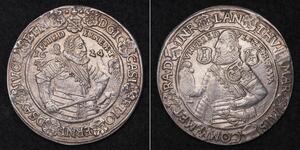
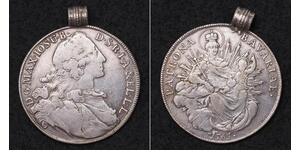
The evolution of money in this region mirrors its political trajectory. In its earlier, more feudal stages before full unification under Vienna, currency was often a patchwork of silver thalers minted at various local castles or fortresses across the former Welf lands. The standardization began earnestly only after 1815.
Coinage served not just as commerce but as political propaganda. For centuries before modern paper money, metal currency displayed the "House Lion"—the symbol of the Welf dynasty—in high relief against castles or religious iconography. As Brunswick integrated into larger German entities like the North German Confederation in 1867, the local silver coinage began to face a crisis: it ceased its role as primary medium of exchange for commerce and was increasingly replaced by standardized federal coins.
This numismatic devaluation occurred largely because sovereign states often lost their ability to mint high-quality silver at will due to international pressure or lack of precious metals, forcing the use of paper money known locally. However, early 19th-century issues remain significant as they represent the final attempts by a specific ruling house to control its own monetary destiny before becoming subject to federal currency reform.
Mints and Coin Production
The minting operations were centered primarily in Brunswick itself (Braunschweig). During the 19th century, this facility served as one of several production centers within the German Empire. Unlike modern automated presses of later eras, early-to-mid-19th-century coins exhibited hand-strike nuances or transitional mechanisms.
The artistic characteristics were distinctively Welfian yet gradually adopting imperial styles to signal acceptance into Germany proper. The mints utilized traditional engraving techniques that prioritized the bold depiction of the coat-of-arms: a lion rampant within a shield, often bearing specific marks indicating the mint location and date.
- The Silver Thaler:
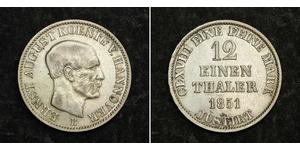
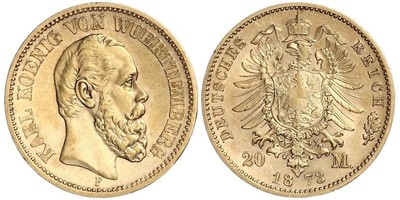
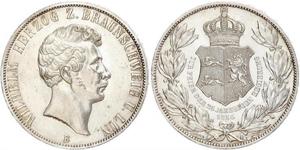
This remained the primary large denomination. High-quality silver was scarce by mid-century, meaning surviving high-grade examples are highly sought after for their preservation of artistic detail on both obverse (portrait) and reverse (eagle or shield).
- The Copper Half-Pennies:
Affordable daily currency made from base metals, these often bore the date to track production runs. While less visually striking than silver issues due to low melting costs, they provide a crucial link in understanding local market activity and inflation during industrialization.
Notable Coins
The 1815 Unification Thaler:
Minted immediately following the Congress of Vienna, this coin is historically significant as it bears the combined symbols often associated with Wolfenbüttel rather than fragmented territories. For collectors, identifying the specific heraldic shield here is key to understanding how the state officially defined itself legally and culturally.
The Regency Period Issues:
During the regencies appointed after 1874 (when William VIII died), coins continued production under temporary guardianship until Ernest Augustus took control. Notable for their often lower artistic refinement due to economic necessity or political transition, these are rarer than standard reign issues.
The Last Duke's Coins:
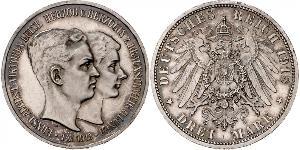
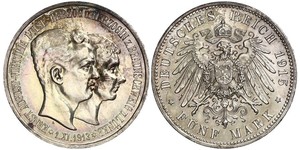
Earned through the marriage of his son Ernst August to Princess Sophia (daughter of Kaiser Wilhelm II), coins minted near 1908 bear a portrait that reflects strong Prussian imperial influence. These are distinguished by their milled edges and adherence to federal German standards, marking the end of Brunswick's unique numismatic era.
Cultural Legacy
Brunswick is not merely historical geography; it represents the intersection of English history (through Welf ancestry in Hanover) and deep European roots. The House Lion itself evolved over centuries from heraldic beasts into state symbols used on coins, banknotes, and uniforms.
The coinage tells a story of resilience—a small German duchy that managed to maintain sovereignty while adapting its currency systems for global trade. As the political landscape shifted away from individual ducal authority toward centralization in Berlin during the 1860s and beyond, these metal artifacts became increasingly valuable as historical markers.
The artistry found on early silver issues captures a time when local states still had control over their own artistic expression. In contrast, later copper pieces reflect industrial mass production that standardized German coinage for decades before the Weimar Republic completely shifted away from gold and high-value metal backing in favor of paper currency.
For Collectors
The historical significance remains vital to numismatists seeking a deeper understanding of 19th-century statecraft. While rare silver issues were heavily taxed or confiscated by imperial governments (Prussia), finding examples with minimal wear offers a window into the economy before WWI.
For those entering this niche, focus should be placed on:
- The House Shield Variations: Collectors can study how subtle changes in heraldry (wolfenbüttel vs hanover influence) appear on reverse designs.
This region offers a compact narrative of German history from the Congress of Vienna to World War I. The metal serves as proof that even small states played pivotal roles in shaping Europe's economic and political fabric through their currency systems.