| View |
| preceded by | |
 Greenland (1721 - )
|
| succeeded by |
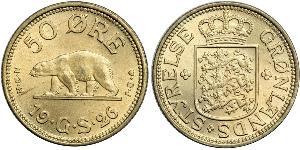
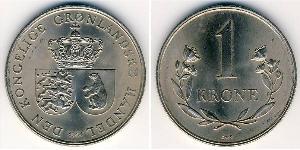
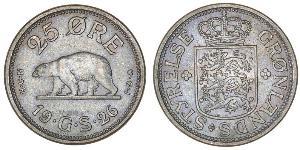
| Greenland (1721 - ) | Link to Wikipedia |
Greenland: History, Coinage and Collectibles
Historical Background
The story of Greenland is a tapestry woven from isolation, maritime exploration, and the resilience of indigenous peoples against an unforgiving landscape. To understand its monetary history, one must first grasp how long this island sat at the edges of empires it never fully joined until very recently.
Sagas speak of Erik the Red navigating to a land he deemed "Green," hoping that his name would lure settlers away from Iceland's volcanic ash and into a world of perceived fertility. This was a marketing masterclass born in survival; the southern fjords were not actually green, but habitable nonetheless. For centuries after their arrival around 986 AD, Norsemen co-existed with Palaeo-Inuit cultures known as Saqqaq and Dorset people.
The economy of early Greenland was a fragile ecosystem built on seal hunting and local grain cultivation before the climate turned against it all too well. The Little Ice Age struck hard in the 14th century, melting ice stores and freezing fjords that had served as ports for trade ships from Europe. By the time Norse settlements like Brattahlíð vanished around 1300 AD due to famine and resource depletion, a new culture was already taking root: the Thule people, migrating in small boats from Canada.
As European empires rose and fell through the centuries of discovery, Greenland became a point on maps rather than an active participant. It remained tied closely to Norway until 1814, when it passed directly under Danish control after the separation between Denmark and Norway. By that time, the island was viewed by colonial powers merely as a strategic chokepoint in Arctic trade routes—a position of immense military importance but little local commerce.
This silence lasted into modern times through World War II and decades of heavy aid dependency on Copenhagen. It wasn't until 1979 that Greenland began its long journey toward Home Rule, followed by the Self-Government Act two decades later in 2008. This period marked a profound shift: moving from being an appendage to the Danish Crown into an autonomous nation with responsibility for internal affairs like education and healthcare. This autonomy eventually reached the realm of symbols—culminating in Greenland finally taking control of its own coin designs.
Currency and Coinage History
For almost a millennium after Erik the Red arrived, there were no coins minted on this land by any local government or ruler. Trade was conducted via goods: dried meat (kiviak), walrus ivory, furs, ironware from Norway, copper pots, and silver dirham used for international trade in seal pelts.
The Danish crown eventually introduced currency to facilitate tax collection and the administration of its colony. During colonial rule, Greenland utilized Danish Kroner without any specific variation; it was essentially an extension of Copenhagen's economy. When Home Rule arrived in 1979, the relationship changed slightly as Denmark allowed for local representation on banknotes and coins issued by the Danish National Bank.
The transition from colony to autonomous territory brought new possibilities in numismatic design. For over a century prior to self-rule (specifically following World War II), coinage was purely standard Danish currency, bearing royal effigies of kings or republics like Queen Margrethe. It is only recently that the land has sought its own monetary voice.
Mints and Coin Production
All circulation coins currently used in Greenland are minted at Royal Danish Mint facilities in Copenhagen, as does much of Europe's silver content today—specifically for bullion products. The physical production is identical to Denmark proper: high-quality steel cores with brass or nickel-plated surfaces that resist corrosion from the harsh marine environment.
The artistry behind these pieces lies not in a Greenlandic mint facility, but in the creative direction granted by local autonomy under Danish supervision. When self-government expanded its powers following 2008 and further developments after Home Rule, artists gained more freedom to depict Inuit heritage rather than standard Nordic royal iconography.
The Minting Tradition
- In the early years of modern Greenlandic coins (often commemorative issues or distinct series introduced in 1978 and following), mint marks were strictly limited. The hallmark "Copenhagen" was common until local designations became necessary.
The use of standard mints allowed for consistency, while allowing collectors to find unique items when the government decided a new artistic theme warranted release—often coinciding with cultural festivals or anniversaries regarding Inuit heritage.
Notable Coins
Coin enthusiasts interested in Greenland must look beyond simple circulation coins into the realm of modern commemorative series and local issues. These are not everyday currency but specific releases that hold immense symbolic weight for locals while appealing to global collectors who appreciate regional distinctiveness.
The 1978 First Coin Series
Dating back to the era shortly before Home Rule, these coins were produced as a way of marking Greenland’s first steps toward self-determination. The reverse designs typically feature traditional hunting scenes or seals set against Arctic ice textures rather than abstract Nordic crosses.
The Modern Self-Government Coins
Following the 2008 referendum, new coinage was authorized to reflect "Kalaallit Nunaat" (the Land of the People). The designs feature indigenous symbols—perhaps a Thule sled or a polar bear in its natural fjord setting. These are minted specifically for circulation alongside Danish currency but carry an identity that is culturally significant rather than just economic.
Cultural Legacy
The numismatic history of Greenland serves as more than a record of trade; it reflects the island's evolution from isolationist colony to autonomous territory. In 1978, coins were issued with Danish royal portraits (Queen Margrethe). By introducing designs that feature Thule heritage and specific Arctic landscapes, these pieces bridge centuries.
The artwork often focuses on nature—the vast ice caps and the resilience of human culture against them—rather than just listing political dates. The shift away from standard Nordic imagery represents a reclaiming of identity after nearly four thousand years where Inuit history was overshadowed by foreign colonization and trading interests.
Thematic Designs
- Nature: Most designs emphasize the stark beauty of the landscape, avoiding political symbols in favor of animals like seals and polar bears which are vital to subsistence culture as well. This artistic focus on biodiversity rather than military might or royal power distinguishes Greenlandic coinage from its mainland neighbors.
For Collectors
Collecting modern Greenlandese coins today is a niche pursuit for the adventurous collector who understands that rarity here comes through limited mintage runs for special occasions, and local artistic preferences. Circulating versions are widely available as currency in Denmark itself; true numismatic challenges arise with early Home Rule commemorative issues or specific mint-run errors.
The appeal of Greenlandic coinage lies not in value fluctuations but in its narrative potential: how a small island navigated the transition from being ruled by distant capitals to governing itself. By acquiring these pieces, collectors preserve stories about Inuit resilience and cultural revitalization within an international monetary system that was once completely dominated by Copenhagen.
These coins stand as silent monuments—a way of carrying forward history not just on pages of books or maps of territories, but in the palm's grip of a collector who appreciates how artistry can reflect freedom.