| View |
 Maldives (1965 - )
| Maldives (1965 - ) | Link to Wikipedia |
Maldives: History, Coinage and Collectibles
In a small nation defined by coral reefs rather than mountains or castles, the story of currency is one of adaptation and resilience.
The Maldives has stood as a vibrant crossroads in Indian Ocean history for centuries. Located where trade winds from Arabia met merchants sailing to China, its strategic location dictated not only political fate but also economic structure. For numismatists exploring the archives of this archipelago, understanding that context is paramount before handling any artifact.
Historical Background
The history of Maldives coinage cannot be separated from the island's geographic reality and its maritime economy. In early centuries, value was established through barter systems involving coconut shells, which were strung into beads to function as currency for daily commerce within local communities. This shell-based system persisted alongside international trade standards until the arrival of European powers shifted the economic landscape. The conversion of Islam in the 12th century brought about a significant shift in legal and religious frameworks that influenced later monetary decrees, replacing earlier Hindu-influenced systems.
Trade Winds and Sovereignty
The islands were protected by Britain first as allies against Portuguese influence, then formally under the British Protectorate from 1887 until independence in 1965. This era defined the region's monetary evolution more than local sovereign mints ever could during this period.
Currency and Coinage History
The transition to modern coinage was a slow process born of colonial dependency. For much of the 18th, 19th, and early 20th centuries, Maldivian residents conducted international transactions using East Indian rupees circulated by regional powers like India or Ceylon (modern-day Sri Lanka). This lack of local coinage is unusual for a sovereign state but reflects historical reliance on colonial trade networks.
The Shift to Sovereignty
Coin production history only truly begins with the assertion of national independence. The first definitive issues emerged following the transition from Protectorate status, though early notes often retained design elements similar to neighboring currencies until full cultural autonomy was felt in monetary policy.
Mints and Coin Production
An island nation rarely establishes its own heavy minting infrastructure due to resource limitations. Consequently, production relies on external facilities or specialized modern workshops that adhere strictly to local artistic standards. The first significant sovereign issues were printed by independent printers but often sourced metal from international refineries.
Minting Traditions
The designs produced during the 20th century bear little relation to mainland European traditions; instead, they draw deeply on maritime life. Early modern series utilized silver and copper-nickel compositions that were practical for island economies where coin circulation was limited compared to paper notes.
Notable Coins
The Protectorate Pattern Issues (19th Century)
Educational value is high here. Rare issues from the colonial period often feature imagery that links the local sultanates with British administration. Collectors search for specific overstrikes or dual-marked coins.
- Significance: These represent the political transition of a small state during great power struggles in the Indian Ocean region.
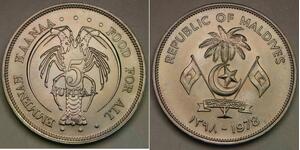
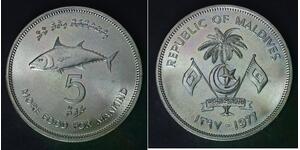
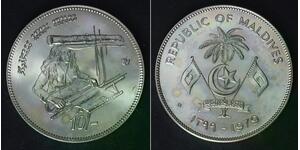
The Independence Series (1968 - 1970s)
The modern collector's focus rests on the early post-independence years. These coins were among the first to carry strictly Maldivian national symbols rather than British royal profiles or foreign emblems.
- Context: Issued following formal independence, these items are foundational for establishing a sovereign numismatic lineage in regional archives.
The Modern Diving and Wildlife Series (1980s - Present)
The most visually distinct modern issues celebrate the islands' natural heritage. Designs often feature manta rays, sea turtles, or the national diving flag used by sport divers globally.
- Design Features: These coins reflect a nation whose primary export is tourism and marine conservation rather than mineral extraction or industrial agriculture.
Cultural Legacy
The coinage serves as a physical record of the archipelago's identity. As an Islamic state, religious motifs appear in historical legal documents but are distinctively absent from modern commemorative faces; however, nature and sport remain prevalent themes that define the currency.
Coin collectors find significance not only in scarcity but also in rarity relative to population size. Finding coins with local language inscriptions or specific dates marks a connection to daily life centuries ago when trade winds blew between Arabia and East Africa.
For Collectors
The Maldives holds a unique place in regional numismatic history because it bridges the gap between colonial dependency on Indian rupees, protectorate administration issues, and modern sovereign coinage. While early silver pieces are rare, their value lies more in historical narrative than market price.
- Market Insight: Collectors should focus on integrity of date ranges that align with specific political transitions from the 1960s onward.
The enduring legacy is one of maritime identity. For a nation built upon coral and sea, coins are not just metal objects but medals representing the survival and prosperity of their people through changing global tides.