| View |
| preceded by | |
| Boeotia (1836 - 2011) |
| succeeded by |
| Boeotia (1836 - 2011) | Link to Wikipedia |
Boeotia: History, Coinage and Collectibles
The region of Boeoitia occupies a strategic place in the narrative of ancient Greece, serving as a geographical bridge between Attica to the south and Thessaly to the north. Situated on the northern shore of the Gulf of Corinth with limited coastline but extensive plains defined by Mount Parnassus and Lake Copais, its political evolution significantly impacted the flow of trade across Ancient Europe.
Historical Background
Boeoitia’s history begins long before coinage emerged. The earliest inhabitants were known as the Minyans, a people closely associated with Orchomenus and distinct from later Dorian immigrants who established cities like Thebes and Thespiae. This region was not merely a land of legend; it was an economic powerhouse whose central location meant that Boeotia functioned effectively as a buffer zone between major powers such as Athens to the south and Macedon or Argos in the west.
The political landscape shifted dramatically over centuries, evolving from loose religious federations into tight alliances led by Thebes. This transition had profound economic implications: unlike isolated villages that hoarded currency for safety, Boeotian cities eventually formed a confederate state that facilitated internal trade but resisted external hegemony until Roman conquest. In 31 BC, the region became part of the province of Achaia under Imperial administration.
The lack of natural harbors meant that Boeoitia relied heavily overland routes connecting Euboea and Thessaly to Attica. This dependency fostered a complex economic system where local barter often coexisted with imported coinage. It is fascinating for historians to note how the region's fertile plain, drained by Lake Copais in antiquity but eventually marshaled into arable land over time (and finally filled with water again during modern construction), created an agricultural surplus that supported a merchant class eager to trade.
A unique cultural aspect of Boeotia is often summarized as "Boeoitians," who were sometimes disparaged by Athenian poets for their perceived lack of finesse. However, these artistic stereotypes mask the reality of two rich dialects: Aeolic and Attic Greek. This linguistic diversity mirrored in its material culture, where city-states developed distinct aesthetic preferences that would eventually be captured on metal.
Currency and Coinage History
To understand Boeoitia’s numismatic history, one must first understand the structure of ancient Greece: it was never a single empire or state. It was an aggregation of independent city-states (*poleis*). Therefore, unlike Athens (the *Owl* tetradrachm) or Sparta (which did not strike coins initially), Boeoitia itself as a political entity generally lacked its own minted currency for the majority of Antiquity.
In the early Archaic period (6th century BC), inhabitants utilized standard Attic silver drachmas which circulated across all regions. As trade expanded, local mints began to appear, but usually under specific city authority rather than regional control. The transition from weight-based barter or foreign currency struck in Athens to locally manufactured metal happened gradually.
The first significant coinage associated with the region appears in the 6th century BC and is closely tied to cities like Orchomenus, which was a major trade hub before being conquered by Sparta. Later issues appeared during periods of Macedonian influence or when Boeoitia acted as a single confederation under Theban leadership. During the Roman Imperial era (post-31 BC), coinage struck in Boeotia reflects its status as part of the province of Achaia, often bearing generic imperial iconography with local city names.
For collectors studying ancient numismatics, this means finding "Boeoitan" coins is synonymous with collecting issues from specific cities such as Orchomenus or Thebes rather than a single unified currency. It was not until the Byzantine period that coinage became more centralized under provincial titles like *Thebais*.
Mints and Coin Production
The concept of the "Boeoitain Mint" is anachronistic because minting in ancient Greece occurred at city centers. The primary production hubs were located at Orchomenus, Thespiae, Plataea, and Thebes. The technology available to these cities was standard for Greek mints: punch-struck silver tetradrachms made from local ore or imported ingots.
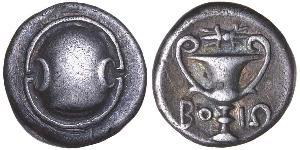
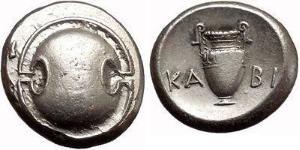
The artistic style evolved rapidly as the region interacted with neighbors like Athens. Early issues often featured simple geometric designs representing a shield or bull, symbols of regional identity distinct from the olive wreaths seen on Athenian coins. The presence of these types was sometimes disputed among scholars until modern archaeological excavations confirmed local minting practices at Orchomenus and other settlements.
In terms of metallurgy, Boeoitia had access to significant silver deposits in its northern regions compared to Athens (which mined Laurion). This abundance allowed for a robust production economy. However, political instability often disrupted these operations; following the Battle of Plataea, Spartan hegemony temporarily halted local minting activities until Thebes reasserted influence during the later Classical period.
The most distinct characteristics were found in coin designs that blended religious reverence with civic pride. For example, Orchomenus coins frequently utilized a shield design representing its military defense and political independence. These mints operated much smaller scales compared to major imperial workshops but allowed for more intricate local iconography depicting specific heroes or landscape features unique to the Boeoitan plain.
Notable Coins
- The Orchomenos Tetradrachm (6th Century BC)
- Historical Context: Struck during a period of significant economic expansion, often associated with the wealth of Orchomenus.
- Design Features: These silver coins typically feature a shield on one side and an owl or similar animal representing the city's protective symbols. They are comparable to Athenian but carry distinct local legends and markings for identification.
- Importance: Collectors prize these as rare specimens of pre-classical Aeolic culture, showcasing how regional trade coins circulated alongside more famous pan-Hellenic types like those from Athens or Corinth.
- Thebes Hellenistic Issues
- Historical Context: Following Theban dominance during the Peloponnesian Wars and subsequent conflicts, this city became the primary mint for Boeoitia.
- Design Features: These coins often depict Heracles or Harpocrates. The imagery reflects local mythology rather than pan-Hellenic symbols found on Delphi issues.
- Importance: They represent a rare instance of regional political cohesion, where the confederation struck currency under one major city’s banner to unify trade routes across Boeoitia and Thessaly.
- Roman Provincial Issues
- Historical Context: After 31 BC (following Roman annexation), coins were issued with "Boeotia" or city names within the provincial framework of Achaia.
- Design Features: Silver denarii often display profiles of Augustus and later emperors, accompanied by inscriptions in Greek indicating specific towns like Plataea or Thespiae. Later bronze issues circulated locally for taxation and wages.
- Importance: These are accessible to collectors who cannot acquire high-grade Athenian coins but wish to explore Roman Imperial history outside major centers of Rome, Alexandria, or Antioch.
- Rarity: Coins minted at Orchomenus pre-480 BC are particularly scarce. They represent the early stages when Boeoitia was an independent confederate league before falling under Theban hegemony or Spartan control.
- Aesthetic Value: Collectors should appreciate that while Athenian coins often feature highly polished silver, regional issues might show wear from extensive inland use. Examining the mint marks on these can help determine which city produced them at a specific time period.
- Cultural Connection: For those seeking to connect history with art and mythology (e.g., Oedipus or Theban myths), this collection offers unique opportunities to acquire pieces depicting specific heroes rather than generic deities like Apollo found on Delphi coins.
Cultural Legacy
The legacy of Boeoitia in numismatics is best understood not as a single currency tradition like Egypt’s Pharaonic gold stater (the Sais) but rather through the fragmentation and evolution of civic identities. The coinage from this region reflects a culture deeply rooted in local mythology—famous for myths surrounding Oedipus, Cadmus, and Dionysus—which frequently influenced artistic representations found on ancient coins.
The shield motif appearing repeatedly throughout Boeoitan history (Orchomenus to Thespiae) speaks volumes about the martial spirit of its inhabitants. Even though they were often viewed as simple-minded by their neighbors in literary sources like Cratinus, the complexity and quality of local minting reveal a sophisticated appreciation for art that rivals other Greek cities.
In contrast to coins struck purely for trade purposes found on ships or islands, Boeoitan coinage circulated inland across the fertile plains. This suggests that economic integration was driven by land-based commerce and agriculture rather than maritime shipping routes (a point confirmed historically). The preservation of local dialect names (*Boiōtĭ́ā*) on these ancient artifacts also marks a unique linguistic heritage in Greek history.
For Collectors
The numismatic appeal of Boeoitia lies in its rarity and historical depth. Since many coins were struck by small city-states rather than centralized empires, survival rates are often low due to war damage or lack of hoarding habits among local populations.
In conclusion, collecting coinage associated with Boeoitia allows enthusiasts to understand the fragmented yet interconnected nature of Ancient Greece. It bridges the gap between famous pan-Hellenic legends and the daily lives of citizens in a fertile but strategically challenging region where wealth depended heavily upon agriculture rather than maritime dominance.