| View |
| preceded by | |
 Andorra (1278 - )
|
| succeeded by |
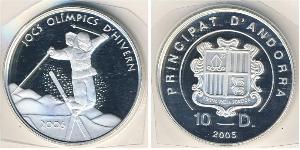
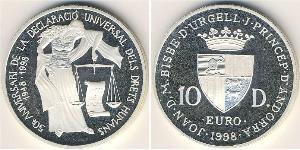
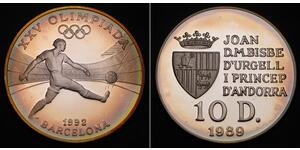
| Andorra (1278 - ) | Link to Wikipedia |
Andorra: History, Coinage and Collectibles
The Principality of Andorra occupies a unique space in European history. Nestled deep within the Pyrenees mountains on the Iberian Peninsula's southern slopes, this landlocked microstate sits at an average altitude that rivals its own capital city, Andorra la Vella. The country is defined not only by snow-capped peaks and heavy rainfall but also by a fascinating numismatic absence for millennia.
In contrast to neighbors like France or Spain, which minted sovereigns with centuries of history behind them, the Principality functioned as a unique political buffer zone between the two empires. This geopolitical position shaped its monetary evolution into a story that is almost entirely modern, yet offers profound lessons for collectors regarding microstate sovereignty and Euro adoption.
Historical Background
The history of the Pyrenees has always been defined by its mountains. In ancient times, the region was a difficult transit corridor for Roman legions traveling between Gaul and Iberia.
Sometime around the first century BCE or CE, Romans established outposts at Urgellet (today's La Seu d'Urgell) to manage trade in wine, cheese, and timber. While these territories were nominally part of Rome, they lacked a centralized state mint that could produce sovereign coins distinct from Imperial currency.
During the Middle Ages, Andorra existed not as an independent kingdom but under the joint sovereignty of two powerful neighbors: the Bishop of Urgell in Spain and the President (Lord) of the French House of Foix. This arrangement meant there was no single national ruler to authorize a "King's Head" coinage.
The region remained economically isolated, relying on transhumance—moving flocks of sheep across borders from summer pastures to winter valleys. The primary trade goods were wool and leather. In such an economy, coins played little role compared to barter or the use of neighbors' money for larger transactions. It wasn't until tourism began in 1960 that Andorra needed its own currency system.
Currency and Coinage History
Fascinatingly, the Principality of Andorra is one of the few European nations to have never produced its own sovereign gold or silver coins. For centuries, trade within the valley was conducted using French francs on the northern side and Spanish pesetas (and later, euros) in southern markets.
Because the country sits on a border between Spain and France, it functioned effectively as "no man's land" regarding state money for much of its existence. The economy relied heavily on cross-border commerce; thus, local residents naturally used whatever currency was legal tender across their borders—primarily Spanish pesetas during the 20th century due to historical trade ties.
The shift occurred in the late 1980s and early 1990s. Following the collapse of Communism in Eastern Europe, Andorra sought closer European integration without joining the EU itself (joining Council of Europe instead). To facilitate this economic stability, it adopted a currency system that eventually led to full Euro adoption.
Mints and Coin Production
Solitude is often found in mountainous regions, but so are mints. For the first few decades of modern statehood (officially recognized as a country under international law since 1993), there was no Andorran mint. Instead, coins were imported or produced locally through agreements with France and Spain.
The "Mint" is essentially a partnership between two nations. Coins circulated in Andorra are legally issued by the French Bank of France (Banque de France) but often carry specific Andorran designs for circulation within the Principality, while other Euro issues follow standard European Central Bank protocols but utilize special commemorative dies approved specifically to represent this microstate.
Notable Coins
The history of Andorran coinage is relatively short, consisting mainly of modern Euro varieties. Collectors prize these items not for age or rarity in the traditional sense (like gold doubloons), but for their artistic representation of a culture that once lacked its own sovereign currency.
The Early Spanish Connection
In the mid-20th century, coins minted in Spain circulated widely within Andorra. These items often bear specific dates and sometimes carry local markings related to trade or border customs. While they are standard Spanish denominations from a catalog perspective, historically for locals, every coin was "Andorran" because it was spent there.
The Modern Euro Transition
Tourism exploded in the late 20th century as Andorra became a tax haven and winter sports destination. The influx of visitors required high-velocity cash changes, necessitating a stable currency standard aligned with France.
The first Euro coins to feature distinctly Andorran elements appeared around 2014 (and in the early 2010s), allowing collectors to purchase "Euro" issues that reflect their specific geography and culture. Unlike standard EU nations where designs are rotated annually, Andorra's coinage often features symbols reflecting its unique status as a microstate between two major European powers.
The most popular series of interest is the "Andorra la Vella Capital City Series." These coins feature high-relief artwork showcasing landmarks like the Romanesque Church of Sant Joan de Caselles or snow-covered peaks. While not rare in terms of mintage quantities, they are valuable for completeness within a microstate collection.
Cultural Legacy
The legacy found on Andorran coins is one of independence through neutrality. The coat of arms depicted on Euro denominations features the "Serpent" shield—a symbol from medieval times representing the co-princeship.
This heraldic design highlights a unique aspect of European history: that sovereignty can exist without traditional state symbols for centuries. By adopting coins with Andorran designs, this microstate re-established its visual identity on the world stage after a long period where French and Spanish mints were responsible for representing it to foreign nations.
For Collectors
The story of Andorra is one of transition. The numismatic history here teaches us that a "sovereign coin" does not require gold or silver; it requires political recognition and the capacity to mint distinct designs.
For collectors, these coins offer an opportunity to possess currency from Europe's highest capital city in physical form. While they do not carry ancient historical weight like Greek drachmas of 400 BCE found near nearby Roman camps (Camp Vermell), their scarcity as a "recent" nation and specific Euro designs make them unique additions.
The value lies entirely in the cultural context: these coins represent a state that once relied on two neighbors for its trade until it finally secured its own identity within the European monetary system. It serves as a reminder of how small geography can define history even when coin production was not part of an ancient tradition, yet remains significant to collectors who appreciate microstates and modern Euro varieties.
In summary, while Andorra's numismatic heritage is recent compared to its 10,000-year occupation by humans (since La Balma de la Margineda in the Paleolithic), it holds a unique place. It stands as proof that value can be derived from history even when mints are absent for centuries.