| preceded by | ||||
|
||||

|
|||||||
 Second Mexican Empire (1864 - 1867)
|
|||||||

| succeeded by | ||||
|

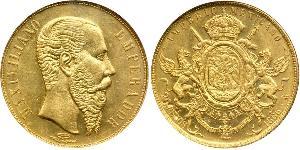
| Second Mexican Empire (1864 - 1867) | Link to Wikipedia |
The Second Mexican Empire: History, Coinage and Collectibles
Welcome to a journey through one of history’s most intriguing geopolitical experiments: The Second Mexican Empire. For the historian or numismatist, it offers a fascinating study in anachronisms—a time when an Austrian Archduke briefly sat upon the throne of North America. This was not merely a change in leadership; it represented a clash between established European dynastic tradition and the emerging ideology of American republicanism. To understand why coins from this specific era hold such high prestige in today's collections, we must first look at the tumultuous waters that produced them.
Historical Background
The path to empire was fraught with difficulty following Mexico's independence movement. The mid-1860s were a decade of immense instability for North America, caught in the shadows of the American Civil War and Napoleon III’s expansionist ambitions in Europe. Under these volatile circumstances, French military intervention allowed Archduke Maximilian I—a distant cousin of Emperor Franz Joseph—to establish rule over Mexico.
This regime lasted from 1864 until its collapse three years later. The historical context is particularly rich for collectors because the empire was built on a fragile foundation: it required heavy financial subsidies to maintain French armies, leading to significant inflation and economic strain within the Mexican borderlands. For coinage historians, this period represents a unique intersection where the economy had just recovered from the chaos of independence but faced fresh disruptions. The culture during these years attempted to blend conservative Catholic traditions with European Romanticism, an effort often reflected in how the new government tried to stabilize commerce and restore confidence in foreign trade.
Currency and Coinage History
Money is a mirror of society’s economy at any given moment. Under this short-lived regime, currency evolution was driven by necessity rather than tradition. The empire initially continued the silver dollar (pesos de plata) system but issued significant gold coinage to combat inflation caused by paper money shortages.
The monetary reform efforts were desperate yet innovative; Maximilian hoped that introducing high-quality European-style standards would help integrate Mexico into global markets, particularly against France and Spain. However, political friction meant the mints often operated under duress or at partial capacity. This led to a distinct era of numismatic scarcity—many coins struck during this period are found only because they were hoarded by citizens fearing another uprising, while others simply melted down as bullion for foreign trade.
Mints and Coin Production
The central hub remained the Casa de Moneda (Mint) of Mexico City. It is here that we see the fascinating blend of artistic styles: Mexican engravers employed by a Habsburg monarchy, working under pressure to strike coins with French designs but using local silver sources.
Coin production faced significant challenges due to political instability and civil war, which often resulted in rushed minting techniques or incomplete obverse dies. Some mints that had been closed during the republican government were hastily reopened to meet immediate demand for coinage used by loyalist forces of Maximilian’s cause. Because these operations lasted so briefly—often less than a year per batch—the resulting coins carry historical significance far beyond their face value.
Notable Coins
The most sought-after treasures from this era are the silver and gold pieces issued between 1864 and early 1867. These include:
- $5 Gold Eagle (Pieces of Five): Often referred to as "Soles," these were minted in limited quantities specifically for high-value foreign transactions, though they remained legal tender within Mexico.
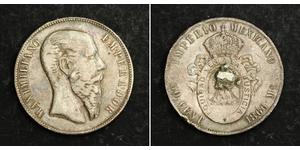
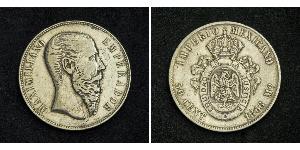
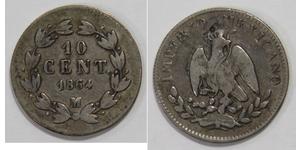
- The Silver Dollar and 1864 Half-Real: These low-mintage issues are particularly significant. The scarcity arises not only from the short reign but because many coins of this period were produced with different mint marks (such as "M" for Matamoros), creating distinct sub-types.
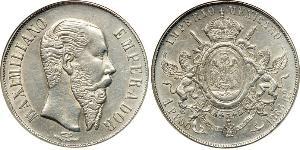
- The 1 Peso Silver Piece: A classic collector's favorite, these pieces often bear legends referencing Maximilian I. They are prized by collectors not just for the condition of the metal but because they represent a period where silver standards were fluctuating rapidly due to inflationary pressures in Latin America.
The "Crown" coins—large gold issues struck during his reign—are often overlooked compared to standard eagle denominations. Collectors prize them for their intricate detailing and the fact that few survive outside of private collections today, having largely been melted down or exported early on.
Cultural Legacy
The legacy of this empire is profound in both art and history; it was a bridge between Old World romance and New World reality. The coinage reflects the era's artistic taste: portraits that were less rigid than previous Mexican republican issues but still carried dignity, reflecting an attempt to legitimize Maximilian as "His Catholic Majesty."
Cultural symbols often found on these coins include religious iconography (crucifixes and crosses) alongside national motifs like eagles. This duality is symbolic of the empire's struggle—trying to merge a European monarchist model with local indigenous culture while resisting foreign occupation forces.
For collectors
The Second Mexican Empire offers one of the highest rewards per piece in numismatic collecting today, largely because it represents such a singular historical anomaly. It is rare for another nation to successfully intervene and install its own ruler over Mexico; even rarer are the gold coins that survived these troubled times.
If you have an opportunity to acquire pieces from this specific era—especially silver issues marked with distinct mints or those bearing the portraits of Maximilian and Empress Carlota—you are acquiring a slice of history. The metal may tell a story, but only the provenance can truly speak to why they were struck at all during such chaotic times. For collectors who value historical narrative over simple grade statistics, these coins stand as testaments to how quickly geopolitical tides turn.