| View |
| preceded by | |
 Gambia (1965 - )
|
| succeeded by |
| Gambia (1965 - ) | Link to Wikipedia |
The Gambia: History, Coinage and Collectibles
Historical Background
To understand the story of The Gambia is to trace one of the most unique geographic footprints in Africa—a nation that stretches like a slender finger along the lower reaches of its namesake river. Historically, this region has always been defined by commerce and connection rather than isolation or conquest. Long before British traders arrived on Portuguese ships seeking new trade routes, Arab Muslim merchants established themselves here between the ninth and tenth centuries, utilizing ancient trans-Saharan networks to exchange gold for manufactured goods.
This early era was one of barter; wealth moved through caravans carrying gold and ivory in exchange for cloth. For a long time, coinage as we know it did not exist within these borders because commerce relied on this older system of trade until external influence shifted the landscape permanently. By 1765, the British Empire had firmly established its presence, bringing with it the administrative infrastructure that necessitated state-controlled currency to manage taxes and public wages.
The transition from a protectorate in 1820s territory to an independent nation was not merely political; it was economic. As The Gambia moved toward independence in 1965 under President Dawda Jawara, the country had already navigated complex colonial transitions that influenced its monetary foundation. Independence signaled a new chapter where local identity needed to be projected onto currency previously designed by London-based authorities. This era of decolonization is perhaps more important for numismatists than any other time in Gambian history.
Currency and Coinage History
The monetary evolution of the Gambia reflects a standard pattern among small West African nations that were once British territories: moving from Sterling fractions to decimal currencies. At independence, The Gambia initially circulated coins and notes based on the pound-shilling-pence system used throughout Britain.
Sterling Era (1965–Early 1970s): During these early years, coins minted elsewhere bore portraits of British monarchs. These pieces were functionally important as they represented the transition from colonial subjects to self-governed states while still maintaining ties with former imperial powers.
The Decimal Transition (Mid-1970s onwards): Following a broader regional shift, The Gambia adopted decimal currency, aligning its economic structure with neighbors and international standards. This reform required the design of completely new coinage to reflect national sovereignty rather than colonial ties.
Mints and Coin Production
The Republic has never operated an independent mint due to the scale of local trade; consequently, all coins were cast abroad—primarily in London or other Commonwealth facilities. This external production creates a unique numismatic profile: Gambian silver proofs are often highly sought after because they bear high-quality craftsmanship from major Royal Mints rather than domestic foundries.
The small surface area of the country—bounded on nearly all sides by Senegal and bisected only by its central river—limited industrial capacity. This geographic reality meant that coinage production was always kept low-volume, resulting in many issues remaining strictly for local circulation or official commemorative purposes rather than mass export to other nations.
Notable Coins
The Independence Issues:
- Historical Context: Commemorating the year 1965 when sovereignty was assumed. These coins typically replaced Sterling issues in circulation almost immediately to honor national pride.
- Design Features: Early pieces often feature maps of the country highlighting its unique shape along the river or images representing key industries such as fishing and agriculture mentioned in regional histories.
The Silver Proofs (1975–2008)
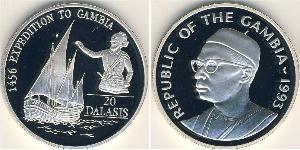
- Historical Context: During these decades, The Gambia issued high-quality silver coins for collectors to mark special anniversaries or significant national events.
- Design Features: Unlike the base-metal circulation pieces which were simple and utilitarian, these proofs featured intricate relief work depicting local wildlife—such as the fish that populate its waters—and traditional agricultural scenes. This reflects how tourism became a primary economic driver alongside farming in later years.
Silver Circulation Coins:
- Historical Context: These were issued to bolster confidence in the economy during times of fluctuating global markets, showing that despite being small, The Gambia could issue its own bullion-standard currency.
Cultural Legacy
The coinage found on a collector’s table tells a story about how culture and geography intersect. Because the capital was originally Bathurst before shifting to Banjul (a name derived from local linguistic terms), numismatic designs frequently utilized symbols that rooted money in this riverine landscape rather than distant imperial icons.
For Collectors
The Gambia offers a fascinating study for those who appreciate the intersection of geography and history. Coins are rare because low-mintage silver proofs were never exported or melted down; they remained hoarded at home, adding to their scarcity today. For collectors, these pieces serve as historical artifacts that document how a small nation preserved its own identity after independence.
The appeal lies in the narrative of the Gambia: from Arab traders using barter systems centuries ago, through British colonial administration establishing formal mints abroad, and finally to an independent republic issuing coinage reflecting its specific culture. Each medal or commemorative piece issued over decades captures a moment when this nation defined itself for the world.