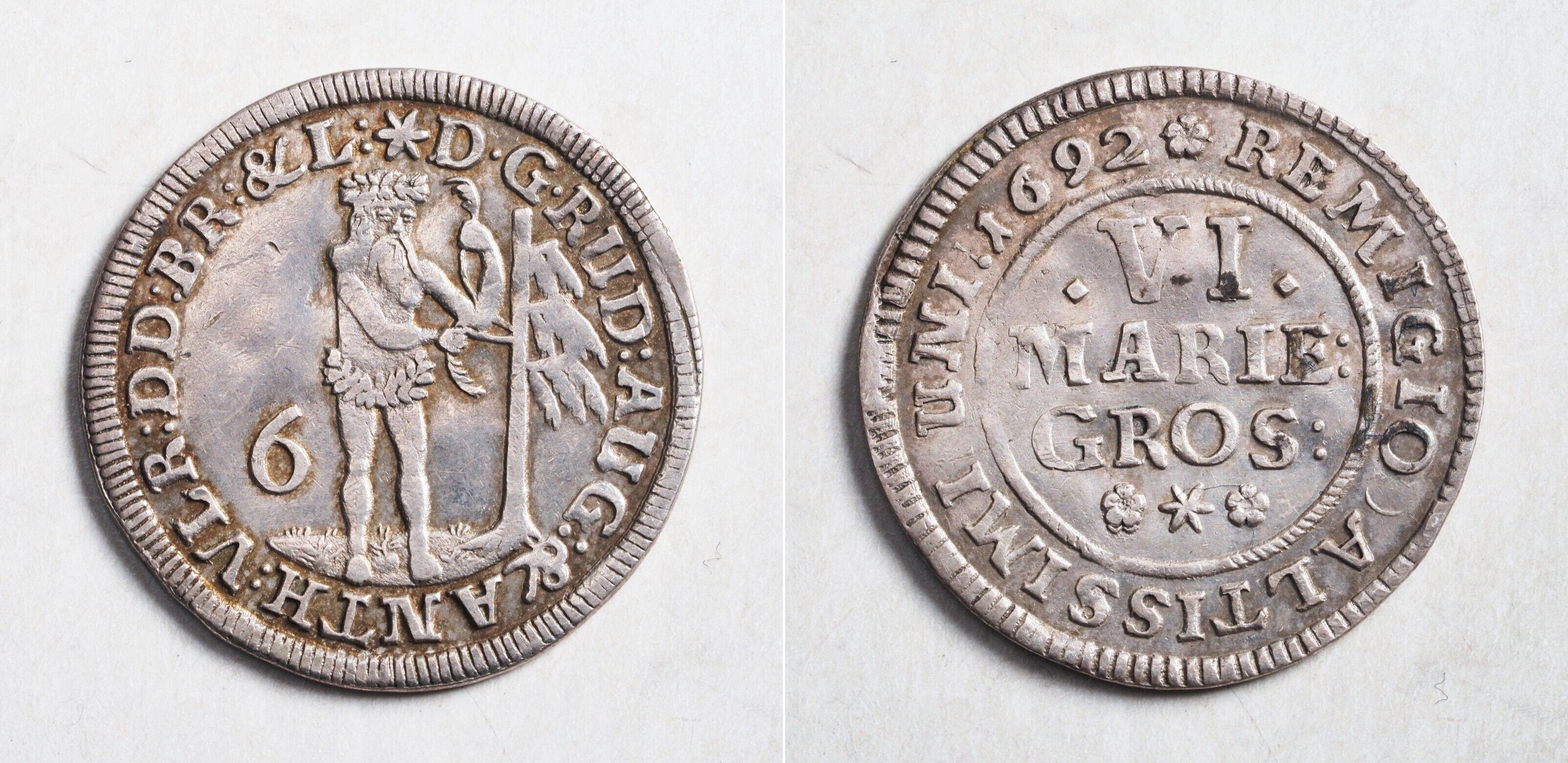
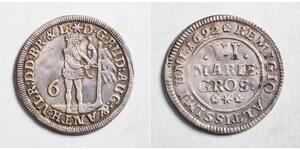
1692, Brunswick-Wolfenbuttel, Antony Ulrich. Silver 6 Mariengroschen Coin. XF!
Mint Year: 1692.
Reference: KM-569.
Denomination: 6 Mariengroschen
Condition: Minor digs and deposits, otherwise a nicely toned XF!
Diameter: 25mm
Weight: 3.24gm
Material: Silver
The wild man or woodwose is a mythological figure that appears in the artwork and literature of medieval Europe. Images of wild men appear in the carved and painted roof bosses where intersecting ogee vaults meet in the Canterbury Cathedral, in positions where one is also likely to encounter the vegetal Green Man. The wild man, pilosus or “hairy all over,” and often armed with a club, was a link between civilized humans and the dangerous elf-like spirits of natural woodland, such as Puck. The image of the wild man survived to appear as supporter for heraldic coats-of-arms, especially in Germany, well into the 16th century. Early engravers in Germany and Italy were particularly fond of wild men, wild women, and wild families, with examples from Martin Schongauer and Albrecht Dürer among others.
The earliest medieval concepts of the wild man focus on him as a normal human gone wild by madness, as in the Biblical story of Nebuchadnezzar; this first occurs in Celtic societies in the High Middle Ages. These Celtic stories attribute to the wild man poetic or prophetic powers. The 9th-century Irish tale Buile Shuibhne (The Madness of Sweeney) describes how Sweeney, the pagan king of the Dál nAraidi in Ulster, assaults the Christian bishop Ronan Finn and is cursed with madness as a result. He spends many years traveling naked through the woods, where he composes verse. The Welsh told a similar story about Myrddin Wyllt, the origin of the Merlin of later romance. In these stories Myrddin is a warrior in the service of King Gwenddoleu ap Ceidio at the time of the Battle of Arfderydd. When his lord is killed at the battle, Myrddin takes to the Caledonian Forest in a fit of madness which bestows him with the ability to compose prophetic poetry; a number of later prophetic poems are attributed to him. The Life of Saint Kentigern includes almost the same story, though here the madman of Arfderydd is instead called Lailoken, which may be the original name. The fragmentary 16th-century Breton text An Dialog Etre Arzur Roe D’an Bretounet Ha Guynglaff (Dialog Between Arthur and Guynglaff) tells of a meeting between King Arthur and the wild man Guynglaff, who predicts events which will occur down to the 16th century.
The Principality of Brunswick-Wolfenbüttel was a principality within the Duchy of Brunswick-Lüneburg, whose history was characterised by numerous divisions and reunifications. Various dynastic lines of the House of Welf ruled Brunswick-Wolfenbüttel until the dissolution of the Holy Roman Empire in 1806. As a result of the Vienna Congress, its successor state, the Duchy of Brunswick, was created in 1814.
Anthony Ulrich (German: Anton Ulrich; 4 October 1633, Hitzacker – 27 March 1714, Salzdahlum) was duke of Brunswick-Lüneburg and ruled over the Wolfenbüttel subdivision of the duchy from 1685 until 1702 jointly with his brother, and solely from 1704 until his death.
Anthony Ulrich was the second son of Augustus the Younger, Duke of Brunswick-Lüneburg; he studied at the University of Helmstedt. After their father’s death in 1666, Rudolph Augustus, Anthony Ulrich’s elder brother, became reigning duke and made Anthony Ulrich his proxy. In 1685, Rudolph Augustus made Anthony Ulrich a coregent with equal rights; Rudolph Augustus had little interest in government affairs and left most decisions to his brother.
After the Hanover subdivision of the duchy had received a new prince-electorship from the Emperor in 1692, tensions between the two states rose, as both Anthony Ulrich and Rudolph Augustus were dismayed that they had not received the electorship. While both Hanover and Lüneburg sided with Emperor Leopold I in the War of the Spanish Succession, Anthony Ulrich decided to enter into an agreement with France. This led to Hanover and Lüneburg invading the Principality of Wolfenbüttel in March 1702; Anthony Ulrich was almost captured while travelling from Wolfenbüttel to Brunswick. By order of the Emperor, Anthony Ulrich was deposed as duke against his brother’s protestations, and Rudolph Augustus remained as the only ruler, while Anthony Ulrich fled to Saxe-Gotha. In April 1702, Rudolph Augustus signed a treaty with Hanover and Lüneburg that Anthony Ulrich later agreed to.
After Rudolph Augustus' death in 1704, Anthony Ulrich took over government again. He continued to settle various disputes with Hanover, until a final agreement between the two sister principalities was reached in 1706.
In 1709, Anthony Ulrich converted to the Roman Catholic Church, but guaranteed to his subjects that this would not influence his government, although he allowed the opening of the first Catholic church in his state. He died at Schloss Salzdahlum, which he had built, in 1714, and was succeeded by his eldest surviving son, Augustus William.
Anthony Ulrich is known as a supporter of scholarship and the arts. He significantly extended the Bibliotheca Augusta, a library founded by his father. He hired the philosopher Leibniz as a librarian, and was a supporter of Anton Wilhelm Amo, the first black Doctor of Philosophy in Europe. He wrote two novels and a number of poems, and had a large art collection, which later became the foundation of the Herzog Anton Ulrich Museum (Duke Anthony Ulrich Museum).
(3205 X 1559 pixels, file size: ~777K)
Posted by: anonymous 2024-03-25
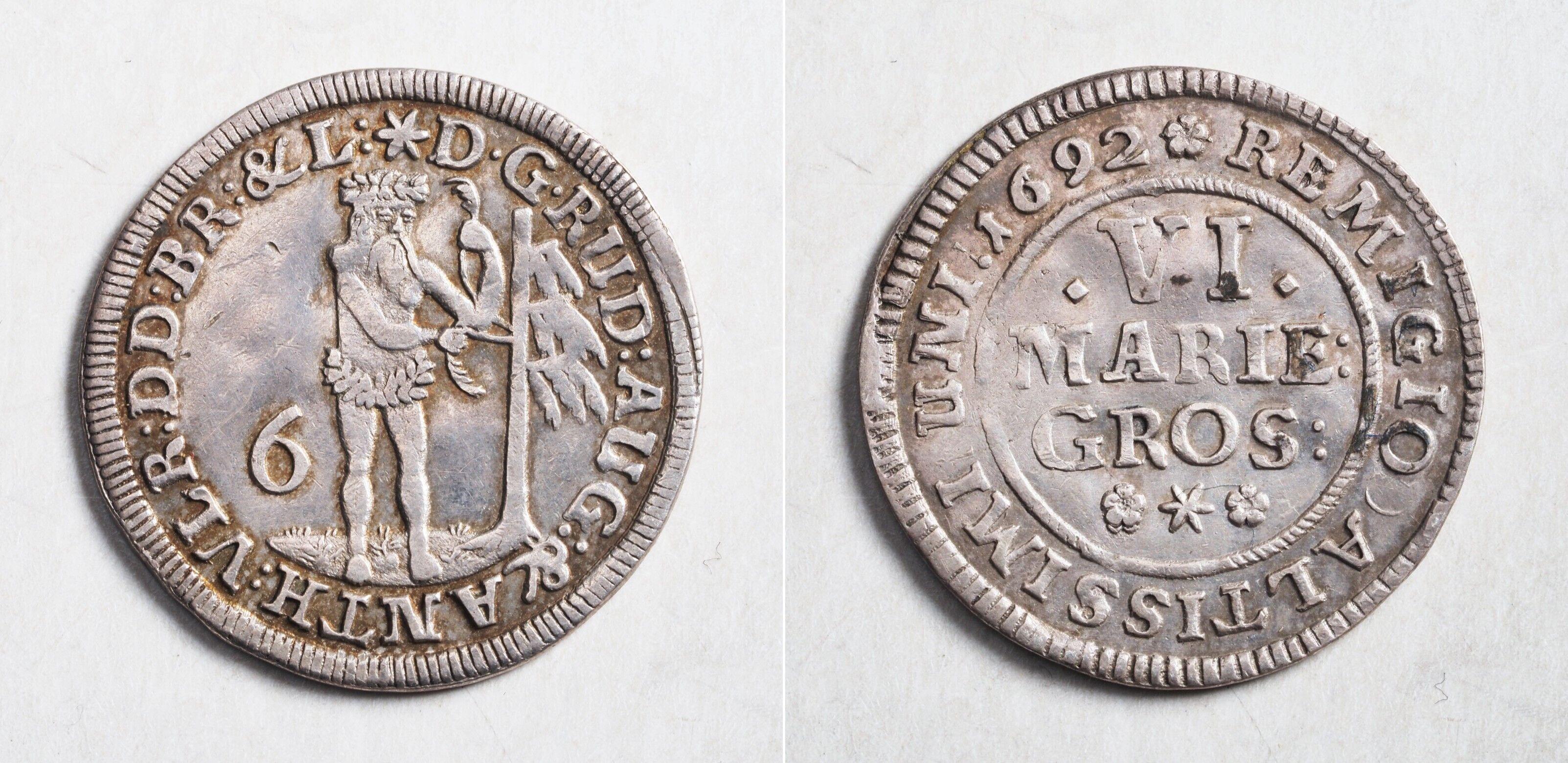
1692, Brunswick-Wolfenbuttel, Antony Ulrich. Silver 6 Mariengroschen Coin. XF! Mint Year: 1692. Reference: KM-569. Denomination: 6 Mariengroschen Condition: Minor digs and deposits, otherwise a nicely toned XF! Diameter: 25mm Weight: 3.24gm Material: Silver The wild man ...
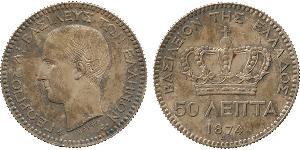
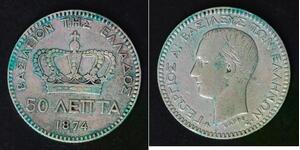
50 Lepta Greece Silver George I of Greece (1845- 1913)
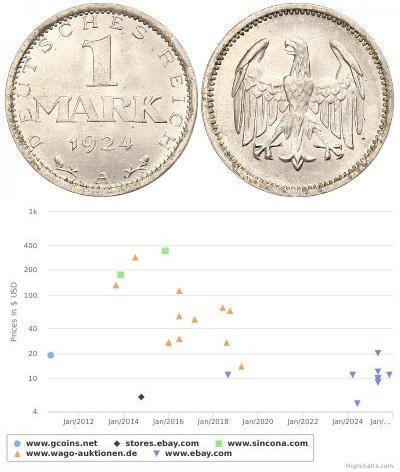
group has 12 coins / 11 prices
⇑