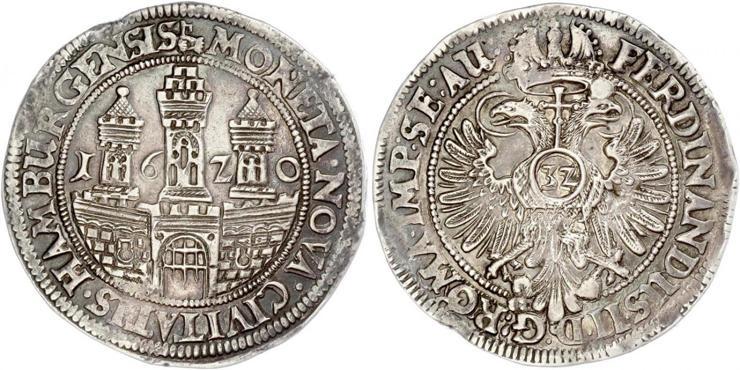
1 Thaler / 32 Shilling Hamburg Silver Ferdinand II, Holy Roman Em ...

1621, Hamburg (Free City). Silver Thaler (32 Schilling) Coin. XF!
Mint Year: 1621
Denomination: Thaler (32 Schilling)
Mint Master: Jochim Rustmeyer (I-R).
Reference: Davenport 5364, KM-100 ($500 in XF!).
Condition: Double-struck reverse with minor weakness of strike, otherwise a nicely toned XF!
Weight: 28.47gm
Diameter: 41mm
Material: Silver
Obverse: Castle with three towers and open dooars and risen porticullis (arms of Hamburg) with date (1-6-2-1) split between towers.
Legend: MONETA . NOVA . CIVITATIS . HAMBURGENSIS (privy mark)
Reverse: Crown above double-headed eagle with value in shillings (32) on breast.
Legend: FERDINANDUS . II . D : G . ROMA . IMP . S : AU :
In 1189 by Frederick I “Barbarossa” granted Hamburg the status of an Imperial Free City and tax-free access up the Lower Elbe into the North Sea. In 1265, a putative forged letter was presented to or by the Rath of Hamburg. This charter, along with Hamburg’s proximity to the main trade routes of the North Sea and Baltic Sea, quickly made it a major port in Northern Europe. Its trade alliance with Lübeck in 1241 marks the origin and core of the powerful Hanseatic League of trading cities. On November 8, 1266 a contract between Henry III and Hamburg’s traders allowed them to establish a hanse in London. This was the first time in history the word hanse was mentioned for the trading guild Hanseatic League. The first description of civil, criminal and procedural law for a city in Germany in German language, the Ordeelbook (Ordeel: sentence) was written by the solicitor of the senate Jordan von Boitzenburg in 1270. On August 10, 1410 civil commotion caused a compromise (German:Rezeß, literally meaning: withdrawal). It is the considered as the first constitution of Hamburg.
Ferdinand II, Holy Roman Emperor (July 9, 1578 – February 15, 1637), of the House of Habsburg, reigned as Ferdinand II, Archduke of Inner Austria (normally called Ferdinand II of Germany when referred to as Archduke) and Holy Roman Emperor from 1619-1637. He was also the Archduke of Styria (Inner Austria) from 1590–1637, King of Bohemia from 1617-1619 and again from 1620-1637, as well as King of Hungary and Croatia from 1618-1625. The expansion of the ongoing acts of rebellion against his Imperial Governors in Bohemia on May 23rd, 1618 directly triggered the Thirty Years' War, and can be blamed on his religious intolerance toward Protestants.
A devout and very pious Catholic, his recognition as King of Bohemia and suppression of Protestantism precipitated the early events of the Thirty Years' War, and he remained one of the staunchest backers of the Anti-Protestant Counter Reformation efforts as one of the heads of the German Catholic League, prolonging the Thirty Years' Wars by insisting the Edict of Restitution be enforced. The duration of his reign was occupied by confessional and military concerns, and some historians blame him for the large civilian loss of life in the Sack of Magdeburg in 1631, as he’d instructed Count Tilly to enforce the edict upon Saxony—his orders causing Tilly to move the Catholic armies east, ultimately to Leipzig, where they suffered their first substantial defeat at First Breitenfeld.
(July 9, 1578 – February 15, 1637), of the House of Habsburg, reigned as Ferdinand II, Archduke of Inner Austria (normally called Ferdinand II of Germany when referred to as Archduke) and Holy Roman Emperor from 1619-1637. He was also the Archduke of Styria (Inner Austria) from 1590–1637, King of Bohemia from 1617-1619 and again from 1620-1637, as well as King of Hungary and Croatia from 1618-1625. The expansion of the ongoing acts of rebellion against his Imperial Governors in Bohemia on May 23rd, 1618 directly triggered the Thirty Years' War, and can be blamed on his religious intolerance toward Protestants.
A devout and very pious Catholic, his recognition as King of Bohemia and suppression of Protestantism precipitated the early events of the Thirty Years' War, and he remained one of the staunchest backers of the Anti-Protestant Counter Reformation efforts as one of the heads of the German Catholic League, prolonging the Thirty Years' Wars by insisting the Edict of Restitution be enforced. The duration of his reign was occupied by confessional and military concerns, and some historians blame him for the large civilian loss of life in the Sack of Magdeburg in 1631, as he’d instructed Count Tilly to enforce the edict upon Saxony—his orders causing Tilly to move the Catholic armies east, ultimately to Leipzig, where they suffered their first substantial defeat at First Breitenfeld.
| 1 | 2 |
|---|

(740 X 370 pixels, file size: ~73K)
Posted by: anonymous 2019-09-24
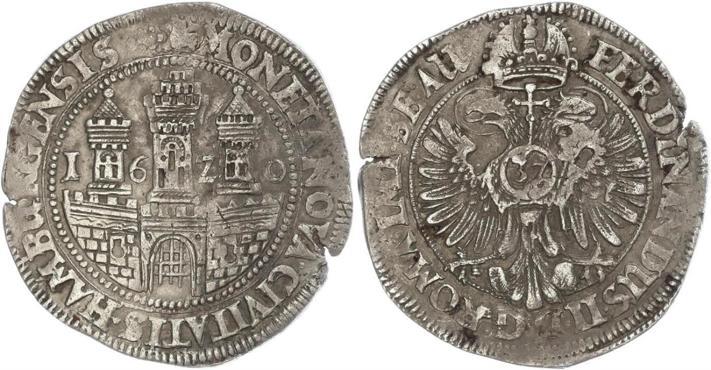
1620,Hamburg-Stadt. Taler 1620. Mit Münzmeisterzeichen 'Faust hält Zainhaken'. Gaedechens 388, Davenport 5364. Schöne Patina. Sehr schön - vorzüglich

(711 X 370 pixels, file size: ~61K)
Posted by: anonymous 2019-05-28
1620,Hamburg-Stadt. Taler 1620. Davenport 5364. Kleine Schrötlingsrisse, sehr schön

(1500 X 743 pixels, file size: ~224K)
Posted by: anonymous 2019-03-25
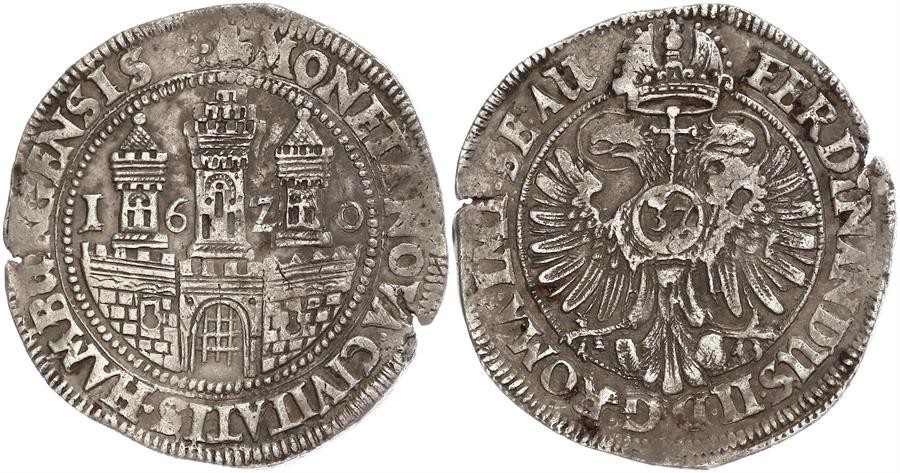
Hamburg-Stadt. Taler 1621. Gaedechens 394 var, Davenport 5364. Schöne Patina. Stempelfehler, Prägeschwäche, sehr schön

(1537 X 746 pixels, file size: ~263K)
Posted by: anonymous 2016-04-25
1621, Hamburg (Free City). Beautiful Silver Thaler (32 Schilling) Coin. XF! Mint Year: 1621 Denomination: Thaler (32 Schilling) Mint Master: Jochim Rustmeyer (I-R). Reference: Davenport 5364, KM-100 ($500 in XF!). Condition: Double-struck reverse with minor weakness of strik ...

(900 X 473 pixels, file size: ~138K)
Posted by: anonymous 2016-06-26
Hamburg-Stadt Taler 1620. Davenport 5364. Kleine Schrötlingsrisse, sehr schön

(3205 X 1561 pixels, file size: ~1M)
Posted by: anonymous 2023-11-28
Untitled Document 1626, Hamburg (Free Imperial City). Large Silver Thaler (32 Schilling) Coin. Mint Year: 1626 Mint Place: Hamburg Denomination: Thaler (32 Schilling) Reference: Davenport 5365, KM-123. Mint Official: Christoff Fuestel (privy mark: a hand holding mint-hook ...
|


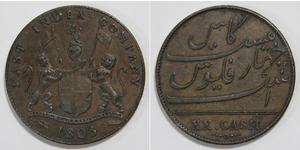
-300-150-sBM32loY8C0AAAFnp5IWgig5.jpg "20 Cash British East India Company (1757-1858) Copper")
20 Cash British East India Company (1757-1858) Copper
group has 7 coins / 5 prices
⇑
-300-150-j6EKbzbirwwAAAFNuRNtvwyS.jpg "1 Ruble Russian Empire (1720-1917) Silver Catherine II (1729-1796)")
1 Ruble Russian Empire (1720-1917) Silver Catherine II (1729 ...
group has 65 coins / 53 prices
⇑