
The Gold Mark
| View | Edit |
The Gold Mark, or "Goldmark" in German, was the official currency of the German Empire from its establishment in 1873 until its dissolution in 1918. Here are some key points about the Gold Mark:
Introduction: The Gold Mark was introduced as part of the German Coinage Reform of 1871-1873, which aimed to standardize the currency system across the newly unified German Empire. It replaced a patchwork of different currencies that had been in use in the various German states prior to unification.
Gold Standard: The Gold Mark was initially tied to the gold standard, meaning that its value was directly linked to a specific quantity of gold. Specifically, one Gold Mark was equivalent to 0.358423 grams of pure gold.
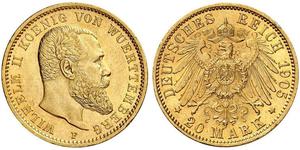
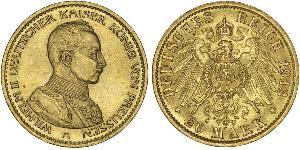
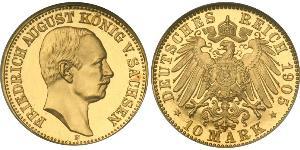
Denominations: The Gold Mark was subdivided into 100 smaller units called "Pfennigs" or "Pfennige." There were various denominations of Gold Mark coins, including 5, 10, and 20 Mark coins, with the 20 Mark coin being the most common and widely circulated.
Design: Gold Mark coins featured various designs depending on the issuing authority and the time period. The obverse typically bore the portrait of the ruling monarch, such as Kaiser Wilhelm I or Kaiser Wilhelm II, along with inscriptions indicating the issuing authority and the denomination. The reverse often depicted national symbols, coats of arms, or other relevant imagery.
Usage: Gold Mark coins were widely used for large transactions, international trade, and as a store of value. They were considered a stable and reliable form of currency due to their tie to the gold standard.
End of the Gold Standard: The gold standard was abandoned during World War I as governments resorted to printing money to finance the war effort. As a result, the value of the Gold Mark became increasingly inflated, leading to its eventual demise.
Legacy: Despite its relatively short existence, the Gold Mark played a crucial role in the economic development of the German Empire and left a lasting legacy in the numismatic history of Germany. Today, Gold Mark coins are highly sought after by collectors for their historical significance and intrinsic value.
You may be interested in following coins
2026-08-27
- Historical Coin Prices
2026-08-26
- New coin is added to 2 Pfennig States of Germany Copper
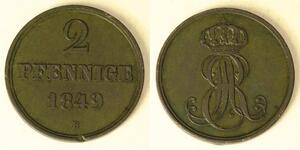
2 Pfennig States of Germany Copper
group has 9 coins / 9 prices
⇑
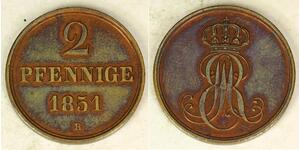
HANNOVER (German State) 2 Pfennig 1851 B - Copper - Ernst August - aUNC - 3753


