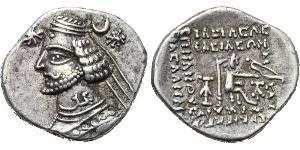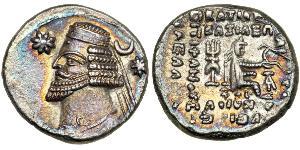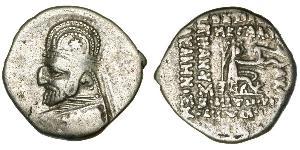
| Orodes I of Parthia (85 - 80 BC) | Link to Wikipedia |
Orodes I of Parthia (c. 80–75 BC): History and Coinage
The Shadowy King
In a realm defined by dynastic rivalry, Orodes I ruled as the son of Gotarzes I during one of ancient Persia's most enigmatic periods. His reign is often overshadowed by literary silence but illuminated by numismatic evidence that bridges gaps in official histories. While some scholars debate the presence of usurpers like Mithridates III, modern historiography increasingly accepts Orodes as a legitimate sovereign who stabilized the empire between established predecessors and his successors.
Orodes is historically significant for reversing independence within Elymais around 78 BC. This campaign demonstrates that Parthian authority remained robust even when written records fail to mention it directly. By subduing local rebels in southwestern Iran, he asserted a direct lineage of power tracing back to the Achaemenids rather than relying solely on new Arsacid legitimacy. His mother likely hailed from Armenian nobility, further embedding him within regional political alliances that sustained his authority against rivals.
The Portrait on Coinage
Coinage provides crucial data regarding political geography during his reign. The majority of Orodes' currency was minted in Ecbatana and Rhagae, central Iranian cities that served as hubs for coin production before the later shifts toward Seleucia or Ctesiphon under subsequent generations.
- Mint Locations: Coins bear marks from cities like Ecbatana (Hamadan) and Rhagae, reflecting administrative focus in western Persia.
- Lifetime Issuance: The currency was produced during active conflict, validating authority against usurpers mentioned in Babylonian reports or among Saka allies who opposed his eventual succession by Sinatruces later on.
The style of these issues often mimics Achaemenid cuneiform traditions rather than purely Greek artistic standards. This choice signaled a cultural reclamation that resonates with collectors interested in imperial identity politics across centuries. These coins were not merely currency but declarations of political unity within the fractured Arsacid house, representing stability during what became known as the Parthian Dark Age.
The Value to Collectors
Orodes I pieces hold immense educational weight for both advanced and entry-level numismatists alike. While many ancient coin catalogs group him loosely with the obscure interregnums of this era, these specific issues allow scholars to trace a lineage often lost in literary texts.
- Rarity: Fewer coins have survived from this period than later generations, making Orodes examples naturally scarce and sought after by specialists.
- Historical Context: They serve as primary documents that physically anchor history which would otherwise be theoretical or entirely missing for standard textbooks regarding the Seleucids-to-Sassanians transition period.
Artistically, these issues display a return to older Persian traditions of record-keeping rather than purely Hellenistic artistic styles prevalent in later antiquity. This stylistic blend offers visual proof that Parthian kings viewed themselves as heirs to Cyrus and Darius despite internal turmoil. Each surviving artifact is a testament to resilience during one of ancient Iran's most enigmatic chapters.
In sum, examining Orodes I's coins connects the viewer directly to administrative struggles while an empire attempted to define itself in decades leading up to its full consolidation under later kings like Vologases II. For those assembling an Arsacid set, finding examples from this transitional era is a challenge that adds depth and authenticity to any private collection.
![STAROŻYTNOŚĆ - PARTIA - Orodes II 58-38 pne. drachma, mennica Suza, Aw: Popiersie króla w lewo, Rw: Siedzący w prawo łucznik (Arkases I), w polu Σt, po bokach ΒΑΣΙΛΕΩ[Σ] ΒΑΣΙΛΕΩΝ ΑΡΣΑΚΟΥ [Ε]ΥΕΡΓΕ ...](https://st.hobbyray.com/fs/300_150/k5QKX9ISbcIAAAFTIdoqgYf5.jpg)