| Kanishka I (?-151) | Link to Wikipedia |
Kanishka (c. 127–150 CE): History and Coinage
In the landscape of ancient imperial history, Kanishka stands as one of the most dynamic figures to have presided over a vast realm stretching from Central Asia down into Northern India. Serving as an emperor of the Kushan dynasty during its golden age, his reign is often defined by military expansion and significant spiritual patronage. Although he never formally converted to any single faith, his influence was instrumental in unifying Greek, Persian, and Indian cultural spheres. His capital located at Puruṣapura served as a vital hub where Greco-Buddhist art flourished alongside the transmission of Mahayana Buddhism towards China.
The Context of Numismatic Legacy
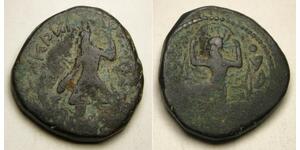
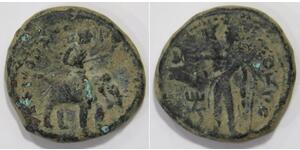
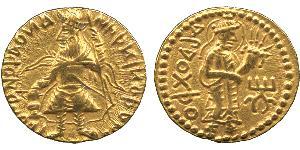
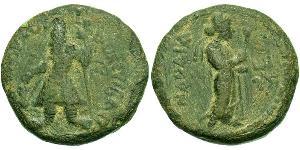
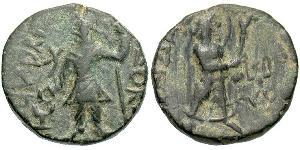
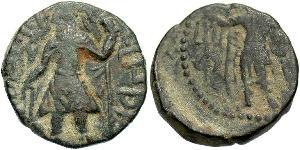
The coins minted during Kanishka's lifetime offer exceptional evidence regarding his political identity and administrative evolution. Early issues from the beginning of his reign featured legends in Greek script, depicting traditional Hellenistic divinities such as Helios or Hephaistos to accommodate westernized subjects within his borders. As Kushan administration solidified control over local populations, later coins transitioned language to Bactrian while retaining a modified alphabet that introduced unique glyphs for indigenous sounds like /š/. Kanishka himself is consistently depicted wearing royal attire reminiscent of Parthian kings, armed with lances or swords and performing sacrificial rites on altars. This visual evolution mirrors the empire's shift from predominantly Hellenic influence toward Persian-centric governance alongside Indian subjects.
The Appeal to Historical Collectors
For specialists in ancient numismatics, Kanishka’s currency represents a crucial chapter of history where world religions collided before being separated by borders. These coins are highly sought after because their legends reveal how political identity changed alongside spiritual affiliation within the same dynasty. A coin depicting Mithra alongside Buddhist symbols signals a ruler who sponsored multiple faiths without conversion to either, making these artifacts vital for understanding religious syncretism in antiquity. Beyond rarity, the artistic quality of Kanishka’s issues is superior due to Gandhara's sculptural tradition influencing minting processes found across his domains including Tripuri and Mathura.
Possessing such pieces allows one to hold a tangible record of how Buddhism traveled from its Indian cradle toward China through Kushan sponsorship. These artifacts remain foundational for understanding cross-cultural exchange in Central Asia, making them indispensable additions to any specialized historical collection focusing on empires that bridged East and West.