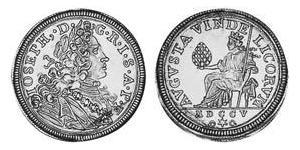
| Joseph I, Holy Roman Emperor (1678 -1711) | Link to Wikipedia |
Joseph I (1678–1711): History and Coinage
Welcome to an exploration of Holy Roman Emperor Joseph I, a sovereign whose reign marked a critical transition within the Habsburg monarchy from late Baroque tradition into emerging Enlightenment governance. Born in Vienna on July 26, 1678, he ascended to the Imperial throne following the death of his father Leopold I at an age where Europe was already weary from prolonged conflict. His reign began during the War of Spanish Succession, a global struggle against Louis XIV's France that demanded vast financial resources for military campaigns led by generals like Prince Eugene of Savoy.
Jospeh was educated as a linguist and lover of music before becoming Emperor at age twenty-eight after his father died unexpectedly in 1705. Unlike some predecessors, he sought modernizing reforms to stabilize the bureaucracy and reduce reliance on feudal privileges which strained state finances. However, his rule ended abruptly when smallpox claimed his life just six years later, leaving an unfinished legacy of financial consolidation that continued under his brother Charles VI.
The Relationship to Coinage
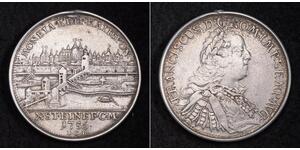
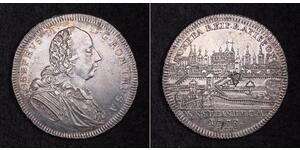
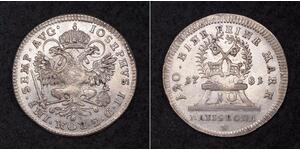
Coin collectors familiar with Habsburg history will recognize Joseph I as a key figure in early eighteenth-century numismatics. During his short reign, Vienna issued silver and copper coinage that served practical economic needs while projecting imperial authority across Europe. These coins were struck primarily during the height of war, when securing treasury funds was vital for maintaining armies abroad.
- The Imperial Portrait: His effigy appeared on thalers and ducats alongside traditional heraldic symbols like the double-headed eagle.
- Mint Authority: The central mint in Vienna maintained strict control during his time to stabilize finances after decades of inflation under previous regimes, ensuring high-quality strikes that define these issues today. Collectors examine pieces for uniformity representing bureaucratic reforms implemented across Central Europe before he died unexpectedly from infection rather than old age.
Why Collectors Value These Coins
Jospeh's coinage holds a specific allure within historical numismatics, particularly among those seeking to complete the set of Habsburg rulers during this turbulent period. Primarily, their scarcity drives interest because fewer dates exist in high grades compared to his long-reigning father.
- Rarity: The brevity of his life means limited production runs were required before the succession pact forced new coinage under Charles VI and subsequently Marie Theresa later on.
- Narrative Value: Holding a coin from this era allows one to touch currency used during Europe's greatest conflicts against French expansion. Reverse designs often depicted military victories secured by Prince Eugene of Savoy who acted alone in Italy before the conflict officially ended at Utrecht after Joseph passed away.
Serious collectors understand that each issue provides insight into a moment when Austria sought to preserve its standing as a great power despite internal rebellion and external threats. The artistic quality found on these medals reflects a bridge between old courtly splendor and new rational statecraft, making them essential additions to any specialized collection of early modern European currency.