| Heinrich XXIV, Prince Reuss of Greiz | Link to Wikipedia |
Heinrich XXIV, Prince Reuss of Greiz (1878–1927): History and Coinage
The life of Heinrich XXIV marks the twilight of an era in Central European aristocracy. Born on 20 March 1878 at Greiz within the Principality of Reuss-Greiz, he ascended to the throne following his father’s death on 19 April 1902. His reign lasted from 1902 until the abolition of German monarchies in November 1918 during the Weimar Republic transition. Unlike many European nobility who expanded their lines, Heinrich XXIV remained single and died without issue at age forty-nine on 13 October 1927. This personal tragedy marked an immediate extinction for his specific branch of the House Reuss.
Beyond mere succession laws, his historical significance is amplified by a complex family tree involving distinguished marriages among five younger sisters. Princess Ida eventually married into Stolberg-Rossla, while others became Empress or Duchess in German principalities like Saxe-Weimar and Eisenach through their spouses from other ruling lines such as the Habsburg sphere relatives mentioned implicitly via his daughters-in-law connections. However, for coin historians, it is Heinrich XXIV’s status that defines numismatic records rather than his sisters—his death meant titles passed to a cousin in Reuss Younger Line.
The Numismatic Context
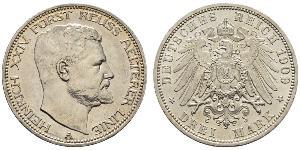
To understand the coins featuring this figure requires context regarding late Imperial German currency systems. Under authorization from Berlin, constituent states like Greiz maintained minting rights or authorized specific markings on coinage circulating within their territories before 1908 and up to World War One disruption. While many minor states used imperial designs, those representing local princes during the sovereign period (pre-1918) are distinct artifacts of that pre-unification autonomy.
Circulation ceased after Heinrich was incapacitated by regency in earlier stages or post-WWI reforms effectively ended such minting for minor territories. Consequently, most coinage associated with his tenure reflects an economic climate transitioning from local currency standards to a unified Reichsmark system. The rarity of these pieces stems not just from low production numbers typical of small state mints but also the sudden cessation of official printing.
Appeal for Modern Collectors
The primary draw for numismatists lies in their connection to a vanishing political structure that survived until 1927. Acquiring these items provides insight into regional sovereignty, offering tangible proof of the minor states’ existence before they dissolved under republican reforms.
- Rarity: Mintages for Reuss-Greiz coins were significantly lower than major imperial territories due to limited economic need within small principalities.
- Historical Weight: Each piece represents the final years of local German rule before central government took total control over monetary policy in Germany post-1918.
- Genealogical Significance: Collectors often seek these items to trace specific family lines ending with Heinrich, distinguishing his unprovenanced status from those who left heirs or marriages producing future coinage legends elsewhere.
Scholars and collectors are encouraged to examine provenance documentation on any Reuss-Greiz issues, as the transition period offers a unique window into German history’s shift from monarchy toward modern republic governance. These artifacts serve not merely as currency but as memorials to local sovereignty.