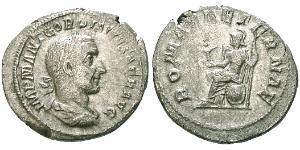
| Gordian I Africanus (159-238) | Link to Wikipedia |
Gordian I c. 158 – 238 CE: History and Coinage
Introduction to Roman Imperial Legitimacy during Crisis
Marcus Antonius Gordianus Sempronianus Romanus, known historically as Gordian I, served a fleeting but significant tenure on the throne of Rome. Rising through the senatorial ranks in late antiquity, he represented a class of men who prioritized civic duty over ambition until forced into power during the chaotic Year of Six Emperors in AD 238.
Circumstance propelled Gordian I from his retirement as governor to command Africa Proconsularis against the tyrannical rule of Maximinus Thrax. His willingness to accept the imperial purple despite being over eighty years old highlights a pivotal moment where the stability of Rome hung in balance on the shoulders of two reluctant emperors—Gordian and his son Gordian II.
The Numismatic Record
Minting during Instability:
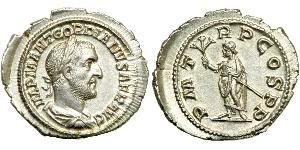
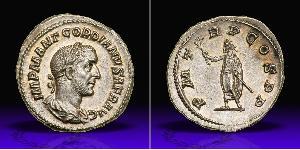
- Era and Authority: While most emperors issue coins throughout their career for public commemoration or propaganda purposes, Gordian I was a figure of rebellion rather than establishment. Coins struck during his short rule were typically intended to demonstrate loyalty to the Senate in Italy as an alternative to Maximinus.
- Fabrication and Attribution: Many pieces attributed historically to this era often originate from rebel mints that attempted to propagate Gordian's lineage, linking back to Roman emperors like Antoninus Pius. Collectors must distinguish genuine issues of the Year of Six Emperors in Africa from later productions or those minted during his son's tenure.
- Mint Locations: Evidence suggests that coinage production was centered on African provinces under rebel control, attempting to project imperial authority across the Mediterranean even as their hold wavered.
The Value for Educated Collectors
Rarity and Historical Weight: The appeal of numismatic artifacts linked to this period lies primarily in rarity. Few specimens exist that definitively belong to the father or son jointly, making any verified issues highly prized within specialized ancient coin circles.
- Educational Context: Acquiring pieces from this specific year allows collectors to study how iconography was used rapidly during insurrection. Legends on these coins often reference African loyalty and Roman virtue rather than standard victories or divine favors common in stable dynasties.
Institutional Importance: Beyond simple rarity, items connected to Gordian I illustrate the fragility of imperial succession when facing a tyrannical ruler. The visual representation—or lack thereof—of his visage speaks volumes about how quickly legitimacy could vanish in Rome. For collectors focusing on political history or specific eras like 238 CE, these objects provide tangible proof of resistance.
Connection to Legacy: While physical coinage is scarce compared to the vast output of Gordian III later in his reign who inherited this lineage through Faustina. Studying potential examples helps fill gaps regarding how early rebels attempted to establish a new regime before their ultimate failure, offering unique insight into the mechanics of ancient political economy during crisis.