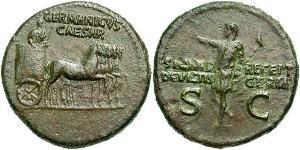
| Germanicus Julius Caesar | |
|---|---|

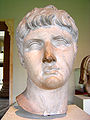
Bust of Germanicus
|
|
| Spouse | Agrippina the Elder |
| Issue | Nero Caesar Drusus Caesar Caligula, Emperor of Rome Agrippina the Younger, Empress of Rome Julia Drusilla Julia Livilla |
| Father | Nero Claudius Drusus |
| Mother | Antonia Minor |
| Born | 24 May 15 BC Rome, Italia, Roman Empire |
| Died | 10 October AD 19 (aged 34) Antioch, Syria, Roman Empire |
| Burial | Mausoleum of Augustus |
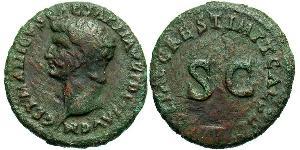
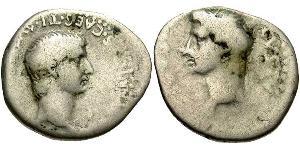
Germanicus Julius Caesar (24 May 15 BC – 10 October AD 19), commonly known as Germanicus, was a member of the Julio-Claudian dynasty and a prominent general of the early Roman Empire. He was born in Rome, Italia, and was named either Nero Claudius Drusus after his father or Tiberius Claudius Nero after his uncle. He was the grandson-in-law and great-nephew of the Emperor Augustus, nephew and adoptive son of the Emperor Tiberius, father of the Emperor Caligula, brother of the Emperor Claudius, and the maternal grandfather of the Emperor Nero. He received the agnomen Germanicus in 9 BC, when it was posthumously awarded to his father in honour of his victories in Germania.
His own campaigns in Germania made him famous after avenging the defeat at the Battle of the Teutoburg Forest and retrieving the legion's eagles lost during the battle. Beloved by the people, he was widely considered to be the perfect Roman long after his death.[1] The Roman people for centuries would consider him as Rome's Alexander the Great due to the nature of his death at his young age, his virtuous character, and his military renown.[2]
Contents
Family and early life[edit]
Germanicus was born in Rome in 15 BC. His parents were the general Nero Claudius Drusus (son of Empress Livia Drusilla, third wife of Emperor Augustus) and Antonia Minor (the younger daughter of the triumvir Mark Antony and Octavia Minor, sister of Augustus). Livilla was his younger sister and the future Emperor Claudius was his younger brother.[3]
.JPG)
Germanicus married his maternal second cousin Agrippina the Elder, a granddaughter of Augustus, between 5 and 1 BC. The couple had nine children: Nero Caesar, Drusus Caesar, Tiberius Julius Caesar (not to be confused with emperor Tiberius), a child of unknown name (normally referenced as Ignotus), Gaius the Elder, the Emperor Caligula (Gaius the Younger), the Empress Agrippina the Younger, Julia Drusilla, and Julia Livilla. Only six of his children came of age; Tiberius and the Ignotus died as infants, Gaius the Elder in his early childhood. Through Agrippina the Younger, Germanicus was maternal grandfather of the Emperor Nero.
Germanicus became immensely popular among the citizens of Rome, who enthusiastically celebrated his military victories. He was also a favourite with Augustus, his great-uncle, who for some time considered him heir to the Empire. In AD 4, persuaded by Livia, his wife, Augustus decided in favour of Tiberius, his stepson from Livia's first marriage to Tiberius Claudius Nero. However, Augustus compelled Tiberius to adopt Germanicus as a son and to name him as his heir (see Tacitus, Annals IV.57). Upon this adoption, Germanicus's name was changed to Germanicus Julius Caesar. He also became the adoptive brother of Tiberius's natural son Drusus the Younger.
Germanicus held several military commands, leading the army in the campaigns in Pannonia and Dalmatia. He is recorded to have been an excellent soldier and an inspired leader, loved by the legions. In the year 12AD he was appointed consul after five mandates as quaestor.
Commander of Germania[edit]


After the death of Augustus in AD 14, the Senate appointed Germanicus commander of the forces in Germania.[4] A short time after, the legions rioted on the news that their recruitments would not be marked back down to 16 years from the then standard 20.[5] Refusing to accept this, the rebel soldiers cried for Germanicus as emperor.[5] Germanicus put down this rebellion himself, preferring to continue only as a general. In a bid to secure the loyalty of his troops and his own popularity with them and with the Roman people, he led them on a spectacular but brutal raid against the Marsi, a German tribe on the upper Ruhr river, in which he massacred much of the tribe and recovered one of the three legions' Eagle standards.[6]
During each of the next two years, he led his 8-legion army into Germany against the coalition of tribes led by Arminius, which had successfully overthrown Roman rule in a rebellion in 9 AD. In 14 A.D., his legions routed and destroyed most of the Bructeri tribe and recovered the lost Eagle of the 19th Legion. His major success was the capture of Arminius' wife Thusnelda in May 15.[7] He let Arminius' wife sleep in his quarters during the whole of the time she was a prisoner. He said, "They are women and they must be respected, for they will be citizens of Rome soon". He was able to devastate large areas and eliminate any form of active resistance, but the majority of the Germans fled at the sight of the Roman army into remote forests. The raids were considered a success since the major goal of destroying any rebel alliance networks was completed.
After visiting the site of the disastrous Battle of the Teutoburg Forest, where 3 Roman legions (15,000 men) had been killed in AD 9, and burying their remains,[8] he launched a massive assault on the heartland of Arminius' tribe, the Cherusci. Arminius initially lured Germanicus' cavalry into a trap and inflicted minor casualties, until successful fighting by the Roman infantry caused the Germans to break and flee into the forest.[9] This victory, combined with the fact that winter was fast approaching, meant Germanicus's next step was to lead his army back to its winter quarters on the Rhine.
In spite of doubts on the part of his uncle, Emperor Tiberius, Germanicus managed to raise another huge army and invaded Germany again the next year, in 16 AD. He forced a crossing of the Weser River near modern Minden, and then met Arminius' army at Idistaviso, further up the Weser, near modern Rinteln, in an engagement often called the Battle of the Weser River. Germanicus' leadership and command qualities were shown in full at the battle as his superior tactics and better trained and equipped legions inflicted huge casualties on the German army with only minor losses.[10] One final battle was fought at the Angivarian Wall west of modern Hanover, repeating the pattern of high German fatalities forcing them to flee.[11]
With his main objectives reached and with winter approaching Germanicus ordered his army back to their winter camps, with the fleet occasioning some damage by a storm in the North Sea.[12] Although only a small number of soldiers died it was still a bad ending for a brilliantly fought campaign. After a few more raids across the Rhine, which resulted in the recovery of two of the three legion's eagles lost in 9 AD, Germanicus was recalled to Rome and informed by Tiberius that he would be given a triumph and reassigned to a different command.[13]
Despite the successes enjoyed by his troops, Germanicus' German campaign was in reaction to the mutinous intentions of his troops, and lacked real strategic value. In addition he engaged the German leader (Arminius) who had destroyed three Roman legions in 9, and exposed his troops to the remains of those dead Romans. Furthermore, in leading his troops across the Rhine, without recourse to Tiberius, he contradicted the advice of Augustus to keep that river as the boundary of the empire, and opened himself to doubts about his motives in such independent action. These errors in strategic and political judgement gave Tiberius reason enough to recall his nephew.[14]
Command in Asia and death[edit]


In an attempt to separate Germanicus from his troops and weaken his influence,[15] Tiberius sent him to Asia, where in 18 AD he defeated the kingdoms of Cappadocia and Commagene, turning them into Roman provinces. During a sightseeing trip to Egypt (not a regular province, but the personal property of the Emperor) he seems to have unwittingly usurped several imperial prerogatives.[16] The following year he found that the governor of Syria, Gnaeus Calpurnius Piso, had canceled the provincial arrangements that he had made. Germanicus in turn ordered Piso's recall to Rome, although this action was probably beyond his authority.[16]
In the midst of this feud Germanicus was stricken with a mysterious illness and died shortly thereafter in Antioch.[17] His death aroused much speculation, with several sources blaming Piso, acting under orders from Emperor Tiberius. This was never proven, and Piso later died while facing trial (ostensibly by suicide, but Tacitus supposes Tiberius may have had him murdered before he could implicate the emperor in Germanicus' death). He feared the people of Rome knew of the conspiracy against Germanicus, but Tiberius' jealousy and fear of his nephew's popularity and increasing power was the true motive as understood by Tacitus.[18]
The death of Germanicus in what can only be described as dubious circumstances greatly affected Tiberius' popularity in Rome, leading to the creation of a climate of fear in Rome itself. Also suspected of connivance in his death was Tiberius' chief advisor, Sejanus, who would, in the 20s, create an atmosphere of fear in Roman noble and administrative circles by the use of treason trials and the role of delatores, or informers.[19]
Posthumous honours[edit]
When Germanicus' death was announced in Rome December of 19, the news brought much public grief in the city and throughout the Roman Empire. There was public mourning during the festive days in December. The historians Tacitus and Suetonius record the funeral and posthumous honors of Germanicus. At his funeral, there were no procession statues of Germanicus. There were abundant eulogies and reminders of his fine character.
His posthumous honors included his name was placed into the following: the Carmen Saliare; the Curule chairs; placed as an honorary seat of the Brotherhood of Augustus and his coffin was crowned by oak-wreaths. Other honors include his ivory statue as head of procession of the Circus Games; his posts of priest of Augustus and Augur were to be filled by members of the imperial family; knights of Rome gave his name to a block of seats to a theatre in Rome.
Arches were raised to him throughout the Roman Empire, in particular ones that recorded his deeds and death at Rome, Rhine River and Nur Mountains. In Antioch, where he was cremated, he had a sepulchre and funeral monument dedicated to him.
On the day of Germanicus’ death his sister Livilla gave birth to twins. The second, named Germanicus, died young. In 37, when Germanicus’ only remaining son, Caligula, became emperor, he renamed September Germanicus in honor of his father. Many Romans considered him as their equivalent to King Alexander the Great, and believe that he would have easily surpassed the achievements of Alexander had he become emperor.[2] Germanicus' grandson was Emperor Nero who died in 68 and was the last of the Julio-Claudian dynasty.
Literary activity[edit]
Germanicus made a Latin version, which survives, of Aratus's Phainomena, for which reason he is ranked among Roman writers on astrology. His work was popular enough for scholia to be written on it, which have survived.
Germanicus in historical fiction[edit]
Robert Graves, in his fictional historical novel I, Claudius, blames the death of Germanicus on Plancina, the wife of Piso, who engaged a witch named Martina to haunt Germanicus' household. The infant Caligula is also implicated. In Graves' version, Plancina begins to place curses on Germanicus, who is extremely superstitious. Caligula, who is only 5 years old at the time, completes the curse and kills his father, because his father had tried to discipline him.
He was portrayed by David Robb in the 1976 BBC-produced TV series I, Claudius.[20] Germanicus is portrayed as virtuous, brave and strongly devoted to his brother Claudius. Piso and his wife, Plancina, were at the root of the plot to poison Germanicus, with tacit consent from Tiberius' mother, Livia, working through a local poisoner named Martina. Livia later confesses to Claudius that she had marked Germanicus for elimination because of his Republican sentiments, although Plancina acted on her own initiative.
In a later episode, Caligula brags to his uncle Claudius that he killed his father in revenge for trying to discipline him, by working on his father's superstitions (planting various 'curses' around his father's residence) and eventually frightening him to death - apparently never realizing that his father was also being poisoned by Martina (Zeus, by Jove! - "I, Claudius" episode 8).
He was featured in the ITV historical drama series The Caesars, played by Eric Flynn; the second episode is also named 'Germanicus'. This series differed in its less sensationalist and more rational treatment of the historical characters and their motives than I, Claudius. Piso, a friend of Tiberius, is implicated in his death more through his own arrogance and open dislike of Germanicus than by any concrete evidence against him.
Photo gallery[edit]
-
Nero Drusus the Elder -

Antonia Minor -

Julia Agrippina the Major -

Gaius Caesar (Caligula) -

Julia Drusilla -

Julia Agrippina Minor -

Nero Caesar


_01.jpg)

Ancestry[edit]
| Ancestors of Germanicus | ||||||||||||||||||||||||||||||||||||||||||||||||||||||||||||||||||||||||||||||||||||||||||||||||||||||||||||||||||||||||||||||||||||||||||||||||||||||||||||||||||||||||||||||||||||||||||||||||||||||||||||||||||||||||||||||||||||||||||||||||||||||||||||||||||||||||||||||||||||||||||||||||||||||||||||||||||||||||||||||||||||||||||||||||||||||||||||||||||||||||||||||||||||||||||||||||||||||||||||||||||||||||||||||||||||||||||||||||||||||||||||||||||||||||||||||||||
|---|---|---|---|---|---|---|---|---|---|---|---|---|---|---|---|---|---|---|---|---|---|---|---|---|---|---|---|---|---|---|---|---|---|---|---|---|---|---|---|---|---|---|---|---|---|---|---|---|---|---|---|---|---|---|---|---|---|---|---|---|---|---|---|---|---|---|---|---|---|---|---|---|---|---|---|---|---|---|---|---|---|---|---|---|---|---|---|---|---|---|---|---|---|---|---|---|---|---|---|---|---|---|---|---|---|---|---|---|---|---|---|---|---|---|---|---|---|---|---|---|---|---|---|---|---|---|---|---|---|---|---|---|---|---|---|---|---|---|---|---|---|---|---|---|---|---|---|---|---|---|---|---|---|---|---|---|---|---|---|---|---|---|---|---|---|---|---|---|---|---|---|---|---|---|---|---|---|---|---|---|---|---|---|---|---|---|---|---|---|---|---|---|---|---|---|---|---|---|---|---|---|---|---|---|---|---|---|---|---|---|---|---|---|---|---|---|---|---|---|---|---|---|---|---|---|---|---|---|---|---|---|---|---|---|---|---|---|---|---|---|---|---|---|---|---|---|---|---|---|---|---|---|---|---|---|---|---|---|---|---|---|---|---|---|---|---|---|---|---|---|---|---|---|---|---|---|---|---|---|---|---|---|---|---|---|---|---|---|---|---|---|---|---|---|---|---|---|---|---|---|---|---|---|---|---|---|---|---|---|---|---|---|---|---|---|---|---|---|---|---|---|---|---|---|---|---|---|---|---|---|---|---|---|---|---|---|---|---|---|---|---|---|---|---|---|---|---|---|---|---|---|---|---|---|---|---|---|---|---|---|---|---|---|---|---|---|---|---|---|---|---|---|---|---|---|---|---|---|---|---|---|---|---|---|---|---|---|---|---|---|---|---|---|---|---|---|---|---|---|---|---|---|---|---|---|---|---|---|---|---|---|---|---|---|---|---|---|---|---|---|---|---|---|---|---|---|---|---|---|---|---|---|---|---|---|---|---|---|---|---|---|---|---|---|---|---|---|---|---|---|---|---|---|---|---|---|---|---|---|---|---|---|---|---|---|---|
|
||||||||||||||||||||||||||||||||||||||||||||||||||||||||||||||||||||||||||||||||||||||||||||||||||||||||||||||||||||||||||||||||||||||||||||||||||||||||||||||||||||||||||||||||||||||||||||||||||||||||||||||||||||||||||||||||||||||||||||||||||||||||||||||||||||||||||||||||||||||||||||||||||||||||||||||||||||||||||||||||||||||||||||||||||||||||||||||||||||||||||||||||||||||||||||||||||||||||||||||||||||||||||||||||||||||||||||||||||||||||||||||||||||||||||||||||||
References[edit]
- ^ Suetonius, "Life of Caligula" 3.1 "It is the general opinion that Germanicus possessed all the highest qualities of body and mind, to a degree never equalled by anyone" http://www.johndclare.net/AncientHistory/Agrippina_Sources1.html
- ^ a b Tacitus, "Annals" 2.73 "If he had become emperor,... he would have surpassed Alexander in military success as easily as he did in mercy, moderation and all the other worthwhile qualities." http://www.johndclare.net/AncientHistory/Agrippina_Sources1.html
- ^ J. W. Meijer (translator) Tacitus: Jaarboeken (Ab excessu divi Augusti Annales). Ambo, 1990. ISBN 902631065X ISBN 9789026310652 – pp. 576–577
- ^ Tacitus, The Annals 1.14
- ^ a b Tacitus, The Annals 1.31
- ^ Tacitus, The Annals 1.51
- ^ Tacitus, The Annals 1.57
- ^ Tacitus, The Annals 1.62
- ^ Tacitus, The Annals 1.63
- ^ Tacitus, The Annals 2.18
- ^ Tacitus, The Annals 2.21
- ^ Tacitus, The Annals 2.24
- ^ Tacitus, The Annals 2.26
- ^ David Shotter, Tiberius Caesar (London: Routledge, 1992) 35-37
- ^ Tacitus, Annals 2.5 "As for Tiberius, the disruption of affairs in the East was not an unwelcome development, since with that pretext he could drag Germanicus away from his familiar legions and install him in new provinces" http://mcadams.posc.mu.edu/txt/ah/tacitus/TacitusAnnals02.html
- ^ a b Shotter, 38
- ^ Tacitus, The Annals 2.72
- ^ Tacitus, Annals 2.26. "Germanicus... saw... that he was hurried away through jealousy from the glory he had already acquired." http://mcadams.posc.mu.edu/txt/ah/tacitus/TacitusAnnals02.html
- ^ Allen M.Ward, Fritz M. Heichelheim, and Cedric A. Yeo. A History of the Roman People, 5th Ed. (Upper Saddle River, NJ: Prentice Hall, 2010), 297.
- ^ "David Robb on IMDB". IMDB. 2013. Retrieved November 7, 2013.
External links[edit]
- (Soprintendenza per i Beni Archeologici dell'Umbria) "The Bronze Statue of Germanicus" of Amelia (Terni). Circumstances of the chance discovery in 1963 and restoration of this extremely fine heroic portrait bronze.
- Works by or about Germanicus in libraries (WorldCat catalog)
- Life of Caligula by Suetonius (Loeb Classical Library translation) Much of Caligua's biography focuses on his famous father.
- Life of Caligula by Suetonius (Alexander Thomson translation)
 |
Wikimedia Commons has media related to Germanicus. |
| Political offices | ||
|---|---|---|
| Preceded by Manius Aemilius Lepidus and Titus Statilius Taurus |
Consul of the Roman Empire together with Gaius Fonteius Capito 12 |
Succeeded by Gaius Silius Aulus Caecina Largus and Lucius Munatius Plancus |
| Preceded by Lucius Pomponius Flaccus and Gaius Caelius Rufus |
Consul of the Roman Empire together with Tiberius 18 |
Succeeded by Marcus Junius Silanus Torquatus and Lucius Norbanus Balbus |
|