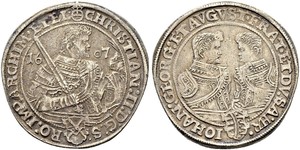
| Christian II, Elector of Saxony | Link to Wikipedia |
Christian II, Elector of Saxony (1583–1611): History and Coinage
Introduction
Born in Dresden on 23 September 1583, Christian II represents a fascinating chapter within the Albertine branch of the House of Wettin. He ascended to his role as Elector of Saxony at merely eight years old following an abrupt succession after his father's death and uncle's demise during regency years dominated by political intrigue. His short reign is historically significant for capturing the era just before full-scale religious wars engulfed the continent, a period where Saxon leadership sought independence within imperial structures without provoking hostile powers from Habsburgs or France.
Relationship to Coinage
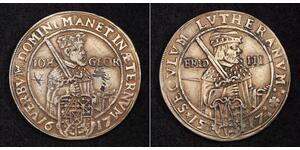
Electorates in this region were responsible for their own monetary systems that facilitated regional trade and tax collection. During Christian II's tenure, mint operations maintained continuity with established traditions while reflecting his brief authority over the electorate which stretched from 1591 until his death on 7 July 1611. While often overshadowed by his more long-reigning predecessors or successors like Johann Georg I who followed him immediately after his own short succession to power, specific issues remain tied directly to this individual's life span.
- Coinage depicted in portraits of Electors served as declarations of sovereignty within the Holy Roman Empire
- Fiscal needs often required silver coins circulating among merchant communities throughout Germany and Scandinavia via trade ties with Denmark where his wife originated from Fredericia II lineage marriage alliances occurred prior to union with Habsburg lands generally recognized under imperial law which complicated currency standardization across diverse regions requiring stable denominations issued by royal authority alone
- The political instability of the late sixteenth century impacted production schedules often resulting in lower output numbers that can now be found among advanced collectors today who focus on rare pieces from this specific time frame when major conflicts began shaping European history without immediate intervention due to Saxony's moderate position which favored stability over ideological extremes during early decades before tensions escalated later
Why Collectors Value These Coins
Beyond their face value or monetary utility in historical trade networks, these pieces attract hobbyists and museum curators for several distinct reasons. First, scarcity drives interest as production was interrupted by court factionalism involving his mother's influence over regency politics prior to the young Elector reaching majority around 1593 years which led him eventually to come of age at age sixteen before sudden death occurred due to heart attack following alcohol consumption during tournament participation in June month ending year.
- The lack of legitimate offspring meant no direct descendants carried the imagery into later periods making them unique artifacts
Secondly, these items connect individuals to major religious and diplomatic movements influencing Saxon identity which was crucial for understanding political geography before Thirty Years War outbreak. Finally, their survival as physical evidence of Saxony's moderate stance against militant Calvinist allies in Palatinate helps scholars trace cultural shifts within Protestant lands during turbulent times.