
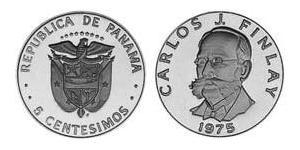

| Carlos Finlay (1833 – 1915) | Link to Wikipedia |
Carlos Juan Finlay {December 3, 1833 – August 20, 1915}: History and Coinage
In the grand tapestry of global history, few stories illustrate scientific perseverance quite like that of Carlos Juan Finlay. A Cuban epidemiologist born in Puerto Príncipe (now Camagüey), he dedicated his career to demystifying infectious diseases during a volatile geopolitical era.
A Medical Revolutionary
Finlay’s journey began with humble origins before moving to Philadelphia for advanced studies at Jefferson Medical College. It was there, amidst political turmoil in Europe and personal hardships like illness abroad, that he formed the hypothesis that mosquitoes acted as disease vectors rather than miasma.
In 1881, Finlay presented this theory internationally but faced ridicule from his peers who still believed disease spread through bad air. Despite mockery, he persisted with exhaustive proofs for nearly two decades until the Walter Reed Commission confirmed his work in 1900. His discovery allowed General William C. Gorgas to eliminate malaria and yellow fever risks during the construction of the Panama Canal.
This breakthrough saved countless lives and enabled safe passage through Central America, but Finlay did not live long enough to see the full magnitude of his impact on international health security. He served as chief health officer for Cuba before succumbing to a stroke in 1915. Though nominated seven times for the Nobel Prize due to scientific bias, he remains a pivotal figure bridging medical science and national history.
The Numismatic Legacy
Collectors encounter Finlay not on standard circulation currency like earlier presidents or military leaders but through specialized commemorative medals issued by the Cuban state. Following his 1908 Legion of Honour award from France, President Gerardo Machado established the National Order of Merit Carlos J. Finlaw in 1928.
- Type: These items serve as high-grade decorations and historical artifacts rather than tender change.
- Circumstance: Issued posthumously to honor contributions to healthcare, they were revived after the 1958 revolution.
The inclusion of his name on such orders connects numismatic enthusiasts directly to the history of tropical medicine. While rare in public mints compared to political figures, these pieces represent a unique intersection between scientific advancement and national pride for Cuban medical science. They stand as tangible reminders that knowledge can be as powerful as conquest.
Why Collectors Value These Issues
For the historical collector, Finlay’s commemorative medals offer more than aesthetic appeal; they serve as documented proof of early twentieth-century scientific achievement. Their scarcity compared to state honors for military heroes makes them sought after by specialists in Cuban history and medical numismatics.
The association with major events like the Panama Canal construction adds significant educational value, encouraging collectors to explore connections between geography, science, and currency artistry preserved through these unique artifacts.


