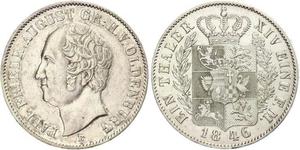
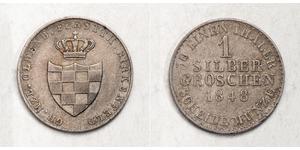
| Augustus, Grand Duke of Oldenburg | Link to Wikipedia |
Paul Frederick Augustus 1783–1853: History and Coinage
In the tapestry of German statecraft during the nineteenth century, few figures are as quietly pivotal yet distinctively represented in history books regarding regional sovereignty as Paul Frederick Augustus. Born on July 13th, 1783, he inherited a throne from his father after significant political upheavals associated with Napoleon's era. His reign, beginning May 21st of 1829 until his passing in 1853, marked a unique transition where the state formally adopted the title "Grand Duke," distinguishing himself and Oldenburg as an independent entity rather than merely holding under lesser titles previously used by predecessors.
Beyond formalities, Paul Frederick Augustus was known to history enthusiasts for his role as a patriarchal reformer who prioritized agricultural stability over radical political change. While he initially hesitated regarding constitutional demands common among European rulers of the 1830s and 40s, it was only under pressure following the Revolutions of 1848 that modern governance took root in Oldenburg. This era allowed the state to focus on economic vitality along the Weser River. His leadership facilitated a period where trade flourished across the Jade and lower Weser estuaries, positioning the city-state as a cultural hub in Northwestern Germany.
Numerical Representation
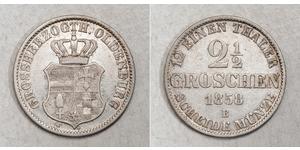
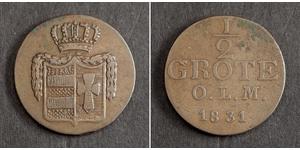
The numismatic record of Paul Frederick Augustus serves as a tangible link to this Hanseatic state. Unlike his neighbors or larger entities such as Prussia which dominated European currency circulation at the time, Oldenburg maintained its own distinct coinage system throughout the early Victorian era. The coins bearing his profile were issued exclusively during his lifetime and shortly after his death in posthumous commemorations.
- The portraits on these pieces typically followed classical numismatic conventions of the period—featuring laureated heads or draped busts symbolizing authority, virtue, and lineage.
- This iconography was employed to unify trade within Oldenburg's small borders. It served not only as legal tender for local transactions but also carried his name across the North German Confederation.
- The coins were struck at mints utilizing older traditions of sovereigns minting currency in lieu of centralized imperial issues, common among semi-sovereign German principalities before unification under a single Reich mark standard.
Intrinsic Value to Collectors
Why do collectors today pursue these pieces? For the student or enthusiast of numismatics, Augustus I offers an opportunity for deep historical context that goes beyond mere metal. His reign represents a specific period where small German principalities preserved their individuality amidst rising nationalism and unification pressures.
Collectors are attracted to this series because they complete otherwise incomplete collections dedicated to the Hanseatic League's legacy or regional variations of coinage not widely circulated internationally. The artistry is simple yet elegant, typical of early-to-mid 19th-century engraving styles where the focus was on clarity for minting and public trust rather than elaborate artistic expression found in later imperial issues.
Furthermore, these coins provide a window into how regional rulers balanced tradition with reform. A single date from his reign helps trace the evolution of administrative reforms that occurred during those turbulent decades following 1830. For anyone looking to explore numismatics beyond standard major power collections, exploring Paul Frederick Augustus's currency offers an engaging entry point for understanding local German history through a tangible object in hand.