
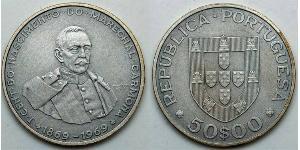
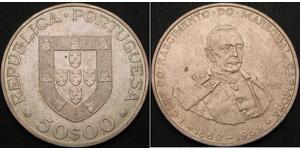
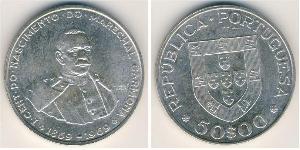

|
This article
needs additional citations for verification.
(August 2013)
|
|
Óscar Carmona
|
|
|---|---|
 |
|
| President of Portugal | |
| In office 29 November 1926 – 18 April 1951 |
|
| Prime Minister | José Vicente de Freitas Artur Ivens Ferraz Domingos Oliveira António de Oliveira Salazar |
| Preceded by | Manuel Gomes da Costa |
| Succeeded by | Francisco Craveiro Lopes |
| Prime Minister of Portugal | |
| In office 9 July 1926 – 18 April 1928 |
|
| Deputy | Abílio Passos e Sousa |
| Preceded by | Manuel Gomes da Costa |
| Succeeded by | José Vicente de Freitas |
| Minister for Foreign Affairs | |
| In office Acting 4 September 1926 – 24 September 1926 |
|
| Preceded by | Bettencourt Rodrigues |
| Succeeded by | Bettencourt Rodrigues |
| In office 3 June 1926 – 6 July 1926 |
|
| Prime Minister | José Mendes Cabeçadas Manuel Gomes da Costa |
| Preceded by | Armando da Gama Ochoa |
| Succeeded by | Martinho Nobre de Melo |
| Minister of War | |
| In office 9 July 1926 – 16 November 1926 |
|
| Preceded by | Manuel Gomes da Costa |
| Succeeded by | Abílio Passos e Sousa |
| In office 15 November 1923 – 18 December 1923 |
|
| Prime Minister | António Ginestal Machado |
| Preceded by | António Maria da Silva |
| Succeeded by | António Ribeiro de Carvalho |
| Personal details | |
| Born |
António Óscar Fragoso Carmona
24 November 1869 Lisbon, Kingdom of Portugal |
| Died | 18 April 1951 (aged 81) Lisbon, Portuguese Republic |
| Political party | National Union (1932–1951) |
| Spouse(s) | Maria do Carmo da Silva |
| Children | Cesaltina Amélia António Adérito Maria Inês |
| Alma mater | Portuguese Military Academy |
| Profession | Army officer |
| Awards | Order of Christ Order of Aviz Order of St. James of the Sword |
| Military service | |
| Allegiance |  Kingdom of Portugal Kingdom of Portugal Portugal Portugal |
| Branch/service |  Portuguese Army Portuguese Army |
| Years of service | 1889–1951 |
| Rank | Marshal |
| Commands | Portuguese Army 4th Division (1922–1925) |
António Óscar Fragoso Carmona BTO ComC GCA ComSE (Portuguese pronunciation: [ɐ̃ˈtɔniu ˈɔʃkaɾ fɾɐˈɡozu kaɾˈmonɐ]; 24 November 1869 – 18 April 1951) was a Portuguese Army officer and politician who served as the 96th Prime Minister of Portugal from 1926 to 1928 and 11th President of Portugal from 1926 until his death in 1951. He also served as the Minister of War in late 1923 and in 1926, and he also served two times as a Minister of Foreign Affairs in 1926.
Political origin[edit]
Carmona was a republican and a freemason and was a quick adherent to the proclamation of the Portuguese First Republic on 5 October 1910. He was, however, never a sympathizer of the democratic form of government, and – as he would later confess in an interview to António Ferro – he only voted for the first time at the National Plebiscite of 1933. During the First Republic, he briefly served as War Minister in the government of António Ginestal Machado in 1923. Unlike the popular marshal Gomes da Costa, Carmona had not seen action in World War I.
Presidency[edit]
.jpg)
Carmona was very active in the 28th May coup d'état of 1926 that overthrew the First Republic. The first Council President, the commandant José Mendes Cabeçadas, a democratic sympathizer supported by the last republican president, Bernardino Machado, was succeeded in June by Manuel de Oliveira Gomes da Costa. Carmona, who had been the Minister for Foreign Affairs between 3 June and 6 July, was the leader of the most conservative and authoritarian wing of the military regime, which considered the more moderate Gomes da Costa a liability. On 9 July, he led a countercoup together with general João José Sinel de Cordes, named himself President, and immediately assumed dictatorial powers. He was formally elected to the office in 1928, as the only candidate.
In 1928 Carmona appointed António de Oliveira Salazar as Minister of Finance. Impressed by Salazar's charisma and qualities, Carmona nominated Salazar as Prime Minister in 1932, and largely turned over control of the government to him.
In 1933, a new constitution officially established the "Estado Novo". On paper, the new document codified the dictatorial powers Carmona had exercised since 1928. However, in practice he was now little more than a figurehead; Salazar held the real power. On paper, the president's power to dismiss Salazar was the only check on his power. However, Carmona mostly allowed Salazar a free hand. He was re-elected without opposition in 1935 and 1942 for seven-year terms. In 1935, he signed the law that forbade Freemasonry in Portugal reluctantly, due to his own Freemason past.
Although the democratic opposition was allowed to contest elections after World War II, Carmona was not on friendly terms with it. When the opposition demanded that the elections be delayed in order to give them more time to organize, Carmona turned them down.
However, there were widespread rumors that Carmona supported the failed military uprising in 1947, which was led by general José Marques Godinho to overthrow Salazar, under the condition that he would remain as President of the Republic. Probably to end these rumors, Carmona finally accepted the title of Marshal.
In 1949, Carmona, 79 years old, sought his fourth term as president. For the first time, he actually faced an opponent in General José Norton de Matos. However, after the regime refused to allow Matos to actually run a campaign, he pulled out of the race on 12 February, handing Carmona another term.
Carmona died two years later, in 1951, after 24 years as the President of the Republic. He was buried in the Church of Santa Engrácia, National Pantheon, in Lisbon.
Personal life[edit]
He was born to Alvaro Rosario Teixeira Carmona, a Portuguese Naval officer from Felgueiras, based in Brazil and part of the Portuguese Military Attache's staff in Brazil. In January 1914, Carmona married Maria do Carmo Ferreira da Silva (Chaves, 28 September 1878 – 13 March 1956), daughter of Germano da Silva and wife Engrácia de Jesus. With this marriage, he legitimized their three children.
He is the grand-uncle of the former Mayor of Lisbon Carmona Rodrigues (2004–2007). He is also cousin of Brazilian President Augusto Tasso Fragoso.[1]
Honours[edit]
 Commander of the Order of Aviz, Portugal (15 February 1919)[2]
 Commander of the Order of Saint James of the Sword, Portugal (28 February 1919)[2]
 Commander of the Order of Christ, Portugal (28 June 1919)[2]
 Grand-Cross of the Order of Aviz, Portugal (5 October 1925) [2]
 Grande Master of the Portuguese Honorific Orders, Portugal (29 November 1926)
 Grand-Cross of the Order of Saints Maurice and Lazarus, Italy (25 April 1930)[2]
 Grand-Collar of the Imperial Order of the Red Arrows, Spain (1939)[3]


Publications[edit]
Carmona wrote a book of rules for the Cavalry School in 1913.
Legacy[edit]
The town of Uíge, Angola, used to be called Carmona after him.[4] It had that name until 1975 when the Portuguese Overseas Province of Angola became independent. He was also portrayed in the Angolan escudo banknote issue of 1972.[5]
References[edit]
 |
Wikimedia Commons has media related to Óscar Carmona. |
- ^ Augusto Tasso Fragoso
- ^ a b c d e "Cidadãos Nacionais Agraciados com Ordens". Página Oficial das Ordens Honoríficas Portuguesas. Retrieved 28 January 2017.
- ^ Jefatura del Estado: "DECRETO nombrando Caballero de la Orden Imperial de las Flechas Rojas, otorgádole el Gran Collar, a S. E. el Presidente de la República Portuguesa, General Antonio Oscar de Fragoso Carmona" (PDF). Boletín Oficial del Estado núm. 139, de 19 de mayo de 1939. p. 2719. ISSN 0212-033X.
- ^ Angola-Carmona (Viagem ao Passado)-Kandando Angola on YouTube, a film of Carmona, Portuguese Angola (before 1975)
- ^ Angola - Banco de Angola 24.11.1972 "Marechal Carmona" Issue Bank Note Museum
External links[edit]
| Preceded by King of Sweden Gustaf V |
The oldest current head of state October 29, 1950 - April 18, 1951 |
Succeeded by President of Finland Juho Kusti Paasikivi |
| Political offices | ||
|---|---|---|
| Preceded by Manuel Gomes da Costa |
Prime Minister of Portugal 1926–1928 |
Succeeded by José Vicente de Freitas |
| Preceded by Gomes da Costa |
President of Portugal 1926–1951 |
Succeeded by António de Oliveira Salazar (interim) |
| Ancestors of António Óscar Fragoso Carmona | ||||||||||||||||||||||||||||||||||||||||||||||||||||||||||||||||||||||||||||||||||||||||||||||||||||||||||||||||||||||||||||||||||||||||||||||||||||||||||||||||||||||||||||||||||||||||||||||||||||||||||||||||||||||||||||||||||||||||||||||||||||||||||||||||||||||||||||||||||||||||||||||||||||||||||||||||||||||||||||||||||||||||||||||||||||||||||||||||||||||||||||||||||||||||||||||||||||||||||||||||||||||||||||||||||||||||||||||||||||||||||||||||||||||||||||||||||||||||||||||||||||||||||||||||||||||||||||||||||||||||||||||||||||||||||||||||||||||||||||||||||||||||||||||||||||||||||||||||
|---|---|---|---|---|---|---|---|---|---|---|---|---|---|---|---|---|---|---|---|---|---|---|---|---|---|---|---|---|---|---|---|---|---|---|---|---|---|---|---|---|---|---|---|---|---|---|---|---|---|---|---|---|---|---|---|---|---|---|---|---|---|---|---|---|---|---|---|---|---|---|---|---|---|---|---|---|---|---|---|---|---|---|---|---|---|---|---|---|---|---|---|---|---|---|---|---|---|---|---|---|---|---|---|---|---|---|---|---|---|---|---|---|---|---|---|---|---|---|---|---|---|---|---|---|---|---|---|---|---|---|---|---|---|---|---|---|---|---|---|---|---|---|---|---|---|---|---|---|---|---|---|---|---|---|---|---|---|---|---|---|---|---|---|---|---|---|---|---|---|---|---|---|---|---|---|---|---|---|---|---|---|---|---|---|---|---|---|---|---|---|---|---|---|---|---|---|---|---|---|---|---|---|---|---|---|---|---|---|---|---|---|---|---|---|---|---|---|---|---|---|---|---|---|---|---|---|---|---|---|---|---|---|---|---|---|---|---|---|---|---|---|---|---|---|---|---|---|---|---|---|---|---|---|---|---|---|---|---|---|---|---|---|---|---|---|---|---|---|---|---|---|---|---|---|---|---|---|---|---|---|---|---|---|---|---|---|---|---|---|---|---|---|---|---|---|---|---|---|---|---|---|---|---|---|---|---|---|---|---|---|---|---|---|---|---|---|---|---|---|---|---|---|---|---|---|---|---|---|---|---|---|---|---|---|---|---|---|---|---|---|---|---|---|---|---|---|---|---|---|---|---|---|---|---|---|---|---|---|---|---|---|---|---|---|---|---|---|---|---|---|---|---|---|---|---|---|---|---|---|---|---|---|---|---|---|---|---|---|---|---|---|---|---|---|---|---|---|---|---|---|---|---|---|---|---|---|---|---|---|---|---|---|---|---|---|---|---|---|---|---|---|---|---|---|---|---|---|---|---|---|---|---|---|---|---|---|---|---|---|---|---|---|---|---|---|---|---|---|---|---|---|---|---|---|---|---|---|---|---|---|---|---|---|---|---|---|---|---|---|---|---|---|---|---|---|---|---|---|---|---|---|---|---|---|---|---|---|---|---|---|---|---|---|---|---|---|---|---|---|---|---|---|---|---|---|---|---|---|---|---|---|---|---|---|---|---|---|---|---|---|---|---|---|---|---|---|---|---|---|---|---|---|---|---|---|---|---|---|---|---|---|---|---|---|---|---|---|---|---|---|---|---|---|---|---|---|---|---|---|---|---|---|---|---|---|---|---|---|---|---|---|---|---|---|---|---|---|---|---|---|---|---|---|---|---|---|---|---|---|---|---|---|
|
||||||||||||||||||||||||||||||||||||||||||||||||||||||||||||||||||||||||||||||||||||||||||||||||||||||||||||||||||||||||||||||||||||||||||||||||||||||||||||||||||||||||||||||||||||||||||||||||||||||||||||||||||||||||||||||||||||||||||||||||||||||||||||||||||||||||||||||||||||||||||||||||||||||||||||||||||||||||||||||||||||||||||||||||||||||||||||||||||||||||||||||||||||||||||||||||||||||||||||||||||||||||||||||||||||||||||||||||||||||||||||||||||||||||||||||||||||||||||||||||||||||||||||||||||||||||||||||||||||||||||||||||||||||||||||||||||||||||||||||||||||||||||||||||||||||||||||||||

| First Republic |
|
|---|---|
| Second Republic | |
| Third Republic | |

- 1869 births
- 1951 deaths
- People from Lisbon
- Portuguese military officers
- Portuguese Roman Catholics
- Presidents of Portugal
- Prime Ministers of Portugal
- World War II political leaders
- Grand Crosses of the Order of Christ (Portugal)
- Grand Crosses of the Order of Aviz
- Commanders of the Order of Saint James of the Sword
- National Union (Portugal) politicians
- Foreign ministers of Portugal
- Government ministers of Portugal
- Field marshals of Portugal
- 19th-century Portuguese people
- 20th-century Portuguese politicians
- Portuguese revolutionaries
- Recipients of the Order of the White Eagle (Poland)


