| View |
| preceded by | |
 Transnistria (1990 - )
|
| succeeded by |
| Transnistria (1990 - ) | Link to Wikipedia |
Pridnestrovie: A Numismatic Journey Through History
Historical Background
To understand the currency of this landlocked enclave, one must first look to its roots in a shifting geopolitical landscape spanning nearly two centuries. The territory is often referred to by collectors as Pridnestrovie or Dniesteria, reflecting its enduring identity "beyond" the river bordering Ukraine and Moldova. Before World War II, these banks were part of Bessarabia under Romanian rule; however, the region's numismatic history began in earnest when it became an administrative unit within Soviet Moldavia following 1940.
The historical narrative is defined by a unique tension: for decades, it was administered as integral to Moldova and Ukraine but functioned economically with heavy reliance on the Russian Federation. Following the collapse of the Soviet Union at the end of 1991, the region established its own governance structure in hopes of maintaining stability within Russia should independent Moldova pursue union elsewhere or separation.
This historical context created a distinct monetary environment where commerce was driven by pragmatic needs rather than political ambition alone. The local economy relies heavily on agriculture—grain production and livestock—alongside light industry like furniture making, though its industrialization remained largely Soviet in character. These economic conditions influenced the currency system; as a breakaway entity, it lacked the extensive resource base to mint high-value coins for international trade, necessitating reliance on stable foreign currencies (often Russian Rubles) or carefully issued domestic banknotes and commemorative pieces.
Currency and Coinage History
The evolution of money in this territory is a study in transition. For much of the 19th and early 20th centuries, the region circulated currencies dictated by its imperial rulers or Soviet decrees from Moscow. When independence was declared de facto after the war ended locally in July 1992, the challenge became establishing trust among local markets without access to global banking networks.
The transition period saw a complex monetary landscape where official banknotes were often issued but not widely accepted outside of specific sectors or for internal use. The region eventually utilized a dual system: legal tender status was nominally tied to Russian law in some contexts, yet practical necessity drove commerce toward the stability of established foreign currency units.
The modern coinage history is particularly interesting because it does not resemble standard sovereign issuance seen elsewhere. For many years following 1990, there were no official gold or silver coins issued by a government mint; instead, collectors encountered commemorative marks and "souvenir" issues produced for internal banking requirements.
Mints and Coin Production
In the early days of independence, coin production was limited to small batches used strictly as proof pieces or banknote supplements rather than general circulation. The primary hub for any numismatic activity in this region historically relied on Soviet-era industrial facilities located within Tiraspol.
The minting traditions here are unique because they blend Soviet precision with local administrative needs. During the 1920s and throughout the mid-century, coins were struck using standard designs authorized by Moscow for Moldavia or Ukraine but modified slightly to fit specific denominations required on paper banknotes that circulated in these zones.
The artistic characteristics found on rare post-independence issues often feature industrial themes—depicting grain silos, local factories, and agricultural machinery—which reflected the region's economy. While official large-scale minting has been minimal since 1992 due to economic constraints, a significant collection of proof silver and gold bullion coins exists in museums, produced largely as souvenirs for tourists or internal banking reserves rather than for general public circulation.
Notable Coins
- The 10 Kopeks Commemorative (Soviet Era): Produced prior to independence but highly significant, these pieces feature the Soviet emblem. For collectors of regional history, these coins represent a time when Pridnestrovie was an administrative unit within Moldavia before its separation in early 1992.
- The First Independent Banknotes: Though technically paper currency rather than coinage, the earliest banknotes issued by PMR (Pridnestrovian Moldavian Republic) are considered among the rarest collectibles of this area. These notes feature stamps depicting local industries and historical landmarks.
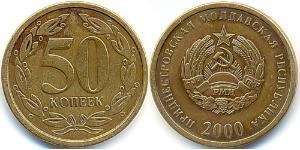
- The 50 Kopeks Coin (Moldovan with Local Seal): During the chaotic early post-Soviet period, standard Moldovan coins circulated in Tiraspol but were often re-marked or replaced. The most valuable examples are those bearing a special stamp of independence rather than national symbols.
- The "Proof" Silver Coins: Issued in limited quantities starting around the late 1990s, these pieces feature designs commemorating local history like the Dniester river and Soviet industrial heritage. They were made for internal banking or as high-quality gifts rather than public exchange.
Cultural Legacy
The coinage of this region serves as a tangible link between its complex past and present identity. Because it lacks the gold reserves to mint standard sovereign coins like larger nations, cultural value is found in the intricate designs on rare paper money and commemorative proof pieces.
Cultural motifs such as industrial landscapes—factories, farms, or dams—are frequently depicted alongside national symbols like the coat of arms designed specifically for PMR. These artistic choices reflect a society focused on stability and local industry rather than warlike imagery often found in other post-conflict zones.
For collectors
The appeal lies not just in history, but in scarcity. Since this region remains unrecognized internationally by most nations (though recognized as an independent state by Russia), finding original coinage is akin to discovering a hidden gem from the 19th century's "lost colonies" era.
Collectors should focus on condition and rarity rather than speculative value, which can fluctuate wildly based on international politics. The most sought-after items remain rare banknotes with official state seals or mint marks that predate independence in the early years of the 1920s to 1940s.
The history here is not one of conquest but of resilience—a narrative preserved in copper-nickel coins and leather-bound paper notes. For those who enjoy exploring the numismatic footprint of a place that exists on a unique border, this region offers an intriguing puzzle where economic necessity dictated artistic expression long before political freedom was granted.