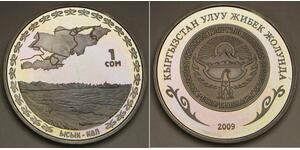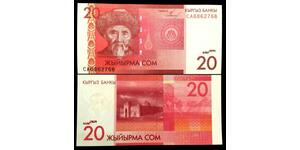

 Kyrgyzstan (1991 - )
| Kyrgyzstan (1991 - ) | Link to Wikipedia |
Kyrgyzstan: History, Coinage and Collectibles
Welcome to our virtual gallery where we explore the tangible history of Central Asia through its monetary artifacts. As museum curators dedicated to preserving economic heritage for future generations, we often look past the maps that divide nations today to understand how trade and culture once flowed across borders long before modern political boundaries were drawn in ink or sand.
Historical Background
The region now known as Kyrgyzstan lies within one of humanity's most significant ancient corridors, historically recognized as a crucial segment of the Silk Road. For centuries, this mountainous land served not merely as a backdrop for commerce but as an active participant in the exchange between civilizations that stretched from China to Europe.
In these early eras, local economies were primarily driven by nomadic traditions involving livestock and goods rather than standardized metal coinage. The wealth of this society was measured in flocks of sheep and horses, not gold or silver disks struck in royal workshops. However, as trade expanded during the Han Dynasty and later under various Central Asian khanates, currency began to circulate more formally.
The landscape itself played a pivotal role in shaping economic history here. The towering peaks of the Tien Shan range acted both as natural barriers and vital passes for caravans. This geography necessitated reliable exchange mediums that could withstand harsh conditions and facilitate high-volume trade. It was only through increasing contact with empires such as Tang China, various steppe confederations like the Mongols, and finally Russian expansion that local populations were introduced to consistent monetary systems.
The transition from a barter-based existence to coinage is a story of adaptation. As political powers shifted control over this territory, economic needs dictated change. The introduction of standardized currency allowed for complex trade networks involving tea, silk, wool, and livestock products that defined the region's global importance until relatively modern times.
Currency and Coinage History
The evolution of money in this specific cultural sphere is distinct because it involves a long period where indigenous minting was absent while foreign currencies circulated widely. When Russian administration arrived, they introduced rubles to facilitate trade within the growing empire's vast territories.
This era marked the shift toward using metal as an accepted medium for commerce on a larger scale. During the later decades of Soviet rule, coins were produced centrally in facilities across the Union but distributed throughout Central Asia. These issues served not just economic purposes but also cultural unification within that sphere.
Following independence following the dissolution of the previous superpower state structure, a major monetary reform was required to assert national sovereignty over local commerce. A new currency unit was introduced to replace the former standard and establish financial identity for the newly independent nation. This transition period is particularly fascinating because it represents one of those moments in history where money becomes an explicit symbol of political freedom rather than imperial obligation.
The designs on these newer coins reflect a desire to reclaim ancient traditions while embracing modern economic reality. The shift from imported rubles to sovereign local currency gave collectors new material to explore, marking the transition back toward self-determined iconography in their national treasury systems.
Mints and Coin Production
To understand the production quality of coins found today in this region's collection markets, one must consider where they were struck. During most periods prior to modern independence, Kyrgyzstan itself did not operate its own dedicated minting facilities for coinage purposes.
Much of what we find from the early statehood period was produced by partner countries or under contract in major international hubs such as Moscow. This practice has allowed collectors worldwide a consistent standard in finish and weight relative to other former Soviet states. The artistry relies heavily on high-relief die craftsmanship inherited from imperial traditions.
The materials used reflect the economic realities of production capacity at the time. While modern precious metals are less common for circulating change, commemorative pieces often utilize silver or bronze-nickel alloys known for their resistance to wear and corrosion.
Notable Coins
- Independence Commemoration Series: The most sought-after items in recent collecting history are those issued immediately after sovereignty was restored. These pieces typically feature imagery celebrating statehood, often depicting eagles or mountain peaks that mirror the region's rugged beauty.
- The First Denominations: Early lower-value issues carry a historical weight regarding how daily life changed with independence. Their simple design serves as an educational tool for understanding what currency represented in the everyday lives of citizens transitioning to a market economy after decades of central planning.
- Nature and Tradition Issues: As production continued, themes shifted toward local fauna like horses or livestock that held deep cultural meaning among nomadic ancestors. These designs serve as modern medals honoring traditions long preserved by oral history before the age of coins was ever reached locally in antiquity.
Cultural Legacy
The coinage from this region is more than mere metal; it serves as a mirror reflecting how society views its own identity through economic artifacts. The symbols used—mountains, eagles, horses—are not arbitrary choices but deeply rooted in the national psyche derived from centuries of pastoral history.
To hold these coins is to feel the weight of landscapes that have sustained generations of travelers and herders alike. Each design tells a story about what leaders valued at specific moments in time: stability, progress, or cultural heritage.
This artistic legacy continues today as modern designers work within traditions established by earlier periods while introducing contemporary graphic styles that appeal to global aesthetics without losing local flavor.
For collectors
In our experience sharing these artifacts with interested parties around the world, we see why collecting from this territory remains so valuable for enthusiasts. These items bridge a historical divide between ancient nomadic history and modern nation-states where economic autonomy was achieved recently in human terms.
The significance of owning pieces that mark such distinct eras cannot be overstated. They tell us how economies adapted to changing geopolitical landscapes while maintaining cultural continuity across turbulent times.
We encourage you to seek out these historical treasures not merely for investment potential but as educational tools that connect the tangible past with our present understanding of Central Asian history. As we continue research and curation efforts, this knowledge is preserved so others may appreciate how currency shapes memory long after paper records might fade or be lost.